USA Vs Khurds
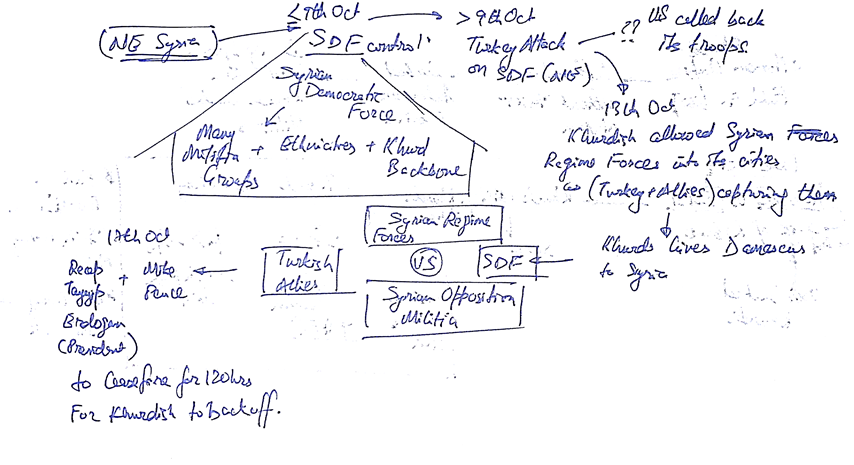
Turkey attack north-east Syria’
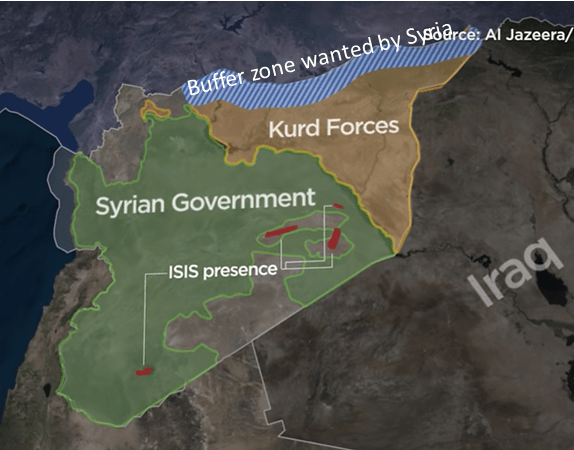
2-3 million Syrian Iraq war refugees. Turkey + Syria wants to settle them in NE Buffer zone to dilute the Khurds
- USA + Turkey are NATO alllies
- Turkey was going closer to Russia
- Turkey faced military coup and then went to USA
- Turkey will buy S400 missiles fron Russia
- USA Took out the support to khurds
- Turkey attacked Khurds
History of Khurds
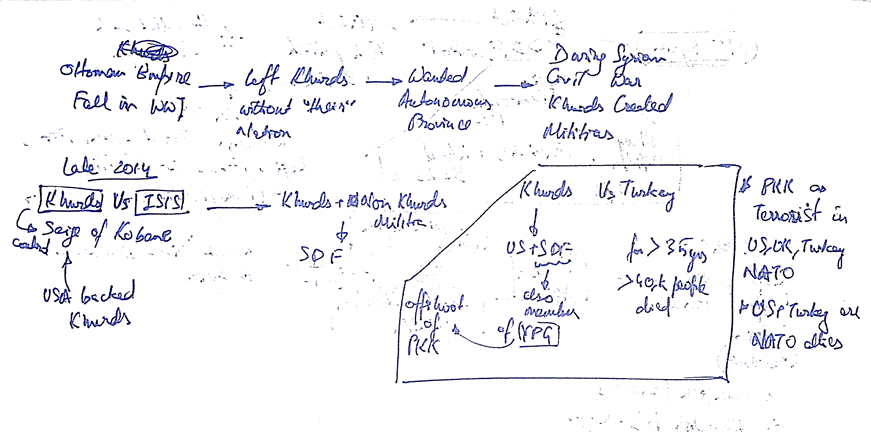
After the fall of the Ottoman Empire following World War I, there was disagreement amongst world powers over how to split up the lands in the Middle East and North Africa that were formerly part of the empire. There were several agreements and treaties put forward, and by the time the new maps were finally decided upon, various ethnic groups in the Middle East were left high and dry. One of those ethnic groups were the Kurds. The Kurds were and are still living in an area of the Middle East that is currently part of western Turkey, northern Iraq & Syria, and western Iran. But they were not given their own country following the fall of the Ottoman Empire. So while the Kurds consider themselves an autonomous people and have been pushing for decades to establish their own independent nation, they are currently living on lands that are technically part of other countries. Throughout the 20th century, the Kurds staged numerous armed revolts and attempted to set up several de-facto states in an attempt to gain independence. None were successful, however. And these revolts were often put down violently. So fast forward to the Syrian Civil War (I know this is a huge jump in time and a lot happened in between, but I’m moving forward for the sake of being concise). With the rise of various radical Islamist groups within Syria (most notably ISIS), the Syrian military was forced to withdraw troops from Kurdish territories in the north in order to deal with the growing conflict in other areas of the country. So, in 2012, the Kurds and their militias began expanding their territory in northern Syria which they now call Rojava. And for several years after that, they continued taking steps to further declare independence and autonomy going so far as to draft their own constitution. With this expansion, they soon found themselves in conflict with groups like ISIS. This is where the US-Kurdish relationship comes into play. As ISIS grew more powerful and took more land, the US needed to find a way to deal with the threat without putting boots on the ground. Since the Kurds were already expanding and already getting into conflict with various Islamist groups, the US decided to team up with Kurdish militias. We provided them with all the weapons, military advising, training, and air support they needed to fight back and win.
Keep in mind, this was at a period in time when ISIS had established its capital city (Raqqa) in Kurdish territory. So Kurdish militias were going to be fighting ISIS regardless of whether they had US support. And the US chose to work closely with the Kurds to combat ISIS rather than the Syrian military because the Syrian government had very close ties with both Iran and Russia. As you can see, multiple factions are working within the country. With ISIS at its peak, all those factions were relatively focused on dealing with that threat. There were sporadic instances where Syrian and Kurdish troops would attack each other, but they weren’t each other’s “primary” enemies so long as ISIS was in play. So fast forward again to today. ISIS has been largely defeated. Kurdish forces pretty much control northern Syria and consider themselves their own separate nation (Rojava) from the rest of the country. This is where Turkey comes in. As history shows, the Kurds want to establish their own nation in the areas that make up eastern Turkey, northern Iraq & Syria, and western Iran. The Kurds have been relatively uninhibited in the expansion of their territory right up to the Turkish border due to the US-Kurdish relationship over the last few years. And Turkey does not like this. The Kurds are now armed to the teeth with US weapons, have received training from US special operations forces, and have some serious combat experience under their belts. In the eyes of the Turks, they see the Kurds as a serious threat and they have no reason to suspect that the Kurds will not continue their expansion into eastern and southern Turkey. And the only reason Turkey has not acted yet has been due to the US’s involvement and the presence of a few handfuls of US military advisors in northern Syria. The Trump administration has officially decided to pull those advisors out of the Kurdish areas along the Turkish border. And it looks like the Turkish military has begun carrying out strikes on Kurdish positions in the area. The decision to pull those US advisors is a difficult one. On one hand, the Kurds have been a solid ally to the US in the fight against ISIS. On the other hand, ISIS has been pretty much dealt with at this point. It doesn’t look like the Kurds are intent to stop pursuing the establishment of their own independent Kurdistan that will inevitably encompass areas within Turkish borders. And if keeping a few handfuls of US advisors on the ground is the only thing preventing conflict between the Kurds and Turkey, that would mean we are using American troops as human shields to prevent a new war that frankly, doesn’t seem like either side is that interested in avoiding. It’s important to remember that when it comes to politics, rarely is the decision between Good and Bad. More often than not, the decision is between Bad and Worse. Food for thought, hope I helpe
 MY BOX