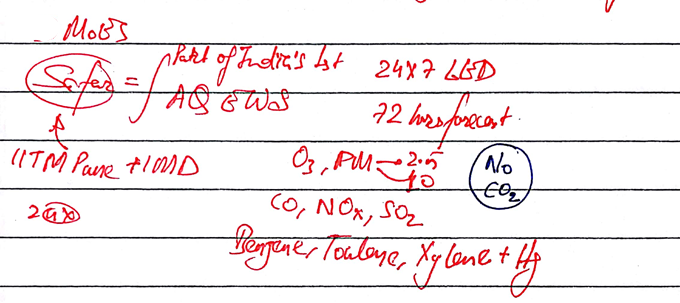
SAFAR= System of Air Quality and Weather Forecasting And Research
MoES–> SAFAR–> to measure the air quality of a metropolitan city, by measuring the overall pollution level and the location specific air quality of the city.
Developed by IITM Pune + IMD
System is indigenously developed by the Indian Institute of Tropical Meteorology (IITM), Pune and is operationalized by the India Meteorological Department (IMD).
Has a giant true color LED display that gives out real-time air quality index on a 24×7 basis with color-coding (along with 72 hours advance forecast).
•The ultimate objective of the project is to increase awareness among the general public regarding the air quality in their city so that appropriate mitigation measures and systematic action
SAFAR is an integral part of India’s first Air Quality Early Warning System (AQWES) operational in Delhi
•It monitors all weather parameters like temperature, rainfall, humidity, wind speed, and wind direction, UV radiation, and solar radiation.
•Pollutants monitored: PM2.5, PM10, Ozone, Carbon Monoxide (CO), Nitrogen Oxides (NOx), Sulfur Dioxide (SO2), Benzene, Toluene, Xylene, and Mercury
WMO has recognized SAFAR as a prototype activity on the basis of the high-quality control and standards maintained in its implementation
Air Quality Index (AQI)– daily air quality– •Ground-level ozone, •PM10, •PM2.5, •Carbon monoxide•Sulfur dioxide, •Nitrogen dioxide, •Ammonia, •Lead,
•Ground-level ozone and airborne particles are the two pollutants that pose the greatest threat to human health in India.
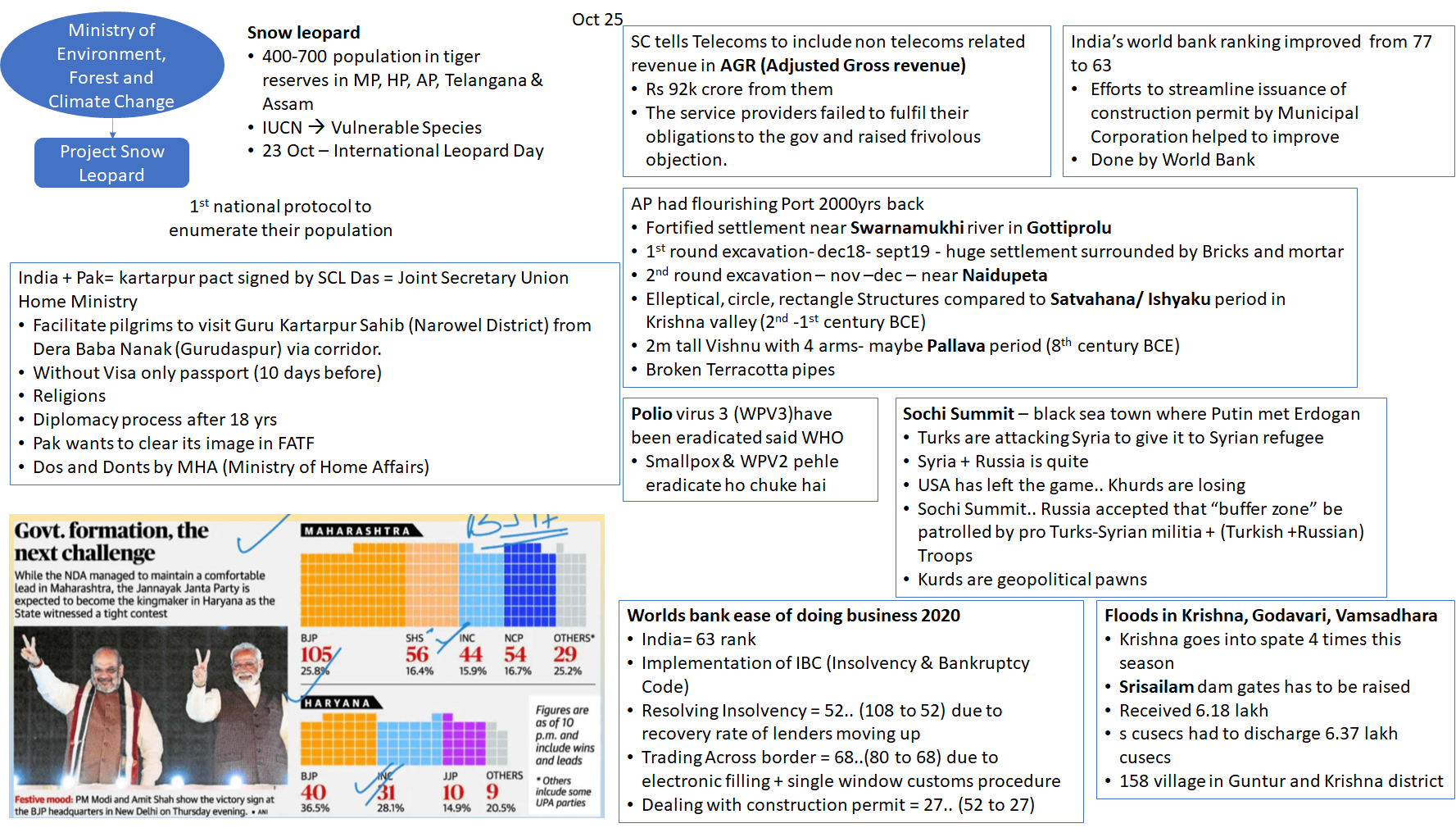
First Snow Leopard Survey
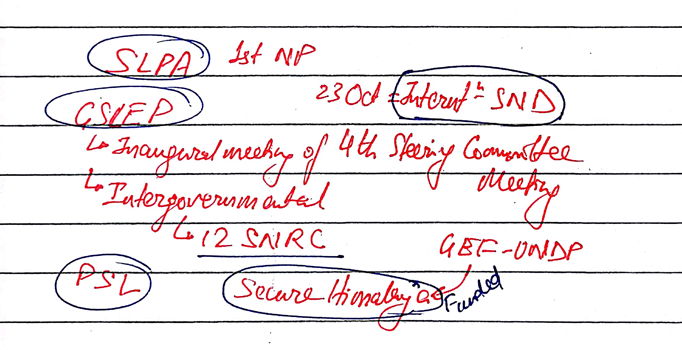
GOI–> 1st National Protocol on Snow Leopard Population Assessment, to mark the occasion of International Snow Leopard Day (23rd October).
Status= ‘Vulnerable’ by IUCN and in the Schedule I of the Indian Wildlife (Protection) Act 1972.
listed in Appendix I of the Convention on International Trade in Endangered Species (CITES) and the Convention on Migratory Species (CMS), revealing the need for the highest conservation status to the species, both globally and in India.
Snow Leopard States/UTs namely, Ladakh, Jammu & Kashmir, Himachal Pradesh, Uttarakhand, Sikkim, and Arunachal Pradesh. (Himalayan + trans himalayan = 5% of Global population)
•The use of technology such as camera traps and scientific surveys will help to estimate the numbers.
Inaugural session of the 4th steering committee meeting of the Global Snow Leopard & Ecosystem Protection (GSLEP) Program. The GSLEP is a high-level intergovernmental alliance of all the 12 snow leopard range countries. GSLEP is being organised by MoEFCC in Delhi.
•The snow leopard countries namely, India, Nepal, Bhutan, China, Mongolia, Russia, Pakistan, Afghanistan, Kyrgyzstan, Kazakhstan, Tajikistan, and Uzbekistan
Currently, the Steering Committee meeting of GSLEP chaired by Nepal and co-chaired by Kyrgyzstan
•Project Snow Leopard (PSL) : It promotes an inclusive and participatory approach to conservation that fully involves local communities.
•SECURE Himalaya: Global Environment Facility (GEF)United Nations Development Programme (UNDP) funded the project on conservation of high altitude biodiversity and reducing the dependency of local communities on the natural ecosystem. This project is now operational in 4 snow leopard range states, namely,
- Jammu and Kashmir,
- Himachal Pradesh,
- Uttarakhand, and
- Sikkim
Artificial Leaf For Clean Gas
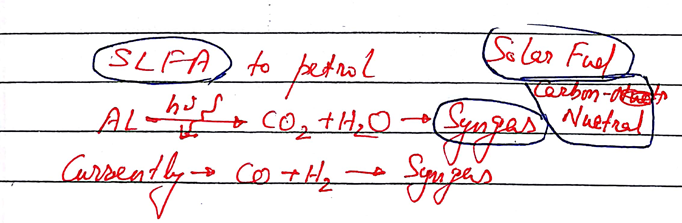
‘artificial leaf’ device that uses sunlight to produce a widely-used gas (syngas) currently made from fossil fuels, and could be used to create a sustainable liquid fuel alternative to petrol. •It is a carbon-neutral device that can directly produce syngas in a sustainable and simple way from carbon dioxide and water, setting a new benchmark in the field of solar fuels.
Does not release CO2.
•Syngas (Synthesis Gas) is currently made from a mixture of hydrogen and carbon monoxide,
Mission Indradhanush
GOI–> Mission Indradhanush–launched in December 2014— has increased India’s immunisation coverage significantly to 87% from 67% in 2014.
But official data on India’s immunisation coverage is still 62%, given as the National Family Health Survey-4 (2015-16).
MoHFW–> EPI–> Immunization programme (1978)
MoHFW= Ministry of Health and Family Welfare
EPI= ‘Expanded Programme of Immunization
1985–> Programme was modified as ‘Universal Immunization Programme (UIP)’.
•UIP prevents mortality and morbidity in children and pregnant women against 12 vaccine-preventable diseases. But in the past, it was seen that the increase in immunization coverage had slowed down and it increased at the rate of 1% per year between 2009 and 2013.
•To accelerate the coverage, Mission Indradhanush was envisaged and implemented since 2015 to rapidly increase the full immunization coverage to 90%.
aim is to fully immunize more than 89 lakh children who are either unvaccinated or partially vaccinated under UIP.
•It targets children under 2 years of age and pregnant women for immunization.
•It provides vaccination against 12 Vaccine-Preventable Diseases (VPD) i.e. diphtheria, Whooping cough, tetanus, polio, tuberculosis, hepatitis B, meningitis and pneumonia, Hemophilus influenza type B infections, Japanese encephalitis (JE), rotavirus vaccine, pneumococcal conjugate vaccine (PCV) and measles-rubella
Ease of Doing Business- 2020–> gives report on 2019
World Bank–> Ease of Doing Business Report, 2020. The indicator measures the performance of countries across 10 different dimensions in the 12 month period ending May 1, 2019
1= New Zealand
2= Singapore
3= Hongkong
190= Somalia
63= India (2019) 77 in 2018
India for the third consecutive year was present in the list of 10 economies where the business climate has improved the most.
India’s ranking improved basically on four parameters:
- Starting a Business
- Dealing with Construction Permits
- Trading across Borders
- Resolving Insolvency
•India continues to maintain its first position among South Asian countries. It was 6th (in 2014).
•The World Bank will now include Kolkata and Bengaluru, besides Delhi and Mumbai, for preparing ease of doing business report, in order to provide a holistic picture of the business environment of the country.
10 different parameters namely
•Starting a Business,
•Dealing with Construction permits
•Electricity availability,
•Property registration,
•Credit availability,
•Protecting minority Investors,
•Paying Taxes,
•Trading across borders,
•Contracts enforcement, and
•Resolving Insolvency.
employing workers and contracting with the government but these are not included in the score and rankings.
Kartarpur Corridor
India and Pakistan have signed an agreement to operationalise the Kartarpur corridor. The agreement is valid initially for 5 years.
Connects the Darbar Sahib Gurdwara in Narowal district of Pakistan with the Dera Baba Nanak shrine in Gurdaspur district in India’s Punjab province. The agreement will facilitate visa-free movement of Indian pilgrims who would just need a permit to cross over to Pakistan.
Was built to commemorate 550th birth anniversary celebrations of Guru Nanak Dev, founder of Sikhism on 12th November 2019.
Guru Nanak Dev Jayanti is observed on the full-moon day in the month of Katak to celebrate the birth of Guru Nanak Dev (1469-1539). He advocated the ‘Nirguna’ form of bhakti. He rejected sacrifices, ritual baths, image worship, austerities and the scriptures of both Hindus and Muslims
He set up rules for congregational worship (sangat) involving collective recitation.
•He appointed one of his disciples, Angad, to succeed him as the preceptor (guru), and this practice was followed for nearly 200 years.
•The 5th preceptor, Guru Arjan, compiled Baba Guru Nanak’s hymns along with those of his four successors and also other religious poets, like Baba Farid, Ravidas (also known as Raidas) and Kabir, in the Adi Granth Sahib.
•These hymns, called ‘Gurbani‘, are composed in many languages. •Kartarpur gurudwara is the revered shrine about 4km across the border where Guru Nanak Dev spent the last 18 years of his life.
Smallest Ozone Hole in Decades
During September and October months of 2019, the ozone hole over the Antarctic has been the smallest observed since 1982
presence of abnormal weather patterns in the atmosphere over Antarctica is responsible for shrinkage of the ozone hole
Due to the warmer temperatures over Antarctica in 2019, fewer polar stratospheric clouds formed and they couldn’t persist longer, which limited the ozone-depletion process <– Result of temporary Antarctic warming.
Developing Country Status in WTO
South Korean Government= 4th highest Asian econmy has decided not to seek any special treatment as a developing country from future negotiations at the World Trade Organization (WTO) though maintaining Developing status.
There are no WTO definitions of “developed” and “developing” countries. Members announce for themselves whether they are “developed” or “developing” countries… Members can challenge each other’s status.
WTO Agreements contain special provisions which give developing countries special rights–>“Special and Differential Treatment” (S&D) provisions.
Special provisions include:
- Longer time periods for implementing Agreements and commitments,
- Measures to increase trading opportunities for developing countries,
- Provisions requiring all WTO members to safeguard the trade interests of developing countries,
- Support to help developing countries build the capacity to carry out WTO work, handle disputes, and implement technical standards, and
- Provisions related to least-developed country (LDC) Members.
Benefits for developing Countries
- the WTO Agreement”) specifies that international trade should benefit the economic development of developing and least-developed countries.
- General Agreement on Tariffs and Trade (GATT)— gives developing countries the right to restrict imports, if doing so would promote the establishment or maintenance of a particular industry, or assist in cases of balance-of-payments difficulties.
- Part IV of the GATT includes provisions on the concept of non-reciprocal preferential treatment for developing countries
U.S. President had put pressure on the WTO to change how it designates developing countries, singling out China, with which the United States is engaged in a trade war,
Following should not invoke the self-declaration option:
- Members of the Organization for Economic Cooperation and Development (OECD)
- Members of the Group of 20 (G-20),
- High income countries as per the World Bank definition, or
- Countries that account for 0.5% or more of global merchandise trade.
Thotlakonda Buddhist Monastery
Mahastupa of the Buddhist heritage site of Thotlakonda, which was reconstructed in 2016 by the State Archaeology department, collapsed recently.
•It is 2000 years old monastic complex with remnants of stupas, chaitya grihas and viharas atop Thotlakonda Hill, Andhra Pradesh.
•The Buddhist monks arriving from places like China, Burma and many other countries used to stay at this site for months before finishing their learning.
•Stupas: These are Buddhist commemorative monument usually housing sacred relics associated with the Buddha or other saintly persons.
•Chaityas: A Chaitya was a rectangular prayer hall within a stupa placed in the centre, the purpose was prayer.
•Viharas: Viharas were the residences of the monks.
Keeladi Significance
Significant findings during the Keeladi excavation in September proved that the history of Sangam Era, earlier considered as old as 3rd century BC, is as old as 6th century BC.
The findings were based on six carbon samples collected by the state archaeology department and tested in the US.
It was also found that Tamil Brahmi script (Tamili) dates back to 580 BC. Evidence that existed earlier had traced Tamili back to 490 BC.
The outcome may be a path to establish a direct link between the Sangam era and the Indus Valley civilisation.
In South India, we have had iron age between 2000 BC to 600 BC. So it is a hypothesis that graffiti marks found in Keeladi may have links to the Indus Valley period.The Indus script is 4,500 years old and the graffiti marks in the Keeladi region are dated between disappearance of Indus script and emergence of the Brahmi script.
“Some 1,001 graffiti sherds found from Keeladi site are believed to be the early writing expressions of the Iron Age people.
While Keeladi excavations, like in Gangetic plains, have unearthed large-scale brick structures and associated artefacts of high value, suggesting an active urban life as early as 6th century BC in Tamil Nadu.State archaeology department commissioner Udhayachandran said, “Madurai city excavation plans are not part of these four locations”.
Excavations in Keeladi, about 13 km south east of the temple city Madurai and close to Vaigai river, were started by ASI in three stages between 2014 and 2017.
Excavation Sites of Sangam Age
The Archaeological Survey of India (ASI) has approved the Tamil Nadu’s request to continue excavations at four locations
expected to bridge the 1000 years gap in history between the Sangam Age and the Indus Valley civilization.
- Keeladi-
- Located in Sivaganga district on the banks of river Vaigai.
- It is an urban settlement of Sangam Age.
- Kodumanal-
- Village located in Erode district, TN.
- Flourishing ancient trade city known as Kodumanam (as inscribed in Pathitrupathu of Sangam Literature).
- It is located on the northern banks of Noyyal River (a tributary of the Cauvery).
- Sivagalai-
- Village in the Tuticorin district, TN.
- It was once known as ‘Small Ceylon’ by Britishers.
- Evidence of megalithic archaeological remains were found here in 2018.
- Adichanallur-
- Located in Thoothukudi district, TN.
- In 2004, iron-age (1500 BC to 500 BC) burial sites were unearthed by ASI from here.
Lakshmi Narasimha Temple: Hoysala Architecture
- Temple was built during Hoysala rule in the early 13th century.
- Style= ‘Trikuta’ style, that is, having 3 shrines- dedicated to Lakshmi Narasimha, Venugopalaswamy and Purushothama.
- The outer walls of the temple bear great detailed carvings in Hoysala style.
- The concrete flooring on the platform, also called jagati, is used by devotees as pradakshina path (ambulatory passageway for circumambulation).
Hoysala architecture is the building style developed under the rule of the Hoysala Empire between the 11th and 14th centuries, mostly concentrated in southern Karnataka.
sometimes called hybrid or vesara as their unique style seems neither completely Dravida nor Nagara, but somewhere in between.
Hoysala temples, instead of consisting of a simple inner chamber with its pillared hall, contain multiple shrines grouped around a central pillared hall and laid out in the shape of an intricately-designed star.
they grow extremely complex with so many projecting angles emerging from the previously straightforward square temple, that the plan of these temples starts looking like a star, and is thus known as a stellate-plan.
made out of soapstone which is a relatively soft stone, the artists were able to carve their sculptures intricately. This can be seen particularly in the jewellery of the gods that adorn their temple walls.
Famous temples are:
Hoysaleshvara temple (Lord of the Hoysalas) at Halebid in Karnataka that was built in dark schist stone by the Hoysala king in 1150,
Chennakeshava temple in Somnathpura, Karnataka built around AD 1268 under Narasimha III,
Kesava temple at Belur in Hassan district of Karnataka built by Vishnuvardhana.
Edge Computing
Edge computing is a distributed computing paradigm that brings computation and data storage closer to the location where it is needed, to improve response times and save bandwidth.
edge computing is any type of computer program that delivers low latency nearer to the requests.
Edge computing broadly as all computing outside the cloud happening at the edge of the network, and more specifically in applications where real-time processing of data is required
Cloud computing operates on big data while edge computing operates on “instant data” that is real-time data generated by sensors or users
The increase of IoT devices at the edge of the network is producing a massive amount of data to be computed at data centers, pushing network bandwidth requirements to the limit.[10] Despite the improvements of network technology, data centers cannot guarantee acceptable transfer rates and response times, which could be a critical requirement for many applications.
Nirvik Scheme
ECGC has introduced the Export Credit Insurance Scheme (ECIS) called NIRVIK to enhance loan availability and ease the lending process.
•It is an insurance cover guarantee that will cover up to 90% of the principal and interest. The cover will include both pre and postshipment credit.
•The ECGC currently provides credit guarantee of up to 60% loss
MoCI–> ECGC Ltd = Export Credit Guarantee Corporation of India is wholly owned by the Ministry of Commerce and Industry.
Mountain Streams Emits Carbon Dioxide
first large-scale study of the carbon dioxide emissions from mountain streams, and their role in global carbon fluxes.
mountains cover 25% of the Earth’s surface, but the streams make up just 5% of the global surface area of the fluvial networks.
streams have a higher average CO2 emission rate per square meter than streams at lower altitudes, due to the additional turbulence caused as water flows down the mountain slopes
likely account for 10% to 30% of CO2 emissions from these networks.
gas exchange velocities across the air-water interface in mountain streams occurs 100 times faster than previously thought.
indicate that the CO2 comes from geological sources, given that carbonate rock dominates geology in numerous regions around the world.These rocks were formed from “skeletal” components of marine microorganisms that lived millions of years ago when Earth was largely covered by oceans.
It is known for a number of years that freshwater ecosystems emit roughly the same amount of CO2 that the oceans absorb,
Whistleblowers Protection Act- India’s whistleblower law not operational yet
Accusations raised against the Infosys Chief Executive Officer (CEO) and other senior officials have brought back the focus on whistleblowers’ safety in India.
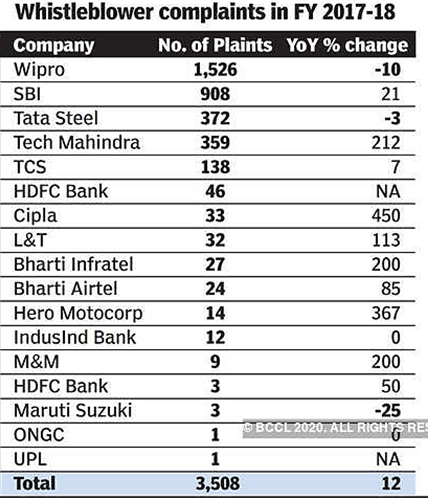
Some with Wipro and State Bank of India (SBI) facing most of them in 2018.
- The Law Commission of India in 2001, had recommended that, in order to eliminate corruption, a law to protect whistleblowers was necessary. It had drafted a bill as well to address this issue.
- In 2004, in response to a petition filed after the infamous murder of NHAI Official, the Supreme Court of India directed the Central government that, ‘administrative machinery be put in place for acting on complaints from whistleblowers till a law is enacted.’
- The government, in response, notified a resolution in 2004 named, ‘Public Interest Disclosure and Protection of Informers Resolution (PIDPIR)’.
- This resolution gave the Central Vigilance Commission (CVC) the power to act on complaints from whistleblowers.
- In 2007, the report of the Second Administrative Reforms Commission also recommended that a specific law needs to be enacted to protect whistleblowers.
- The UN Convention against Corruption to which India is a signatory (although not ratified) since 2005, encourages states to facilitate reporting of corruption by public officials and provide protection for witnesses and experts against retaliation.
- The Convention also provides safeguards against victimization of the person making the complaint.
- To conform with such regulations, in 2011 Whistleblowers Protection Bill was proposed which finally became a law in 2014.
- The Companies Act, 2013, as well as the Securities and Exchange Board of India regulations have made it mandatory for companies to take notice of all such complaints
- mechanism to receive complaints related to disclosure of allegations of corruption or n 2003, Satyendra Dubey, a project engineer with National Highways Authority of India, exposed corruption in the Golden Quadrilateral project in Bihar. He was shot dead in November 2003 in Gaya. Three persons were given life term in 2010 for the murderwilful misuse of power or discretion, against any public servant, and to inquire or cause an inquiry into such disclosure.
- allows any person, including a public servant, to make a public interest disclosure before a Competent Authority
- law does not allow anonymous complaints to be made
- The maximum time period for making a complaint is 7 years.
- Exemptions: The act is not applicable to the Special Protection Group (SPG) personnel and officers, constituted under the Special Protection Group Act, 1988.
- Court of Appeal: Any person aggrieved by any order of the Competent Authority can make an appeal to the concerned High Court within a period of sixty days from the date of the order.
- Penalty: Any person who negligently or mala-fidely reveals the identity of a complainant will be punishable with imprisonment for a term extending up to 3 years and a fine which may extend up to Rs 50,000.
- The Whistleblowers Act overrides the Official Secrets Act, 1923 and allows the complainant to make public interest disclosure before competent authority even if they are violative of the later act but not harming the sovereignty of the nation.
- In 2015, an amendment bill was moved that proposes, whistleblowers must not be allowed to reveal any documents classified under the Official Secrets Act of 1923 even if the purpose is to disclose acts of corruption, misuse of power or criminal activities. This dilutes the very existence of the 2014 Act
- 200–> Satyendra Dubey, a project engineer with NHAI= National Highways Authority of India, exposed corruption in the Golden Quadrilateral project in Bihar. He was shot dead in November 2003 in Gaya. 3 persons were given life term in 2010 for the murder.
- Arvind Gupta, a shareholder activist, exposed the alleged loan fraud and quid pro quo between the bank’s then CEO Chanda Kochhar and her family and the Videocon group. CBI investigation happening.
- Centre notified the Whistle Blowers Protection Act, 2014, in May 2014, it told Parliament earlier this year that the Act needs amendments tosafeguard against disclosures that may have national security implications. To that end, Centre brought in the Whistle Blowers Protection (Amendment) Bill, 2015, that was passed by Lok Sabha in May, 2015. But the amendment Bill did not clear Rajya Sabha and lapsed upon the dissolution of the 16th Lok Sabha before the 2019 general elections. The government thereafter told Lok Sabha the framework of existing laws is “considered adequate to provide for safety and security to all citizens, including RTI activists”
- Sebi mandates provisions for whistleblowers– Audit and consulting firm Deloitte says the Companies Act, 2013, and Sebi have made it mandatory for certain classes of companies to set up mechanisms to receive whistleblower complaints.
 MY BOX