CAA 2019
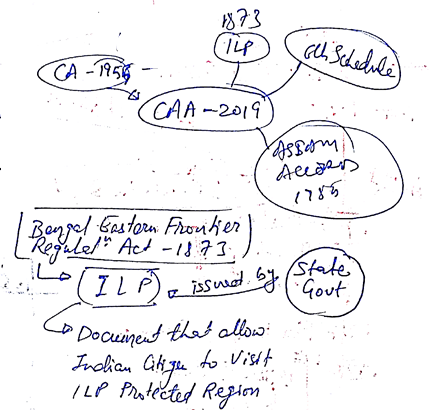
The Citizenship (Amendment) Act, 2019 of Parliament received the assent of the President. It amends the Citizenship Act, 1955.
Exclusions from the Applicability of CAA:
- The 6th schedule of the Constitution– It shall not apply to tribal areas of MMTA – Meghalaya, Mizoram, Tripura, Assam. These tribal areas include Karbi Anglong (in Assam), Garo Hills (in Meghalaya), Chakma District (in Mizoram), and Tripura Tribal Areas District.
- The Inner Line Permit (ILP) (notified under the Bengal Eastern Frontier Regulation, 1873)- Areas covered in the States of Arunachal Pradesh, Mizoram and Nagaland that are protected by have also been excluded
| CAA 2019 | CA- 1955 |
| Nationality to 6 communities — Hindus, Christians, Sikhs, Parsis, Jains and Buddhist From 3 countries ABP-Afghanistan, Bangladesh & Pakistan. | The Act allows a person to apply for citizenship by naturalisation, if the person meets certain qualifications (Religious basis was not among those). |
| Cut-off date for entry to India to get citizenship under Naturalization= 31 Dec 2014 | 26 Jan 1950 |
The Assam Accord (1985)
- It was a Memorandum of Settlement (MoS) signed between representatives of the Government of India and the leaders of the Assam Movement on 15 August 1985.
- It brought an end to the Assam Agitation and paved the way for the leaders of the agitation to form a political party and form a government.
- It states that Bangladeshis who came between 1966 and 1971 will be barred from voting for 10 years.
- It has a provision that the international borders will be sealed and all persons who crossed over from Bangladesh after 1971 (Midnight of 24-25 March) are to be deported.
6th Schedule of Indian Constitution:
- The Sixth Schedule relates to special provisions in administration of certain Northeastern states.
- It provides special powers for Autonomous District Councils (ADCs) in these states.
- ADCs have powers to enact laws in areas under their jurisdiction on a variety of subjects, one of its objectives being to boost self-governance by tribal communities.
- In order to get this benefit, they have also been exempted from the Foreigners Act, 1946 and the Passport (Entry into India) Act, 1920 by the central government.
- The 1920 Act mandates foreigners to carry passport, while the 1946 Act regulates the entry and departure of foreigners in India.
The Inner Line Permit (ILP) system
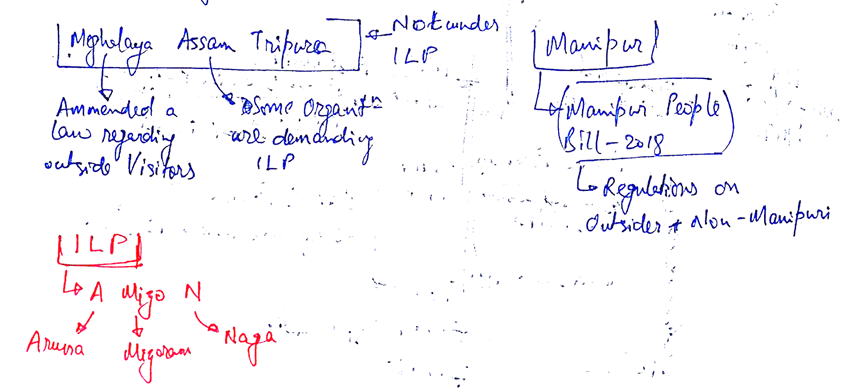
- 3 Northeastern states — Arunachal Pradesh, Nagaland and Mizoram. (MAN).
- The ILP is now extended to Manipur.
- No Indian citizen can visit any of these states unless he or she belongs to that state, nor can he or she overstay beyond the period specified in the ILP.
- An ILP is issued by the state government concerned
Criticism
- Idea of India
- Afghanistan was not part of pre-Partition India
- India were committed to a secular state
- Violation of Article 14 – guarantees the right to equality.
- Article 14 is not confined to the citizens. It gives benefits of equality to any person within the territory of India even to a foreigner.
- Leaving out a particular religion (Muslims) aren’t in line with the basic feature (Secularism) of the Constitution.
- It also undermines the very foundation of the Republic in a spacious and plural idea that was nurtured and nourished by the freedom movement.
- The Concern of the North-East:
- Fear that granting citizenship to foreign refugees will undermine their ethnic communities.
- The bill is in conflict with NRC and Assam Accord 1985.
- The Cut-Off Date in the NRC (Mid-night of 24-25 March 1985) and the Proposal in the CAA (December 31, 2014), both are different.
- The sub-nationalist politics may emerge. Eg. The Brahmaputra Valley (Opposing the Bill) Vs. the Barak Valley (Supporting the Bill).
- Demographic Concern:
- Though the Cut-Off date is 31st Dec. 2014. It may give impetus to the influx of immigrants from the 3 countries. India already has a huge population burden.
- Methodology
- There is no concrete data to tell exactly how many illegal immigrants are there in India.
- The religious affiliation of the migrants are also not conclusively known.
- Negligence of Other Neighboring Countries’ Refugee
- The excluded people from the Aasam’s NRC didn’t get citizenship through CAA.
- If the intent is to protect victims of persecution, there is no logic to restrict it only to religious persecution (Excluding Political persecution).
- The reasons for leaving out refugees from other neighbouring countries are not clear –
- Sri Lankan Tamil
- Chakma and Hajong of Myanmar
- If the CAA is born of empathy for the vulnerable and the persecuted, why not extend it to the
- Rohingya from Myanmar
- Ahmadiyas from Pakistan
- If the ‘State Religion’ has been taken into consideration then there is no logic to leave the christian minority of Bhutan (constitutionally a religious state — the official religion being Vajrayana Buddhism) from the list.
The 6th schedule to the Constitution includes 10 autonomous district councils of Assam, Meghalaya, Mizoram and Tripura (MMTA- Try Mega Mazing Ass)
Assam
- Bodoland Territorial Council
- Karbi Anglong Autonomous Council
- Dima Hasao Autonomous District Council
Meghalaya
- Garo Hills Autonomous District Council
- Jaintia Hills Autonomous District Council
- Khasi Hills Autonomous District Council
Tripura
- Tripura Tribal Areas Autonomous District Council
Mizoram
- Chakma Autonomous District Council
- Lai Autonomous District Council
- Mara Autonomous District Council
Art 244 deals with the administration of the tribal areas in the 4 northeastern states of MMTA
125th amendment bill: It seeks to increase the financial and executive powers of the 10 Autonomous Councils in the Sixth Schedule areas of the northeastern
region
Demands of Amendments to Article 280 to provide greater financial resources to the councils that administer the tribal areas of Assam, Meghalaya, Mizoram and Tripura and enable them to undertake development works.
 MY BOX