NRC
- Mandatory for usual citizen – Indian + foreigner
- Head of the family will be scrutinized under Local Registrar
- Slip will be issued for NPR
- Once the details over entire country is done, the NPR will be done.
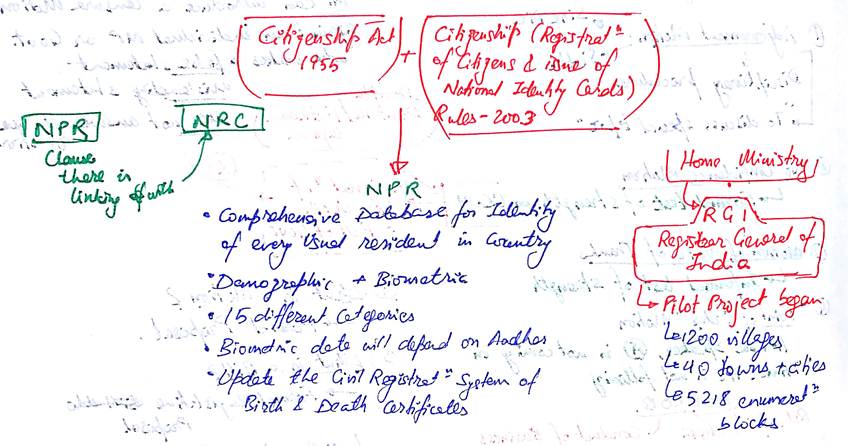
The NPR, as it stands, and according to the website of the Office of the Registrar General and Census Commissioner of India, is a register of usual residents of the country: “It is being prepared at the local (village/sub town), sub-district, State and national levels under the provisions of the Citizenship Act, 1955, and the Citizenship (Registration of Citizens and issue of National Identity Cards) Rules, 2003. It is mandatory for every usual resident of India to register in the NPR as a person who has resided in a local area for the past 6 months or more or a person who intends to reside in that area for the next six months or more.”
The objective of the NPR is to create a comprehensive identity database of every usual resident in the country, which would contain demographic and biometric particulars. The home page, which is regularly updated by the parent Home Ministry, also lists 15 demographic details to be collected from every individual. All this was contrary to what Javadekar spelt out in the press conference. The website also does not mention that the NPR would be used as a database for targeted benefits. On the contrary, there is ample reason to believe that the NPR has links with the proposed NRC for the whole country.
on December 24, Home Minister Amit Shah told a television channel categorically that the NPR had nothing to do with the NRC. However, he did not clarify whether the NRC would be implemented all over the country as stated by him on several occasions, including in Parliament.
“We will bring the CAB. Under this, Hindu, Sikh, Buddhist, Jain refugees will be given citizenship. After that, a National Register of Citizens will be formed.”
Murmurs about “illegal migration” and compulsory registration of citizens and non-citizens began in 2003 itself. The Citizenship Rules, 2003, provide for the creation of a National Register of Indian Citizens (NRIC) and Population Register. The NRIC would be established and maintained by the Registrar General of Citizen Registration.
L.K. Advani, who was the party’s prime ministerial candidate, unveiled a separate IT Vision document and said that if voted to power, the BJP would enact a law to make a multipurpose national identity card (MNIC) mandatory for every person.
The vision document also mentioned that the Citizenship Act, 1955, would be amended to combine the offices of the Registrar General of the Census of India and the Unique Identification Authority of India (UIDAI) to set up a Citizenship Regulatory Authority of India that would be responsible for maintaining an NRC. The amended Citizenship Act would make it mandatory under law for all citizens to acquire an MNIC.
| Javadekar- | |
| NPR was not the NRC and the NPR did not have any connection with citizenship either. | 1.Annual report of the Ministry of Home Affairs of 2018-19, (Registrar and Census Commissioner of India: Chapter 15): The NPR is the first step towards the creation of the National Register of Indian Citizens under the provisions of the aforementioned statute 2.2003, the Act was amended and Section 14 A inserted : The Registrar General India has been designated as the National Registration Authority/Registrar General of Citizen Registration under the Act. 3.Same with Annual reports of 2017-18 and 2016-17. 4.The report of 2015-16 has a section referring to the 2003 amendment to the Citizenship Act. Interestingly, here it is also mentioned that “as a first step towards the creation of a National Register of Indian Citizens, the government has decided to create a NPR in the country”. 5.Separate section titled “Creation of the NRIC”, the report clearly states that the NPR is the first step towards the creation of the NRIC. “Once the NPR is completed, the next step is to create the NRIC by verifying the citizenship status of every usual resident in the NPR. z |
| 1.NPR à April 2020 – September 2020 1.No proof would be demanded. 2.No biometrics of individuals be 3.No documents would be required. “Jo aap kahogey, wahi sahi hai 4.The process would be one of self-certification. | The home page, which is regularly updated by the parent Home Ministry, also lists 15 demographic details to be collected from every individual. All this was contrary to what Javadekar spelt out in the press conference |
| NPR was done in 2010 (UPA regime) + 2015 (NDA Gov) + Manmohan Singh distributed IDs | |
| Data would be used fro targeted benefits and schemes & help gov make plans | No mention of the NPR would be used as a database for targeted benefits. |
NPR a precursor to NRC
According to the annual report of the Ministry of Home Affairs of 2018-19, (Registrar and Census Commissioner of India: Chapter 15):
“The RG and CCI also discharges the statutory function of Registrar General of Citizens Registration under the Citizenship Act, 1955, and the Citizenship (Registration of Citizens and Issue of National Identity Cards) Rules, 2003. The NPR is the first step towards the creation of the National Register of Indian Citizens under the provisions of the aforementioned statute.”
In 2003, the Act was amended and Section 14 A inserted, which stated:
“Central government may compulsorily register every citizen of India and issue National Identity Card to him. The Registrar General India has been designated as the National Registration Authority/Registrar General of Citizen Registration under the Act.”
The Citizenship (Registration and Issue of National Identity Cards) Rules, 2003, were formed simultaneously to give effect to the Act. All this happened during the NDA regime. The architecture for the compulsory registration of every citizen was laid down in the first NDA government.
Similar references to the NPR and the NRIC exist in the annual reports of 2017-18 and 2016-17. The report of 2015-16 has a section referring to the 2003 amendment to the Citizenship Act. Interestingly, here it is also mentioned that “as a first step towards the creation of a National Register of Indian Citizens, the government has decided to create a NPR in the country”.
The NPR would contain demographic information of all usual residents in the country besides the photograph, 10 fingerprints and two iris prints. The report also states that the NPR was being sent to the UIDAI for de-duplication and issue of Aadhaar numbers.
The report mentions that an allocation of Rs.6,649.05 crore had been approved by the Cabinet for the NPR.
Under a separate section titled “Creation of the NRIC”, the report clearly states that the NPR is the first step towards the creation of the NRIC. “Once the NPR is completed, the next step is to create the NRIC by verifying the citizenship status of every usual resident in the NPR. The proposal for the same is under the consideration of the government.”
The BJP’s claim that the NPR was not its idea is untrue. The idea was always the BJP’s; the Citizenship Rules of 2003 are testimony to that. Yet, there is no doubt that it was taken forward in the second Congress-led UPA government following the 2008 Mumbai attacks. The government introduced a system of national identity cards in nine coastal States and planned to extend it. However, the UPA did not implement the extension plan.
At that point, biometrics for both Aadhaar and the NPR were being conducted and there were apprehensions of duplication. While the UIDAI was under the Planning Commission, the NPR was under the Home Ministry.
The Congress never followed up on the NPR beyond setting up NPR camps and issuing some cards but went ahead with Aadhaar, which was primarily envisaged as a scheme of financial inclusion. There were reports to suggest that the UIDAI was reluctant to accept the biometric database generated in the NPR camps.
While Aadhar was optional, the citizen card was not. The story ended there with the change of government. The BJP went further ahead, making Aadhaar linkages mandatory, which was challenged and led to the famous judgment on privacy.
Curiously, when in opposition, the BJP had not objected to either of the two; it was civil society groups and the Left parties that raised concerns over mapping citizens and issues of surveillance and possible violation of privacy. It is also a fact that the updation of the NPR was done in 2015, during Modi’s first tenure, and a gazette notification was issued under the Citizenship Act, 1955, which the BJP also does not deny.
There was a renewed effort to revive the project that the UPA did not complete. NPR centres were opened and the government felt it would be “useful for the enrolment of beneficiaries” for various government schemes. An allocation of Rs.951.35 crore was approved by the “appropriate authority” that year. “The updation of the NPR database would be over by 2016,” the annual report for 2015-16 stated emphatically.
The NPR already has a digital database of around 119.95 crore residents and it is a part of the amended Citizenship Rules, 2003.
With the constant reiteration in government documents that the NPR is the first step towards the creation of an NRC and given the constant rhetoric of singling out “infiltrators” in the broader context of the CAA, which selectively legalises citizenship of certain religious categories of hitherto illegal migrants, the concerns of ordinary citizens are justifiable.
The BJP may have scored ideological points with its “infiltrator” rhetoric, but with its leaders speaking in multiple voices and distrust mounting within its own ranks, its strategy seems to be coming apart at the moment.
https://www.barandbench.com/columns/litigation-columns/caa-npr-nrc-the-bermuda-triangle-2
https://www.livelaw.in/top-stories/what-is-the-caa-npr-nrc-linkexplainer-151105
 MY BOX