Rohingya
Findings of Report: 2018 UN Investigation
The UN secretary-general has accepted an independent report on how the UN System operated in Myanmar, leading up to the mass exodus of the Rohingyas following serious human rights abuses. •The report concluded that there were “systemic and structural failures” that prevented a unified strategy from being implemented.
•It covers the period 2010-2018, encompassing the UN’s response to the systematic and brutal abuse of hundreds-of-thousands of mainly – Muslim Rohingya in Rakhine state, by the national army and security forces, which began in August 2017.
•It was described by the UN human rights chief at the time as a textbook example of ethnic cleansing.
•The report says that the UN Security Council should bear some responsibility, “for not providing enough support to the Secretariat when such backing was required and continues to be essential.
•The key lesson was to foster an environment encouraging different entities of the UN System to work together to reinforce a “broader, system-wide strategy”.
•Fragmented strategy:
The report has expressed displeasure over the functioning of the UN agency in handling the violence against the Rohingya. It observes that serious errors were committed and opportunities were lost in the UN system following a fragmented strategy rather than a common plan of action.
•Improper reporting:
There appear to have been instances of deliberately de-dramatizing events in reports prepared by the Resident Coordinator, as well as instances of various UN entities, including the Office for the Coordination of Humanitarian Affairs (OCHA), of not sharing their analysis with other entities of the UN System.
•The report also emphasises the impact of competing strategies between some UN agencies and individuals while dealing with the Rohingya crisis.
•Polarisation:
It appears that the increasing polarisation among officials and staff was fuelled, at least in part, by the emotional reactions to the horrific events taking place on the ground. The foundations of systemic and structural shortcomings in the UN’s presence in Myanmar.
- •Insufficient inter-governmental support.
- •The absence of a clear and unifying strategy.
- •The weakness of a clear nodal point for coordination.
- •Dysfunctional actions at the level of the Country Team.
- •Shortcomings of systematic and unified analysis from the field
•Shared responsibility:
It was the shared responsibility on the part of all parties to protect the Rohingya’s.
•The agencies involved have not been able to accompany the Government’s political process with constructive actions.
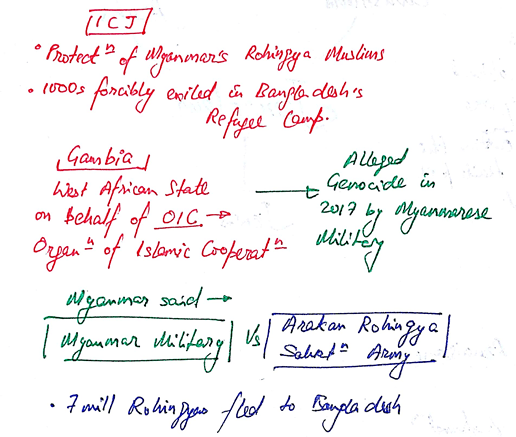
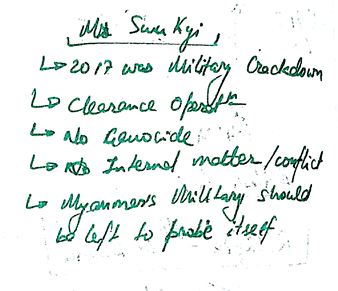
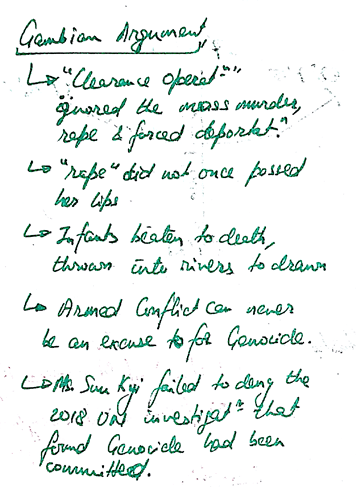
The ICJ, which adjudicates disputes between countries, has handed down guilty verdicts in a few cases relating to crimes of genocide. But crucially, it has stopped short of pinning the blame directly upon states as in the 2007 ruling on the Bosnian war of the preceding decade, relying on a differentiation between ethnic cleansing and genocide. The challenges of establishing conclusive proof of the intention to extirpate entire communities underlies this caution. A decision regarding genocide relating to the atrocities against the Rohingya is not expected any time soon.
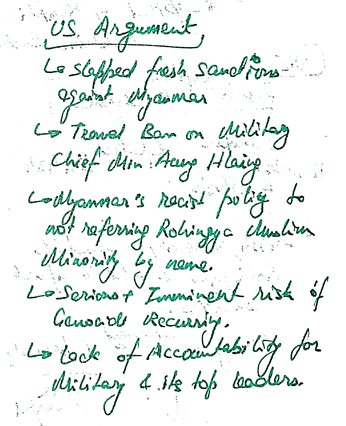
The United States of America has slapped sanctions against Myanmar’s Military Chief Min Aung Hlaing and three other top officers for gross human rights violations, including killing of Rohingya Muslims. The announcement in this regard was made by US Secretary of State Mike Pompeo.
Key Highlights:
Following the US sanctions,
Myanmar’s Army Chief and others namely
Deputy Commander-in-Chief Soe Win, Brigadier General Aung Aung and Brigadier General Than Oo along with their immediate family members have been banned from entering US. In 2018 US had designated two other generals Lieutenant General Aung Kyaw Zaw and General Maung Maung Soe.
With this move US has become 1st government to publicly take action with respect to most senior leadership of Burmese military.
Arguments by US
Ethnic cleansing of Rohingyas is an example of continued and severe lack of accountability for military and its top leadership.
The United Nations has adopted
3.07 billion USD budget on December 27, 2019 for 2020.
2.9 billion USD budget for 2019.
The organization for the first time included investigation of war crimes in Myanmar and Syria in its fund allocation.
Increase in the budget is mainly due to inflation, additional missions and exchange rate adjustments.
This year the investigation of crimes in Syria, Myanmar has been made as compulsory contributions to the member countries for the first time.
The United Nations has categorized its spending in to 5 general groups namely
- Humanitarian assistance (34%).
- Development assistance (24%),
- Peacekeeping operations (19%),
- Knowledge-creation operations (16%)
- Technical cooperation (7%).
 MY BOX