India’s decision to skip the Belt and Road Forum (BRF) may have led to the exclusion of the Bangladesh- China- India- Myanmar (BCIM) Economic corridor from the list of projects covered by the China-led Belt and Road Initiative (BRI) umbrella.
Citing “sovereignty” concerns, India, for the second time, has not officially participated in the BRF, as CPEC—a flagship of the BRI—passes through Pakistan occupied Kashmir (PoK).
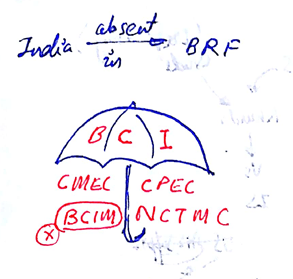
South Asia is covered by 3 major undertakings—
- the China-Myanmar Economic Corridor (CMEC),
- the Nepal-China Trans-Himalayan Multi-dimensional Connectivity Network, including Nepal-China cross-border railway,
- the China Pakistan Economic Corridor (CPEC).
The BCIM economic corridor aims to connect Kolkata with Kunming, capital of the Yunnan province.
It envisages formation of a thriving economic belt, focusing on cross-border transport, energy and telecommunication networks.

Importance of BCIM:
- India will benefit in terms of the development of the Kolkata port and the opening up of the economic potential of the northeast states.
- BCIM offers India an opportunity to create its own win-win relationship with China.
- India’s gain from the BCIM includes the ability to connect to the One Belt, One Road project thus opening up markets to the east.
- It can also use the economic corridor for negotiating downstream industries to be located within India.
- With natural gas reserves of about 200 trillion cubic feet, the largest in the Asia-Pacific, Bangladesh could become one of the major energy exporting countries.
- Tourism too will get a boost.
- BCIM can not only be a game-changer for this region in Asia, but is also pivotal for India’s ‘Act East’ Policy.
- Economic Benefits include access to several booming markets in Southeast Asia, improvement of transport infrastructure and setting up of industrial zones.
- The regional connectivity would facilitate cross-border movement of people and goods, reduce overland trade bottlenecks, ensure access and increase volume of trade.
- Substantially reduce transaction costs, enhance trade and investment and poverty alleviation in the region.
Concerns:
Indian critics of BCIM state that China cannot be trusted, and cite the divergent positions of the two countries on Arunachal Pradesh and PoK.
Security is a very important aspect of BCIM that ethnic insurgencies, terrorism, drug trafficking and the accompanying spread of HIV infections, smuggling, as well as cross-border human trafficking, threatened to derail the project.
Need of hour:
The immediate priority for India is to build and upgrade infrastructure, including roads, railway network, waterways and air connectivity within north-eastern states.
Work on the India-Myanmar-Thailand Trilateral Highway joining India’s Northeast with Thailand and other ASEAN members through Myanmar needs to be expedited. This network will provide connectivity between the isolated Northeast and the expanding economies of South East Asia
Similarly, the Kaladan Multimodal Transit Transport Project will help connect the Northeast with Myanmar as well as with West Bengal.
Bangladesh, Bhutan, India, Nepal (BBIN) needs to be accorded the highest priority as it has great potential to deliver rich dividends quickly.
Emphasis on the implementation of Act East Policy.
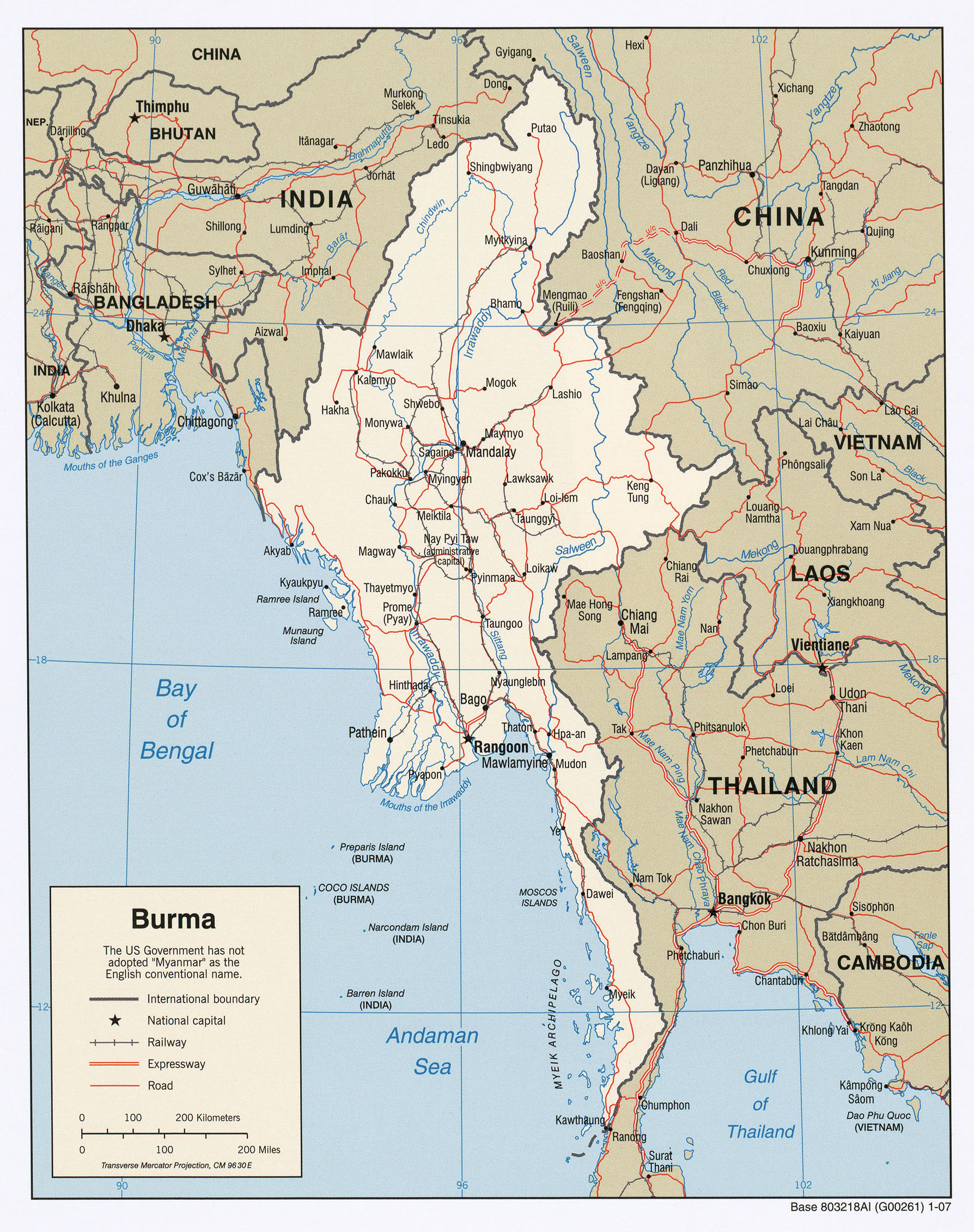
India shares nearly 1643 km long terrestrial border with Myanmar and a long maritime border as well. It touches Indian states of Arunachal Pradesh, Nagaland, Manipur and Mizoram.
(Aruna ke Man ki Maina Mauz mein Naach rahi hai)
Myanmar s Importance for India
Gateway to the East
Myanmar is the only ASEAN member that shares its borders with India and thus provides opportunity for deepening ties with south-east Asian nations under the Look East and Act East policies.
Regional Cooperation
Myanmar is a key component of India s ambitions at bridging South Asia and South-East Asia through BIMSTEC which brings together 21% of world s population and has a combined GDP of nearly $2.5 trillion. BIMSTEC also offers an alternative to SAARC which has been held back due to strains in Indo- Pakistan ties.
Security in North East
Cooperation with Myanmar is crucial for controlling insurgency in North Eastern states. Besides, the porous borders provide fertile grounds for organized crime that is human trafficking, drugs peddling and smuggling of arms and ammunition. These can be checked only with the collaborative effort between India and Myanmar.
Energy security
Myanmar has rich reserves of oil and natural gas. Since India imports nearly 80% of its fuel, Myanmar is important for India.
Food security
Import of pulses and beans from Myanmar is vital to ensuring food security in India.
Counterbalancing China
India needs to increase its presence in Myanmar so as to counter the growing Chinese dominance in the region. Myanmar thus has strategic significance for India.
India Myanmar Relations Challenges
- Bilateral trade between the two countries remains far below potential. A major reason for this is the movement of infrastructure projects at snail s pace. Notably, India’s project implementation capacity is very lacklustre.
- Rohingya Influx India hosts nearly 40,000 Rohingya Muslims who are denied citizenship in Myanmar and who sought refuge in India in order to escape religious persecution. But India faces tremendous burden on its resources on account of refugees and also apprehends a security threat from radicalized Rohingya youth. As a result, India pushes for repatriation of refugees back into Myanmar.
- Growing Chinese presence Myanmar agreed to be a part of the Belt and Road Initiative and has also welcomed Chinese investments in various infrastructure projects including port projects such as Kyaukpyu port. This has made India apprehensive as growing Chinese presence in India s neighbourhood spells strategic concerns.
- Conflict in Rakhine state Rakhine state is central to many a connectivity projects currently underway between India and Myanmar such as the Kaladan Multi-modal highway. Conflict in the region has slowed the progress of such projects. This does not augur well for a bilateral trade.
- India imposed restrictions on the import of pulses in order to improve price realization for Indian farmers. This decision did not go down well with the Mynamarese government as it impacted Myanmar s exports to India.
India shares many common concerns with Myanmar that range from socio-economic development, similar ecological and climatic concerns, shared concerns over insurgency and regional peace and preserving sovereignty in light of growing Chinese assertiveness. These offer tremendous scope for cooperation. India needs to seize this opportunity and expedite the work on ongoing projects while at the same time exercising soft power through constructive aid and cultural exchange.
 MY BOX