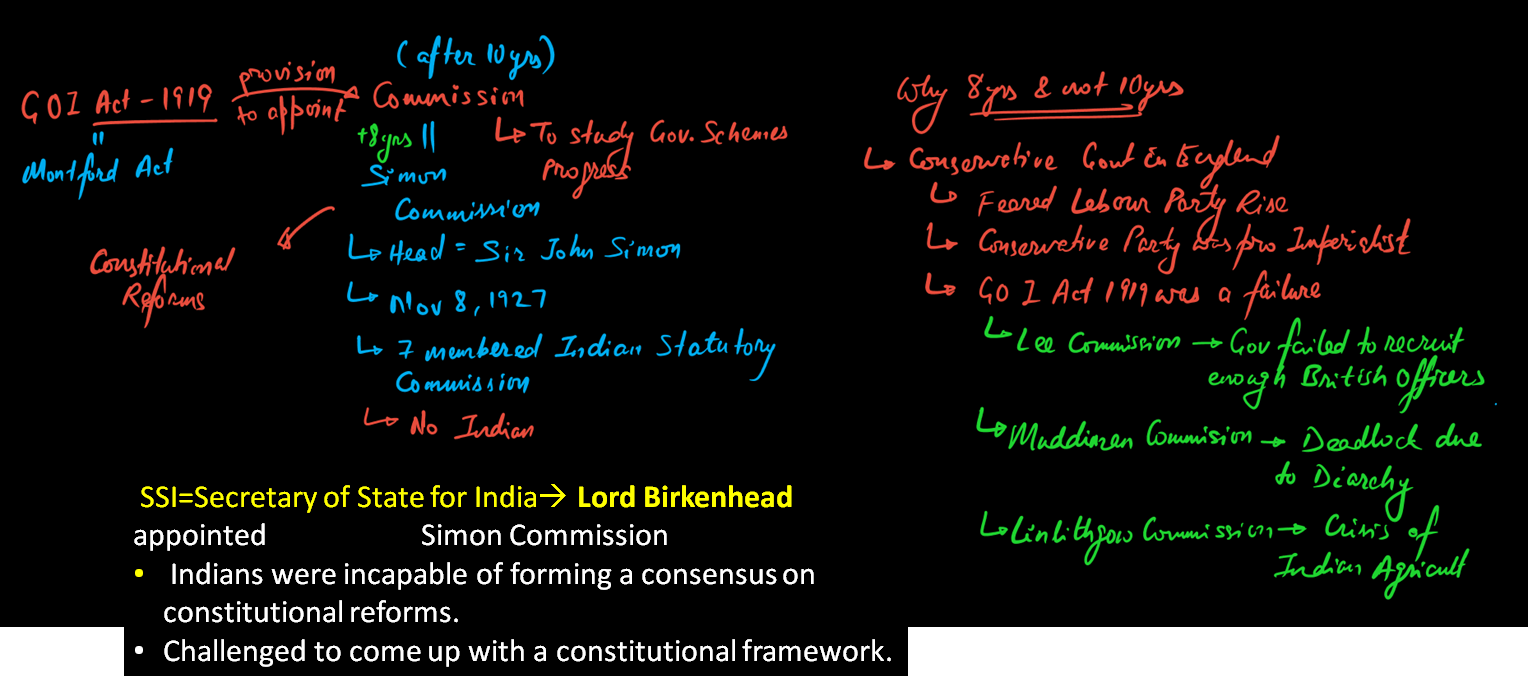
December 1927–> Congress session @ Madras
- under the presidency of M.A. Ansari
- passed a resolution to boycott the commission “at every stage and in every form”.
Reaction to Simon commission
- Angered everyone
- Foreigners would discuss and decide upon India’s fitness for self-government was indigestible for one and all.
- It was also seen as a violation of the principle of self-determination
- Deliberate insult to the self-respect of Indians.
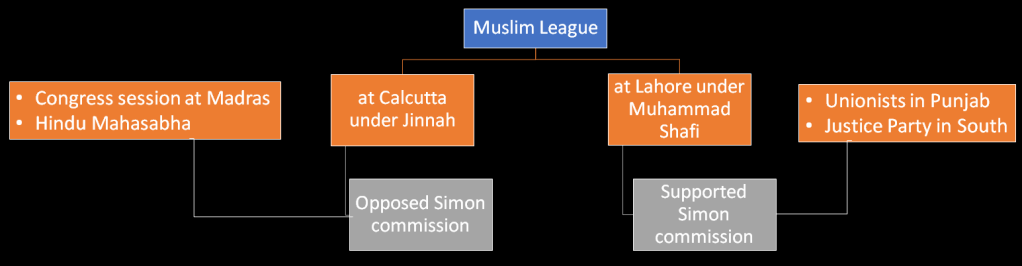
February 3, 1928–> commission landed in Bombay
- Countrywide hartal was organised with mass rallies.
- People waved black flags + shouted slogans of “Simon Go Back”.
- J.L. Nehru + Subhash Bose ably led this new wave of youth and students.
- The Socialism + radical ideas spread which is reflected in the emergence of groups
- Punjab Naujawan Bharat Sabha,
- Workers’ and Peasants’ Parties
- Hindustani Sewa Dal in Karnataka.
- Repression by the Police
- Lathi charges on everyone, even the senior leaders JL Nehru and G.B. Pant were beaten up in Lucknow
- October 1928–> In Punjab, Lala Lajpat Rai received severe blows on his chest
- November 17, 1928–> Lala died
Involvement of Dr. B.R Ambedkar
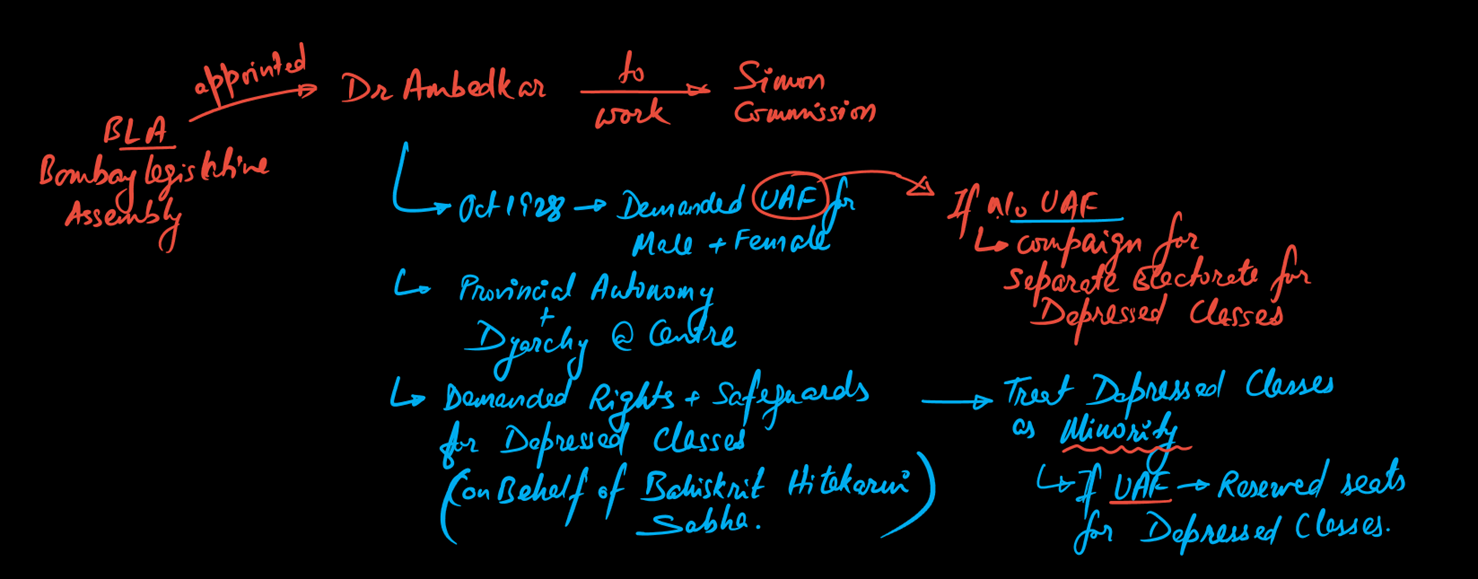
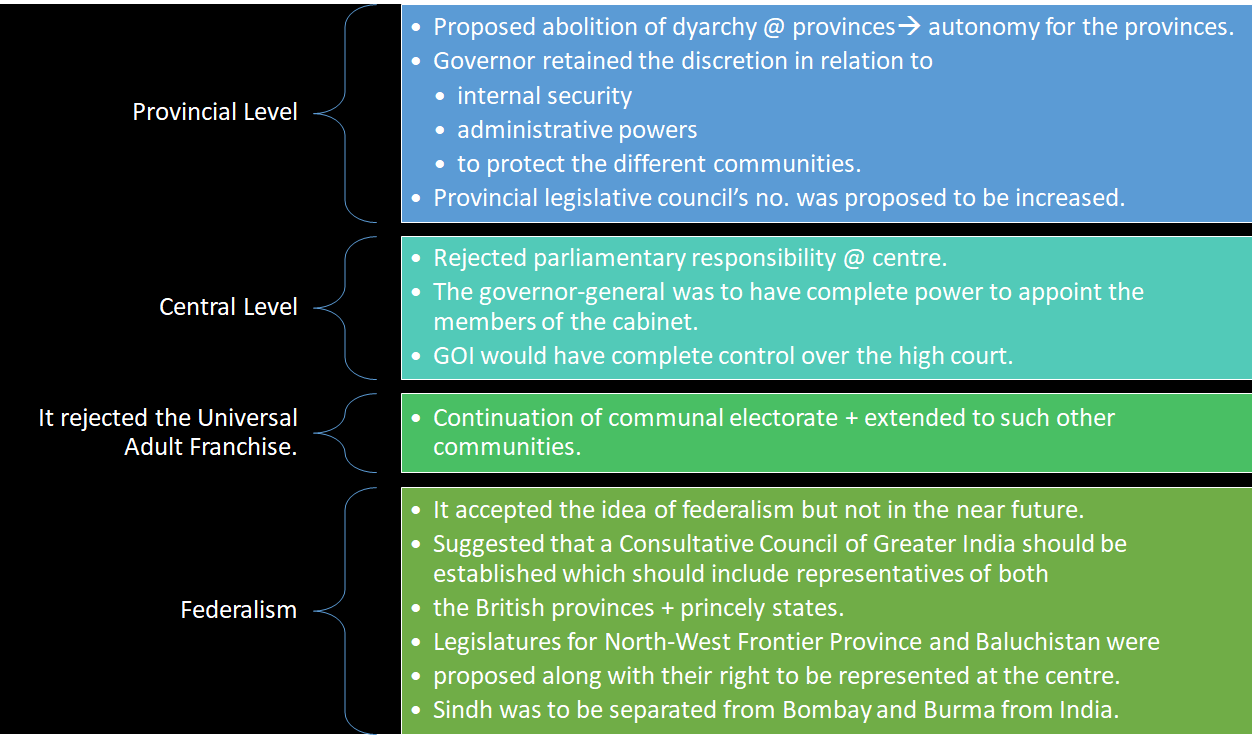
May 1930–> Simon Commission Report
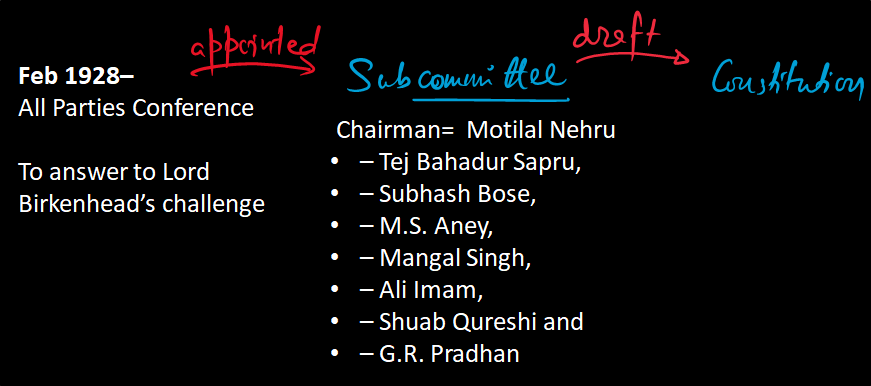
10 August 1928–> The NEHRU report was submitted
- Unanimous in its recommendation except for “dominion status”.
- A Minority of them(young leaders) favored ‘Complete Independence’.
- Dominion status on lines of self-governing dominions as the form of government
- Rejection of separate electorates.
- Instead demanded joint electorates with reservation of seats for Muslims at Centre and in provinces where they were in minority.
- In provinces where Muslims were in majority, there in proportion to the Muslim population with the right to contest additional seats.
- Creation of Provinces on Linguistic lines.
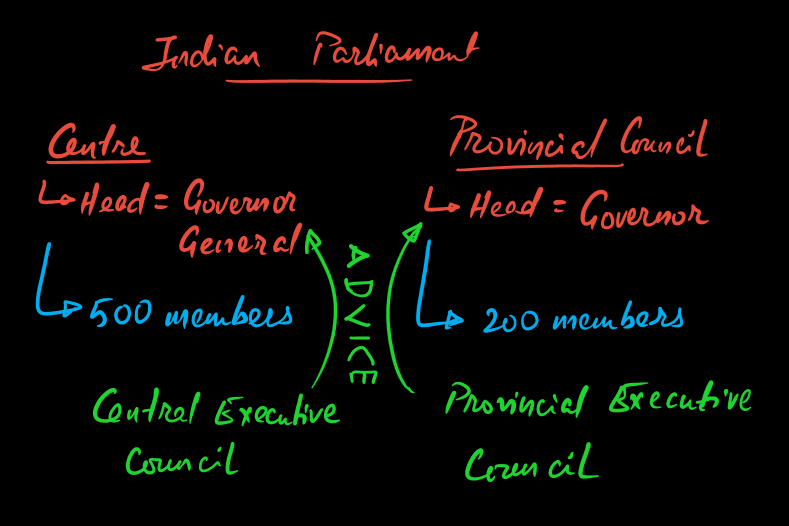
- Demanded bicameralism
- Provincial Autonomy– no Provincial dyarchy
- Centre to have residuary powers.
- Independent Judiciary- ~Supreme Court
- 19 fundamental rights including equal rights for women, the right to form unions, and universal adult suffrage.
Demanded Bicameralism
Controversies
Muslim League–> Delhi proposals
December 1927, @ Delhi
- Joint electorates in place of separate electorates with reserved seats for Muslims;
- 1/3 representation to Muslims in CLA= Central Legislative Assembly;
- Representation to Muslims in Punjab and Bengal ∝ their population;
- Formation of 3 new Muslim majority provinces—
- Sindh
- Balochistan
- NWFP=North-West Frontier Province
December 1927, @Madras–> All 4 were accepted by the Madras session of the Congress
Hindu Mahasabha–> Demands
- The Hindu Maha Sabha opposed to the proposals for creating new Muslim-majority provinces and reservation of seats for Muslims majorities in Punjab and Bengal.
- According to them, it would ensure Muslim control over legislatures in both. It also demanded a strictly unitary structure.
- Demands of both the parties were conciliated and a compromise was struck in the Report with the following
- Joint electorates proposed everywhere but reservation for Muslims only where in minority
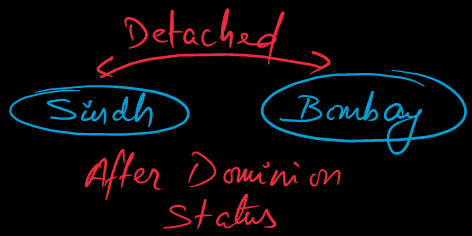
- Sindh to be detached from Bombay only after dominion status was granted
Jinnah proposed amendments
December 1928–> All Parties Conference @Calcutta to consider the Nehru Report.
Jinnah proposed amendments on behalf of Muslim League such as
- 1/3 representation to Muslims in CL= Central legislature.
- Reservation to Muslims in Bengal + Punjab legislatures ∝ to their population until adult suffrage was established;
- Residual powers to provinces
March 1929–> Shafi faction — Jinnah’s demands were not accepted, so Jinnah went back and gave 14 points
- Federalism with residual powers to provinces.
- Provincial autonomy.
- A constitutional amendment cannot be passed by the centre without the acceptance of the states in the federation.
- Adequate representation of Muslims in every province without reducing a majority of Muslims in a province to a minority or equality.
- Adequate representation to Muslims in the services and in self-governing bodies.
- 1/3rd of Muslim representation in the central legislature.
- 1/3rd members to be Muslims in Cabinet.
- Separate electorates.
- No bill or resolution to be passed if three-fourths of a minority community consider such a bill or resolution to be against their interests.
- Any territorial redistribution not to affect the Muslim majority in Punjab, Bengal, and NWFP.
- Constitutional reforms in the NWFP and Balochistan.
- Separation of Sindh from Bombay.
- Full religious freedom to all communities.
- Protection of Muslim rights in religion, culture, education, and language.
Failure of Nehru Report
- The Muslim League, the Hindu Maha Sabha, and the Sikh community were unhappy about the Nehru Report,
- Lucknow Pact-1916–> Congress agreed for separate electorate for Muslims
- Even the younger members of the Congress led by Jawaharlal Nehru + Subhash Bose were also angered over the idea of dominion status in the report as a step backward.–> started Independence of India League.
- Nehru and Subhash Bose rejected the Congress’ modified goal and jointly set up the Independence for India League.
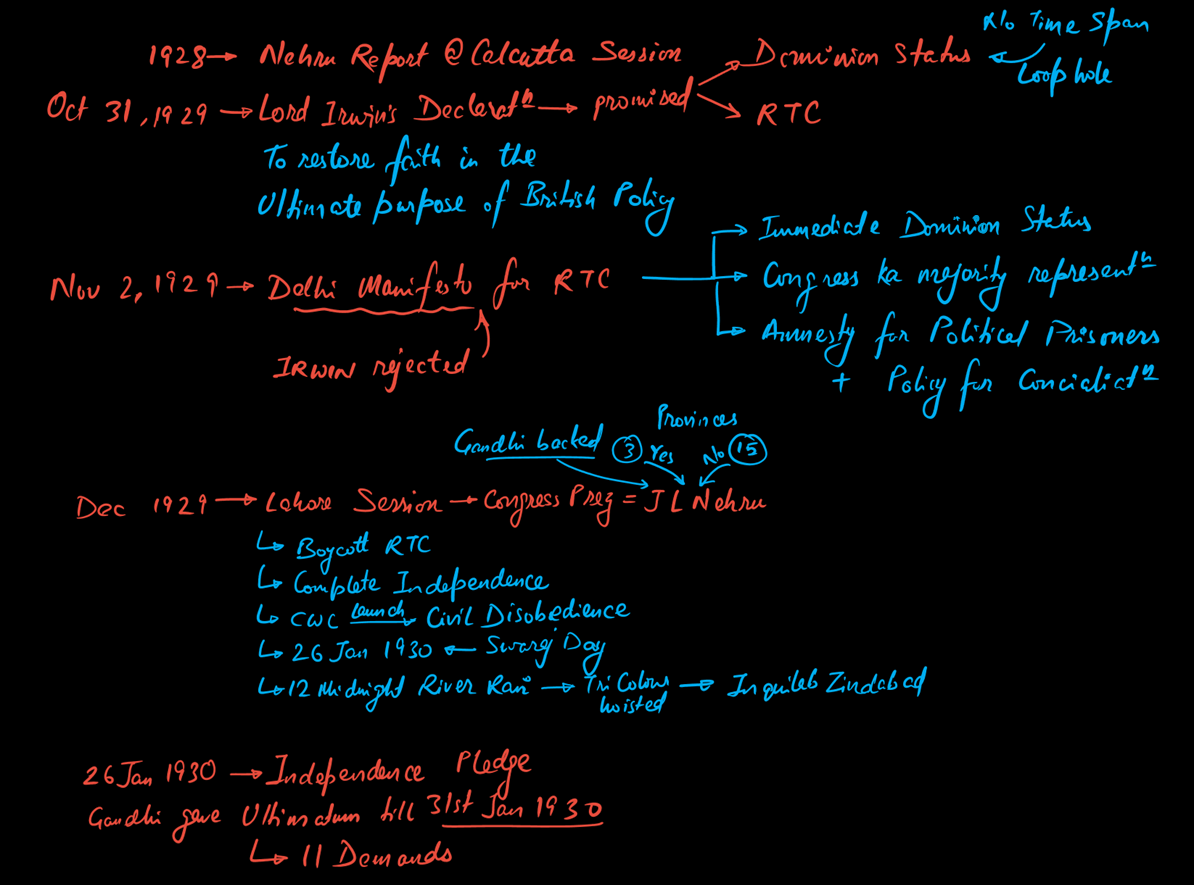
Gandhi’s 11 Demands
- Reduce expenditure on Army and civil services by 50%
- Introduce total prohibition.
- Carry out reforms in the Criminal Investigation Department (CID).
- Change Arms Act allowing popular control of the issue of firearms
licences. - Release political prisoners.
- Accept Postal Reservation Bill.
- Reduce rupee-sterling exchange ratio
- Introduce textile protection.
- Reduce land revenue by 50 percent.
- Abolish salt tax and government’s salt monopoly.
- Reserve coastal shipping for Indians.
• There was no response from the govt.
• Feb 1930–> Brdoli meeting–> Congress working committee (CWC) gave Gandhi full powers to launch
the Civil Disobedience Movement at a time and place of his choice.
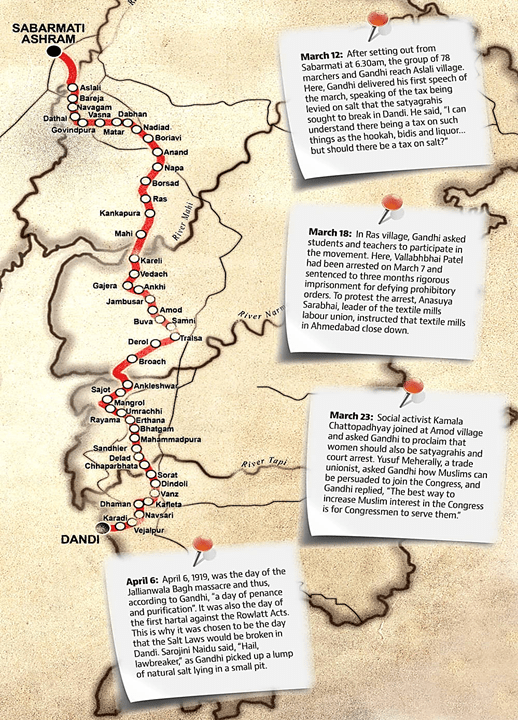
Dandi March
- March 2, 1930–> Gandhi informed the viceroy of his plan of action.
- Gandhi along with 78 peoples of Sabarmati Ashram would to march from Ahmedabad through the villages of Gujarat for 240 miles and reach the coast at Dandi.
- He announced that the salt law would be violated by collecting salt from the beach.
- March began on March 12 and Gandhi broke the salt law by picking up a lump of salt at Dandi on April 6.
- It evoked huge protests and demonstrations all over India
- Gandhi was arrested on May 4th ,1930 when he had announced that he would lead a raid on Dharasana Salt Works.
In the starting of Civil Disobedience Gandhi asked
- people to show civil disobedience of the salt law wherever possible.
- To picket foreign liquor and cloth shops.
- Lawyers to give up the practice, refuse to pay taxes, and boycott courts.
- Government servants to resign.
As a response to Gandhi’s arrest, the CWC sanctioned the following:
- Non-payment of revenue in ryotwari areas;
- No-chowkidari-tax campaign in zamindari areas; and
- Violation of forest laws in the Central Provinces.
- • As Gandhi was arrested before the raid on Dharasana Salt Works, Sarojini Naidu, Imam Sahib, and Manilal (Gandhi’s son) took up the unfinished task and On May 21, 1930, they raided it.
- The police resorted to lathi charge on the unarmed and peaceful crowd which left 2 dead and 320 injured.
- People everywhere raided the Salt Works such as in Wadala (Bombay), Karnataka (Sanikatta Salt Works), Midnapore, Balasore, Puri, and Cuttack.
Sholapur
- Sholapur in southern Maharashtra saw the fiercest response to Gandhi’s arrest.
- Textile workers went on a strike, residents burnt liquor shops and other symbols of government authority such as railway stations, police stations, municipal buildings, law courts, etc.
- The activists established a virtual parallel government here and could only be dislodged with martial law after May 16.
- It was during this movement, the maximum mobilization of masse happened.
- And innovative methods such as Prabhat pheris, Vanar senas, Manjari senas, Secret patrikas, and Magic lantern shows were also used.
IFRA- 1827+ FRA- 1927 drove away tribals from forests and prohibited them from its use.
Protests at Different Places in South
- C. Rajagopalachari organised a march from Trichinopoly to Vedaranniyam on the Tanjore coast to break the salt law.
- The anti-liquor campaign gathered forceful support in interior regions of Tamil Nadu in Coimbatore, Madurai, etc.
- K. Kelappan, a Congress= hero of Vaikom Satyagraha, organised the salt march in Kerala. He has been called the “Kerala Gandhi”.
- District salt marches were organised in East and West Godavari, Krishna and Guntur of Andhra Pradesh.
- Sibirams (camps) were set up to serve as the headquarters of the Salt Satyagraha.
Protests at Different Places in East
- Under Gopalbandhu Chaudhuri, a Gandhian leader, salt satyagraha proved effective in the coastal regions of Balasore, Cuttack, and Puri districts of Odisha.
- Cunningham Circular which banned students’ participation in politics was protested successfully in Assam in May 1930.
- Chandraprabha Saikiani led the aboriginal Kachari villages to break forest laws in December 1930.
- During the same period, Surya Sen Chittagong revolt group carried out a raid on two armouries and declared the establishment of a provisional government.
- Protests at Different Places in East • Champaran and Saran were the first two districts to start salt satyagraha.
- In landlocked Bihar, manufacture of salt on a large scale was not practicable and at most places, it was a mere gesture.
- In Patna, Nakhas Pond was chosen as a site to make salt and break the salt law under Ambika Kant Sinha.
- A very powerful no-chowkidari tax agitation replaced the salt satyagraha in Bihar due to physical constraints in making salt.
Protests at Different Places in Northwest
- Khan Abdul Ghaffar Khan’s educational and social reform worked among the Pathans in Peshawar.
- He is also called ‘Badshah Khan’ and ‘Frontier Gandhi’.
- He organised a volunteer brigade ‘Khudai Khidmatgars’, also known as the ‘Red-Shirts’.
- They pledged to the freedom struggle and non-violence.
- There were mass demonstrations in Peshawar which was virtually in the hands of the crowds for more than a week until the order was restored using a reign of terror and martial law.
- A section of Garhwal Rifles soldiers refused to fire on an unarmed crowd here.
Rani Gaidinliu
At 13 year old–>Rani Gaidinliu= a Naga spiritual leader, who followed her cousin Haipou Jadonang, raised the banner of revolt against foreign rule.
• The British authorities caught Haipou Jadonang and hanged him on charges of treason in 1931.
• Rani Gaidinliu outwitted the British till October 1932 when she was finally captured and sentenced to life imprisonment.
• The Interim Government of India set up in 1946 that inally ordered her release from Tura jail.
Government’s Response
The ordinances banning civil liberties were issued and the press was
gagged also.
- The provincial governments were given freedom to ban civil disobedience organisations.
- There were lathi charges and firing on unarmed crowds which left several killed and wounded while thousands of Satyagrahis and other Congress leaders were imprisoned.
- The Congress Working Committee was declared illegal in June.
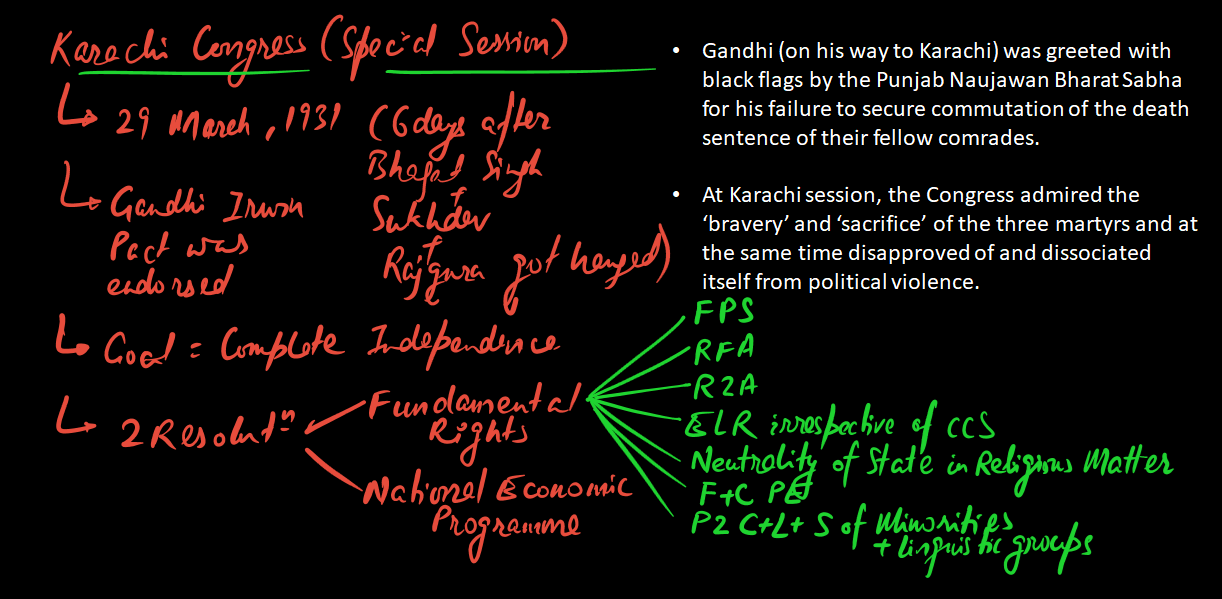
The Resolution on Fundamental Rights guaranteed—
- – Free speech and free press;
- – Right to form associations;
- – Right to assemble;
- – Equal legal rights irrespective of caste, creed, and sex;
- – Neutrality of state in religious matters;
- – Free and compulsory primary education;
- – Protection to culture, language, the script of minorities and linguistic groups.
Resolution on National Economic Programme provided for—
- – Substantial reduction in rent and revenue in the case of landholders and peasants;
- – Exemption from rent for uneconomic holdings;
- – Relief from agricultural indebtedness and control of usury;
- – Better conditions of work including a living wage, limited hours of
- work and protection of women workers in the industrial sector;
- – Right to workers and peasants to form unions;
- – State ownership and control of key industries, mines, and means of transport
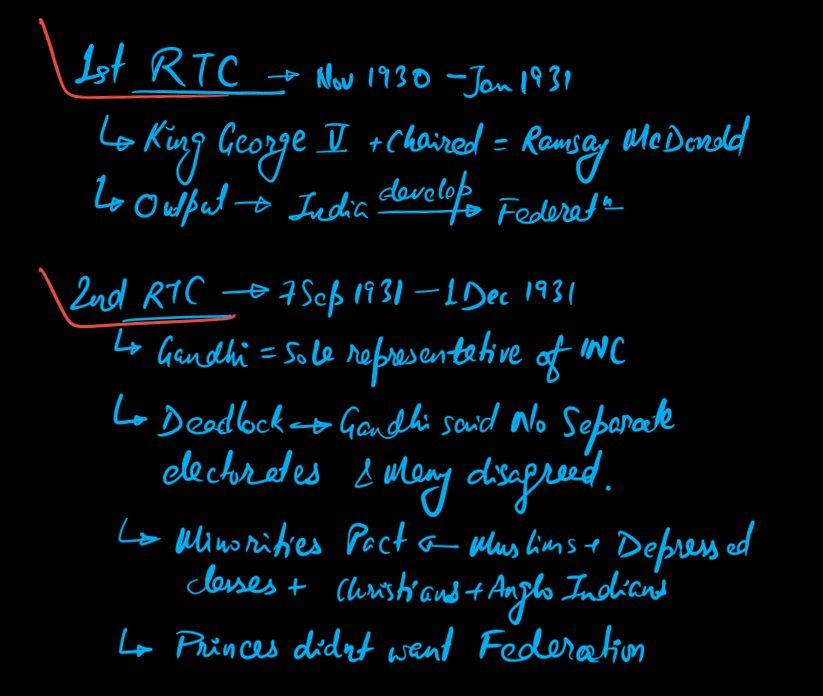
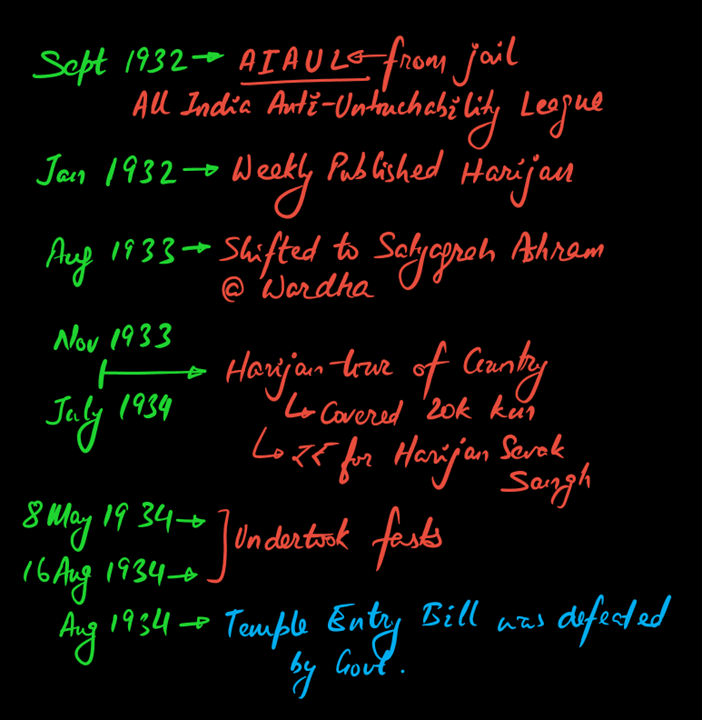
May 1934–> AICC=All India Congress Committee met at Patna to setup a Parliamentary Board to fight elections under the aegis of the Congress.
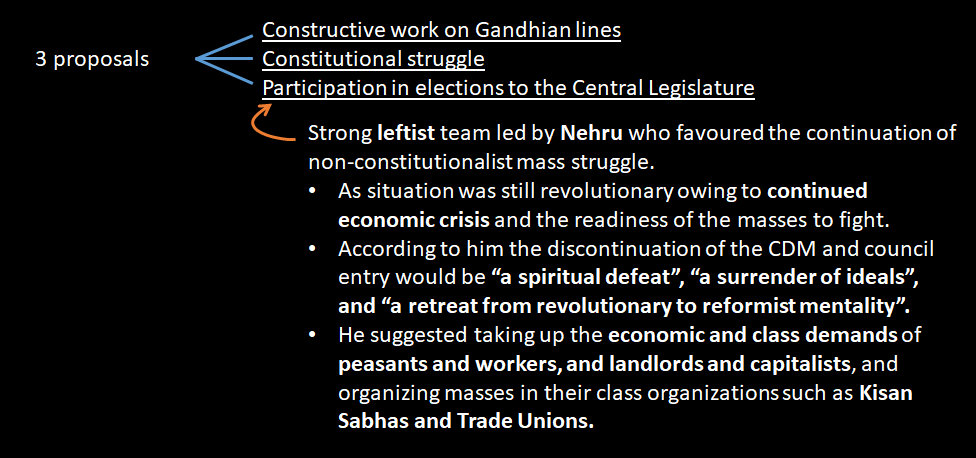
- The trends in the Congress favored parliamentary politics with which he was in fundamental disagreement.
- The socialists led by Nehru also had differences with Gandhi.
Outcome of Debate
- October 1934–>Realizing that Gandhi was out of tune with the Congress. he announced his resignation from the Congress.
- November 1934–> In the elections to the Central Legislative Assembly held, the Congress captured 45 out of 75 seats reserved for Indians.
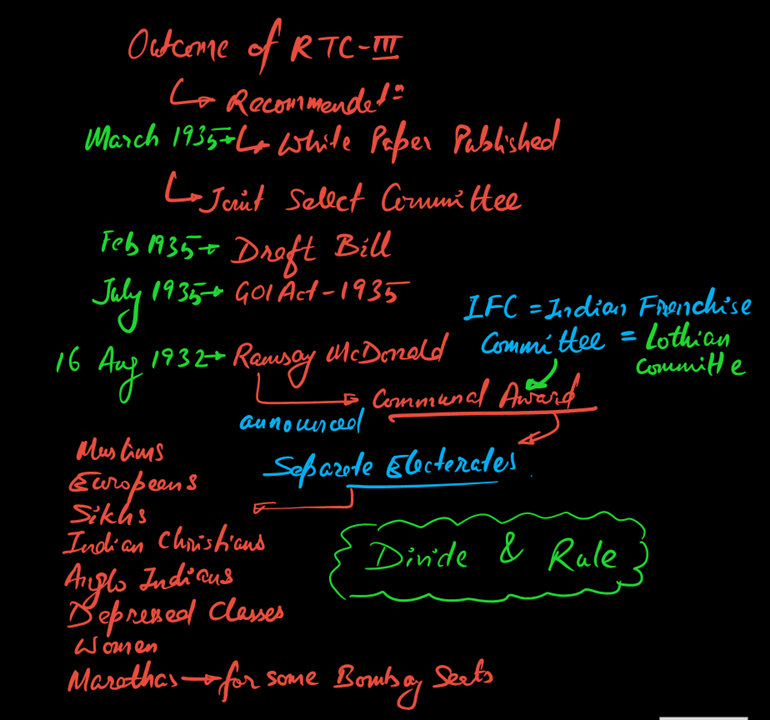
- Meanwhile, the third RTC led to the formulation of the Act of 1935 and it was passed by the British Parliament in August 1935.
GOI Act – 1935
Processes + Events
Basis of the Act:
- The report of Simon Commission
- The report of all parties conference(Nehru Committee report)
- The discussions of 3 RTC
- White paper (march-1933)
- The Joint Committee report
- The Lothian report that led to Electoral provisions of the Act
- Lothian Committee→ Lord Lothian is chairman of the committee Indian franchise committee
- A franchise which would be a suitable foundation for a system of responsible government
- per cent and 5 per cent of the seats in both provincial legislatures and the assembly should be reserved for women
- proposed educational and property qualifications for voter
- Gandhi demand for universal adult suffrage was rejected increases in the number of qualified voters in the provinces and made special provisions to guarantee representation for women and the “untouchables,”
- worried about mass movement in India→especially due to post world war event in India.
- Carrot and Stick Policy Suppression→weaken the nationalist movement through divide and rule policy.
- Aware→Congress party and other political parties would support ‘Constitutional reforms’ a
- limited political package to Indians
- The government of India Act, 1935 should be seen in this perspective too.
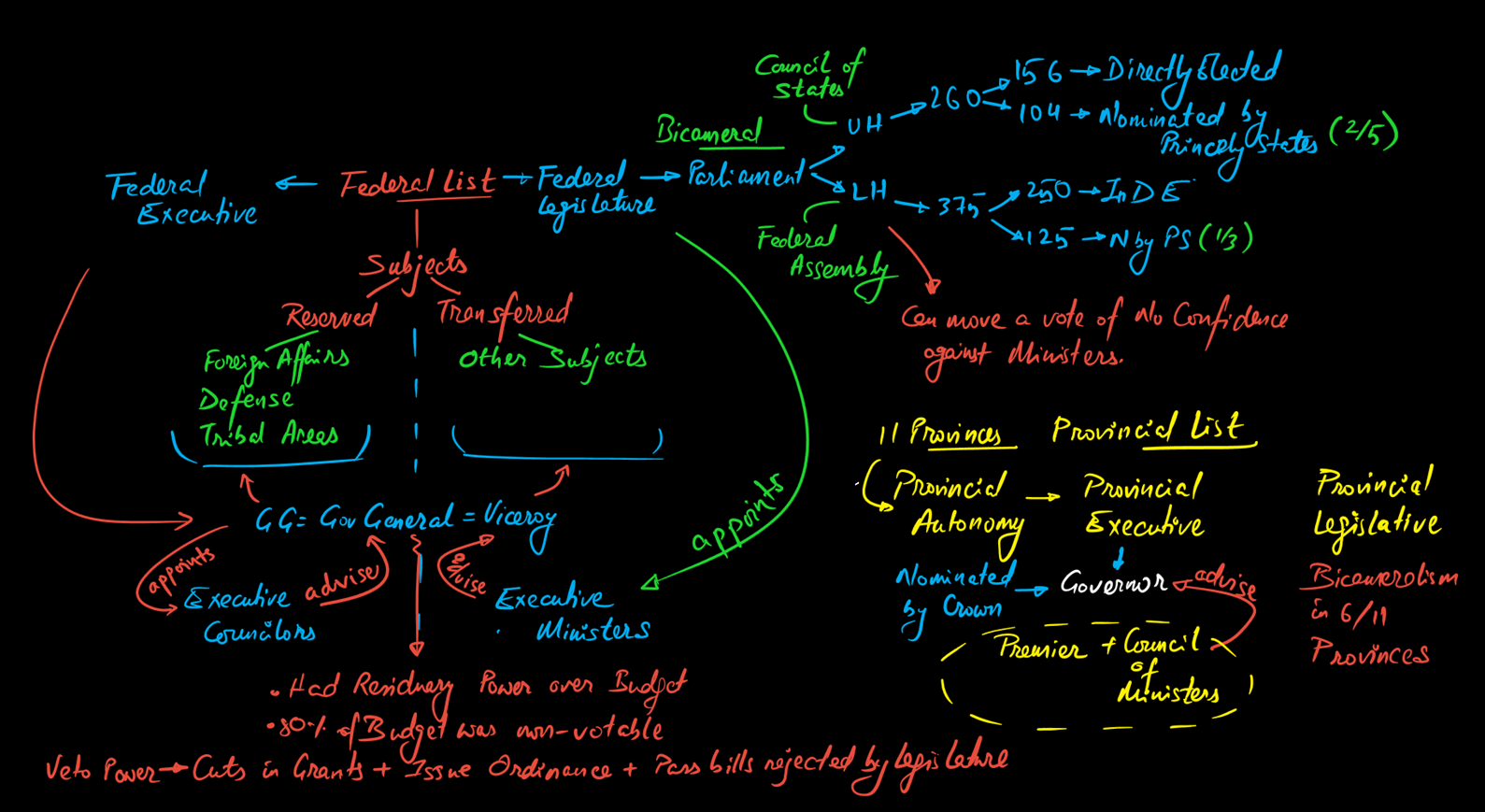
Provincial Legislature– Madras, Bombay, Bengal, U.P., Bihar and Assam
Separate Electorates
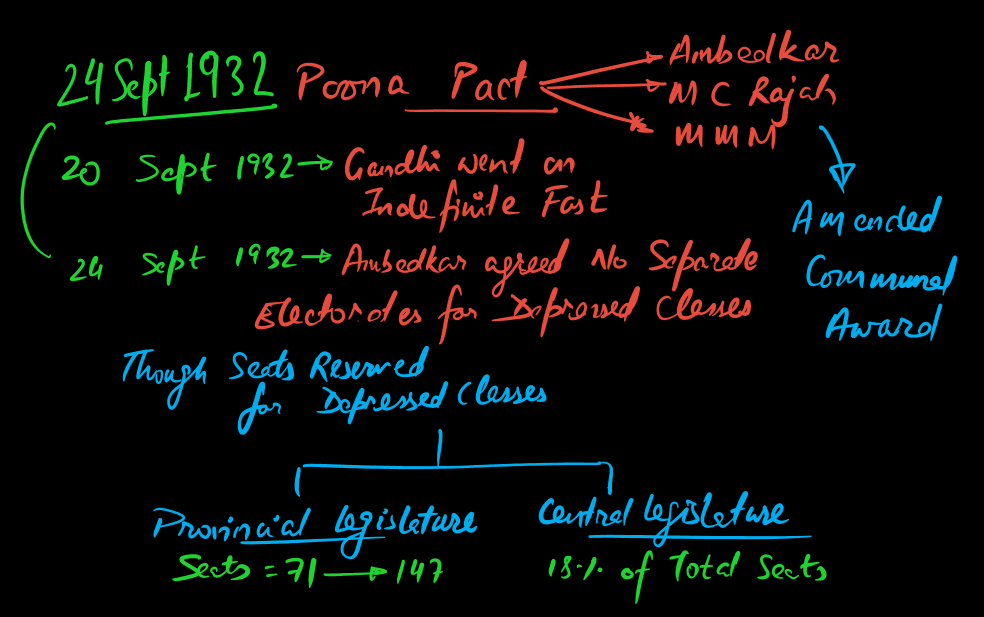
The provision of separated electorate continued. For depressed class, certain seats were reserved in the general constituency, as agreed at Poona .
It was claimed by the government that maximum autonomy was granted to the provinces, but in reality the governor, centre’s nominee, retained special powers. He could veto legislative and administrative measures concerning the issues of –
(i) The Minorities (ii) The rights of civil servants
(iii) Law and order (iv) British business interests
The governor also had the power to take over and run the administration of a province indefinitely.
Todays emergency are inspired from it–
N- National emergency- Art352
S- State emergency- Art356
F- Financial emergency- Art360
Federal Court
Federal court at centre which had both original and appellate powers, besides power to interpret the constitution, but the final court of apple was privy council in London.
Secretary Of State Secretary of State (In England) was given advisers, who might or might not be consulted. Indian council was abolished because of much agitation in India.
 MY BOX