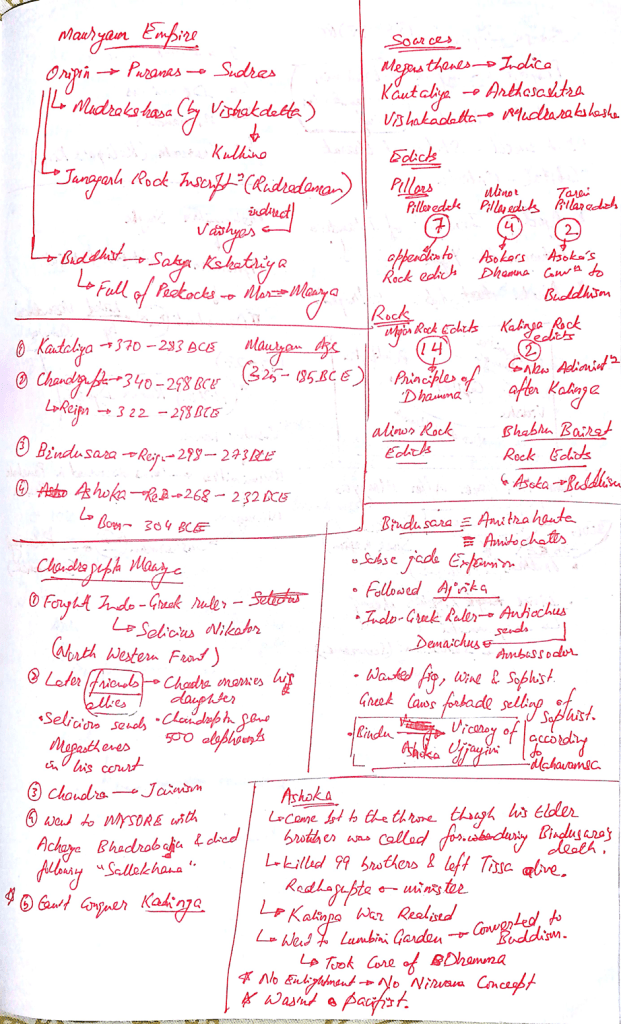
Mauryan empire
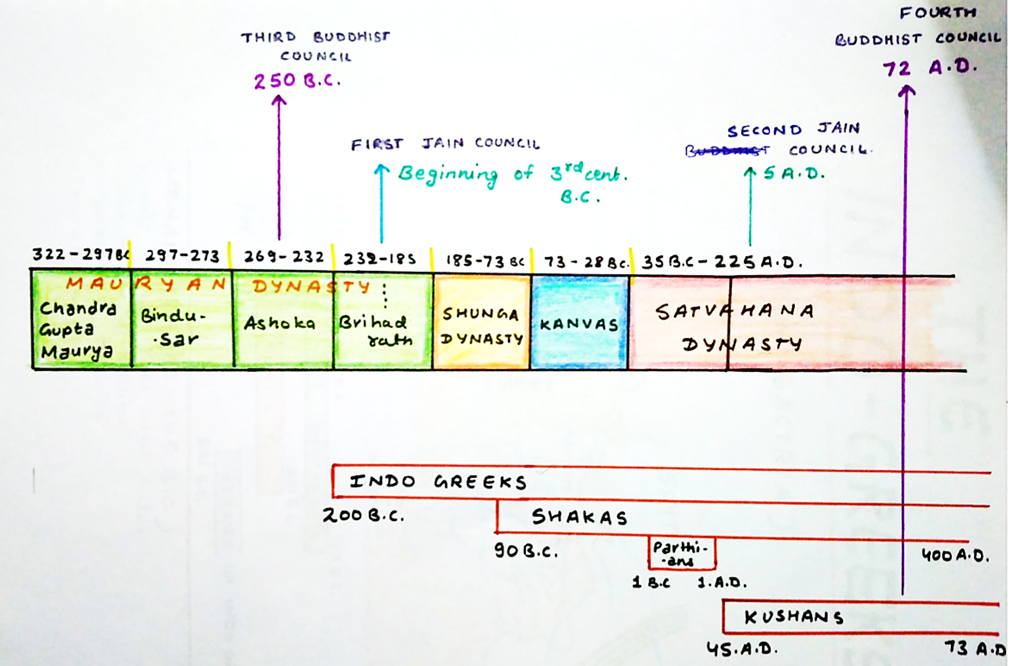
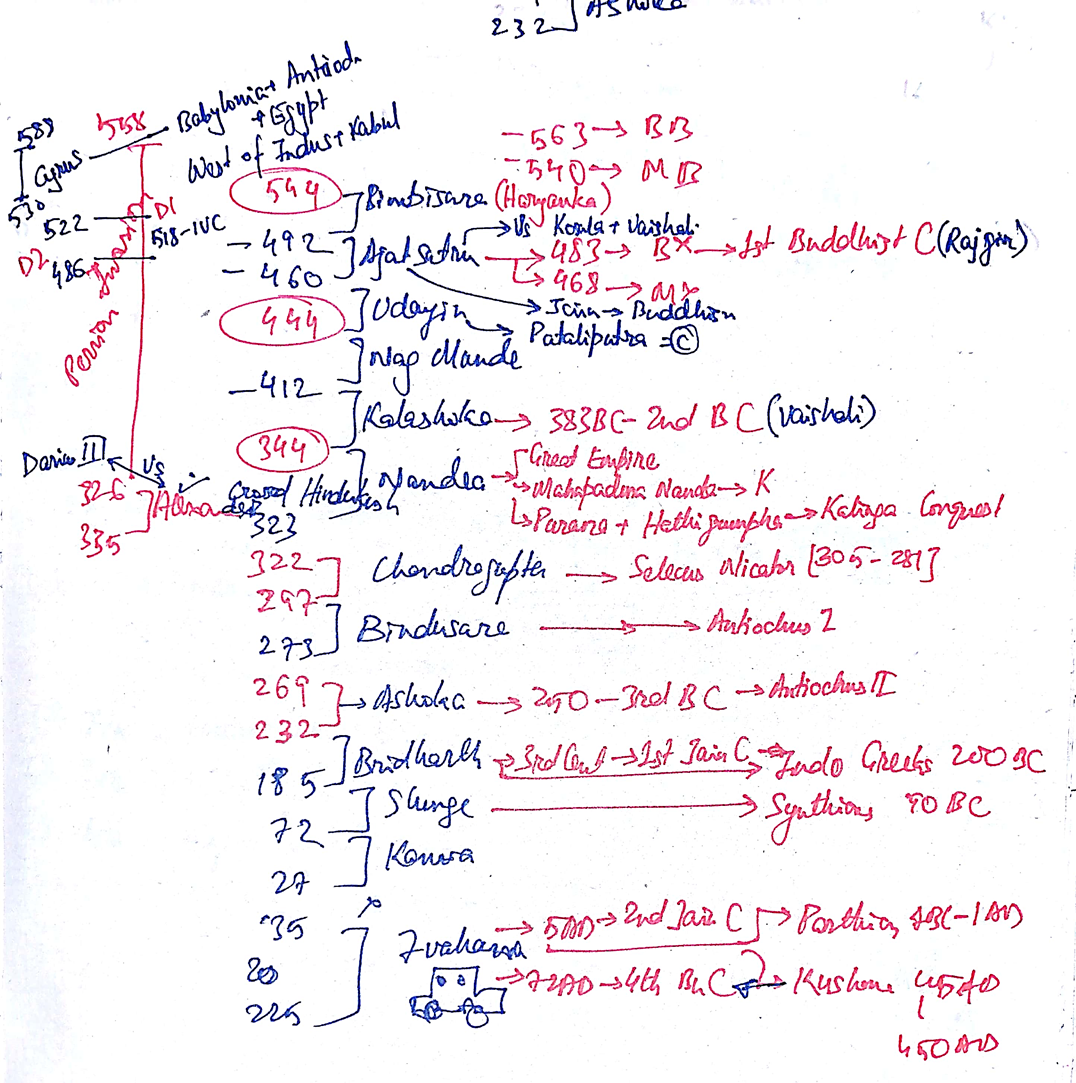
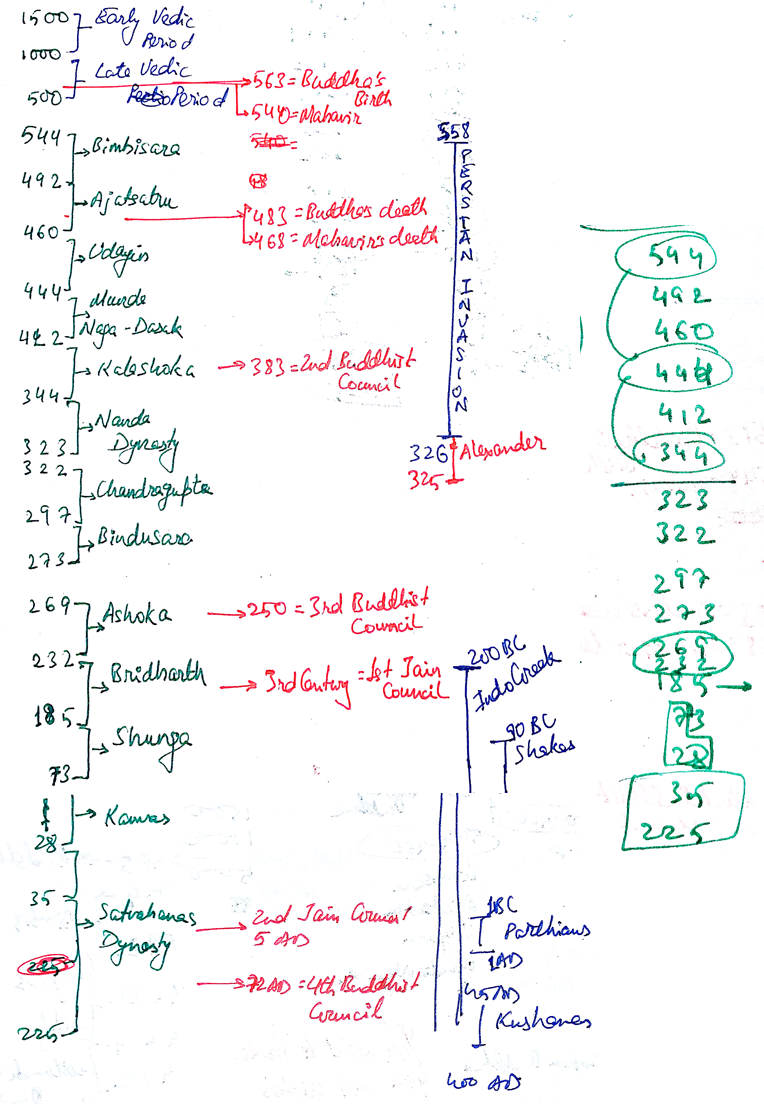
323- 297 BCE–Chandragupta I
297-269-BCE- Bindusara
269- 232 BCE- Ashoka
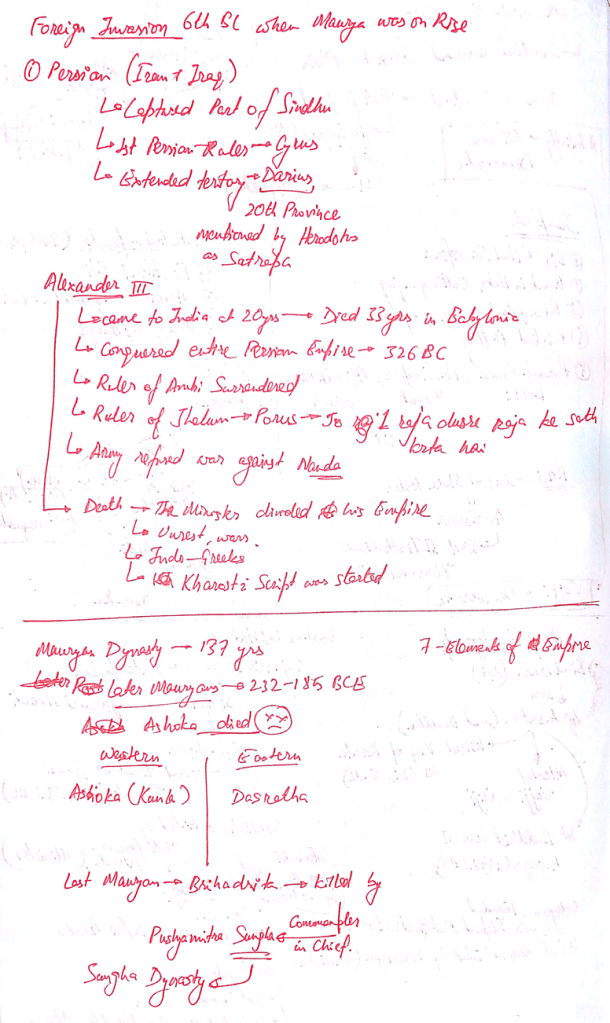
232- 185 BCE- Later Mauryas
- Dasaratha (East) & Kunala (West) – Division of empire
- Samprati – Reunion & subsequent loss of the west
- Salisuka
- Devavarman
- Satadhanvan
- Brihadratha – Greek invasion & overthrow by Pusyamitra
Rise of Mauryan Empire
• Chandragupta Maurya inherited a large army of the Nanda dynasty.
• He conquered almost whole of the north, the northwest, and a large part of peninsular India.
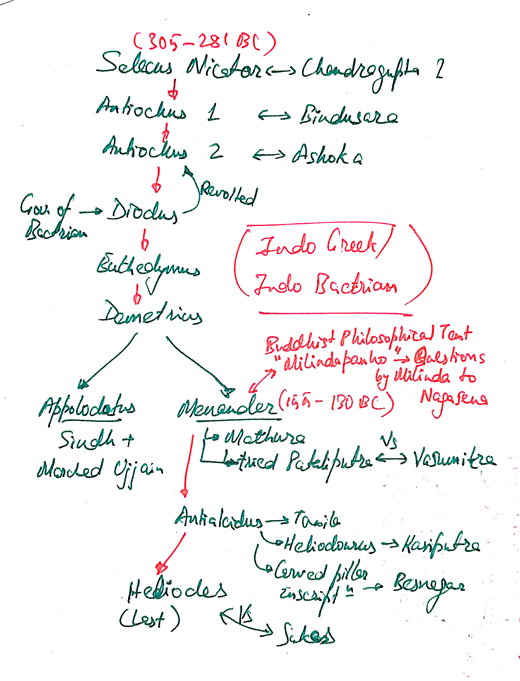
• He defeated Seleucus Nicator, a Greek governor in Northwest India.
• Seleucus gave his daughter in marriage to Chandragupta and also the provinces of eastern Afghanistan, Balochistan, and the area west of the Indus.
• Thus, he built up a vast empire which included almost entire sub-continent except for Kerala, Tamil Nadu, and parts of north-eastern India.
Alexander had abandoned his India conquest a within a year, Chandragupta had defeated so Greek-ruled cities in the north-western part. ·Kautilya provided the strategy while Chandragupta executed it.
Chandragupta as a king ? Started the campaign in the North-West & Within India
Within India→ Expansion upto Gujarat
Saurashtra Province→ governed by the Vaishya Pushyagupta Construction of the Sudarshan lake
embraced Jainism towards the end of his life and stepped down from the throne in favour of his son→ Bindusara
Accompanied by Bhadrabahu @ Sravana Belgola
deliberately starved himself to death in the approved Jaina fashion (sallekhana)
The Mauryan dynasty is a turning point in the history of early India because for the first time a number of sources are available which throw better light on the history of this period.
• These include Edicts issued by Ashoka = serve as the 1st evidence of writing in ancient India.
• Archaeological sources –>punch-marked coins, remains of the palace of Ashoka at Kumrahar, and several pieces of sculptures.
BINDUSARA
Taranatha= the Tibetan Buddhist monk who visited India in the 16th century–said Bindu conquered 16 states, comprising ‘the land between the two seas, presumably the Arabian Sea and the Bay of Bengal.
Tamil texts → Mauryan rule upto Tamil Nadu and Kerala.
Ashoka
Ashoka (269–232 BC) succeeded Bindusara.
– Ashoka fought Kalinga War around 261 BC in which, according to inscriptions, 100,000 people were killed and 150,000 were taken as prisoners
– The bloodshed melted his heart, therefore he abandoned the policy of military expansion and declared that he would replace Bherighosha (war drum) with Dhammaghosha (drum of dhamma).
Ashoka spent the rest of his life in spreading the policy of Dhamma.
• He also sent missionaries to Sri Lanka and Central Asia.
• Ashoka’s Dhamma was a code of conduct which he appealed to his subjects to follow. The tenets of Dhamma included –
Compassion (daya) –
Charity (dana) –
Truthfulness –
Purity –
Gentleness
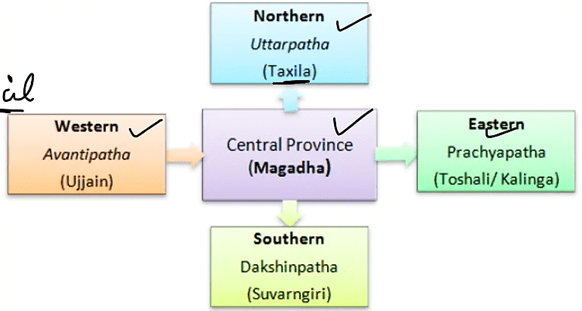
- Taxila (northwestern India),
- Suvarnagiri (southern India),
- Tosali (eastern India) and
- Ujjain (western India
Initially was just one of the Mauryan kings mentioned in the Puranas. In 1837 James Prinsep → Brahmi script referring to a king called ‘Devanampiya Piyadassi’ (beloved of the gods). Same inscriptions attributed to Asoka found at different places
In 1915 → the Maski Edict→ Asoka as Piyadassi. Mahavamsa → Asoka used ‘Piyadassi’, as his second name in the inscriptions.
Literary Sources
Greek Historians
- Megasthenes= ambassador of Selecus Nicator–> Wrote Indica, stayed at patalibothra (pataliputra) Original book lost, but preserved in writings of different authors
- Accounts of Diodorous, Strabo, Ariaana Mentions about the slavery, caste-system, administration of the Mauryas
Foreign accounts–
- Account of Voyage by Nearchus→ Naval commander of Alexander
- Deimachus → Ambasador of Syrian king Amitrochates
- Egyptian envoy→ Dionysus
Indian/ Desi–
- Kautilya–> Arthasastra–> book in Sanskrit. Also called ‘Indian Machiavelli’. 1st discovered by R. Shama Sastri in 1904— Contains 15 books.– written by multiple authors but the main part –> Adhyakshapracara have been assigned to the 3rd – 4th century BC which is Kautaliya’s life frame.
The name ‘Kautilya’ denotes that he is of the kutila gotra; ‘Chanakya’ shows him to be the son of Chanaka and ‘Vishnugupta’ was his personal name.
All sources of Indian tradition—Brahmanical, Buddhist and Jaina —agree that Kautilya (also referred to as Vishnugupta in a stanza traditionally included at the end of the work) destroyed the Nanda dynasty and installed Chandragupta Maurya on the throne of Magadha
15 adhikaranas or books. Each book has Multiple chapters, prakaranas and verses in all. A prakarana is a section devoted to a specific topic;
The Arthasastra is mainly in prose of the sutra form, with only 380 shlokas.
Divided in 2 parts–
1. State Politics + Policy
2. Foreign Policy
A state has 4 dangers
1. Internal
2. External
3. Internally aided by external
4. Externally aided by Internal
Buddhist & Jain Literature
- Parsistiparvan→ Jain work→ conversion of Chandragupta Maurya to Jainism
- Kalpasutra→ Book by Bhadrabahu, also talks @ Mauryan History
- Buddhist literature→ Mahavastu, Lalitavistara, Divyavadana Written in Sanskrit literature
- Jataka Stories→
- Dipavamsa & Mahavamsa→ Talks @ origin of Buddhism in Ceylon Role of Asoka
Visakadatta’s Mudrarakshasa
drama in Sanskrit
written during the Gupta period
Story→how Chandragupta with the assistance of Kautilya overthrew the Nandas
the socio-economic condition of mauryas
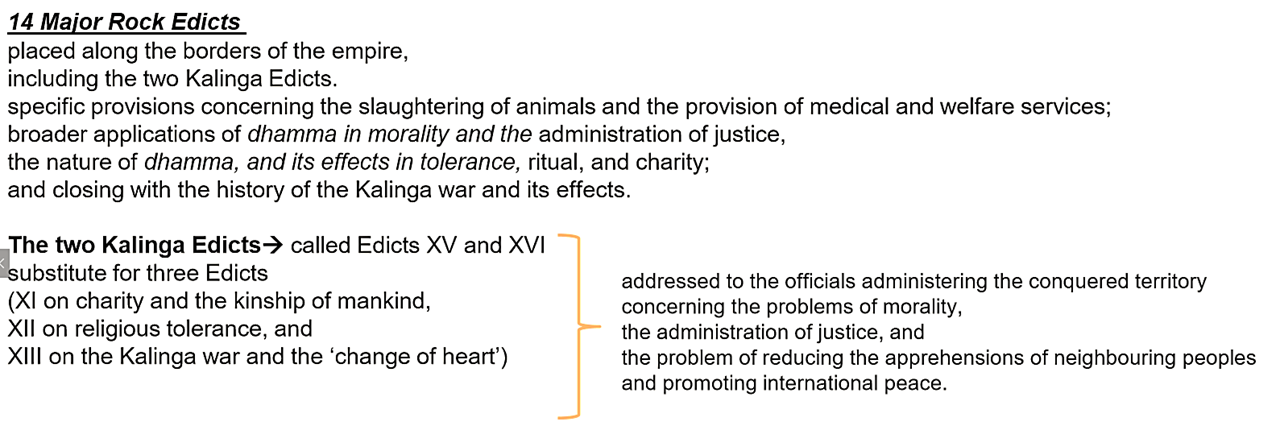
Asokan Edicts–> Rock Edicts+ Pillar Edicts–>
first deciphered by James Princep in 1837
Pali, Prakrit, Aramic & Greek language+
Brahmi & Kmharosti script
Rock edict 1 calls for a ban on animal sacrifice.
Rock Edict 2 mentions about the measures to be taken for the construction of hospitals, roads, inns, wells, and planting of shade-giving trees.
Rock edicts 3, 4 and 12 ask people to respect parents, relatives, Brahmanas and Shramanas (monks).
12th Rock edict calls him “Devanaama Piyadassi”, the beloved of the gods.
Rock edict XIII→ 150000 killed and many perished
Ashoka appointed officials called ‘Dhamma mahamatras’ who had to oversee and supervise the peaceful function of the principles of Dhamma
Mauryan empire
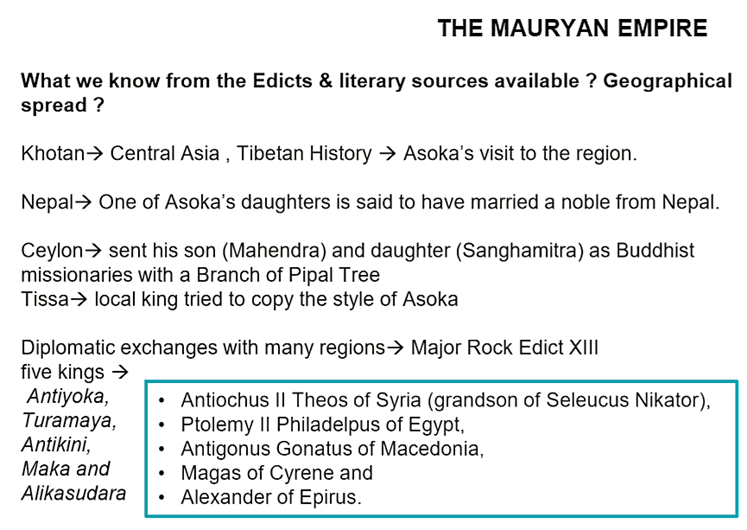
What we know from the Edicts & literary sources available ? Geographical spread ?
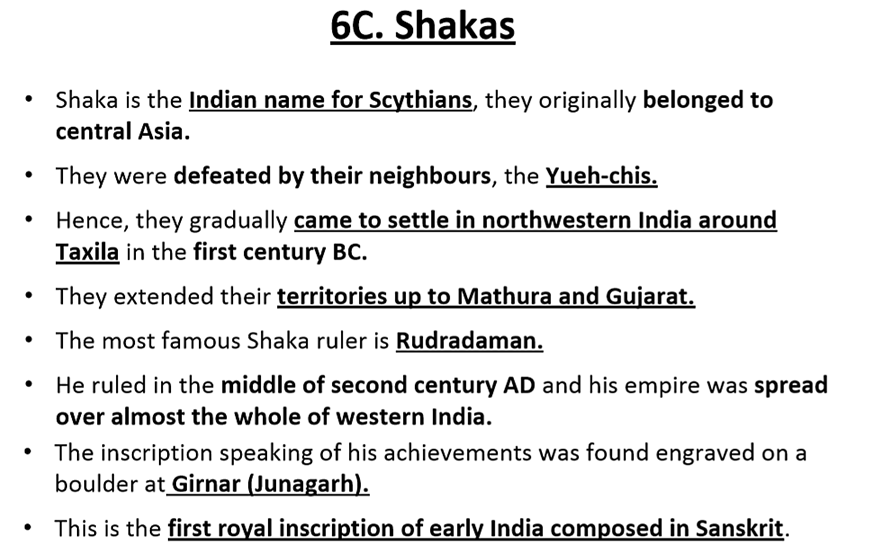
Tusaspa (Asoka’s governor) in the Junagarh inscription → that there might have been a foreign settlement of Persians or Greeks in western India.
Asokan inscriptions→ Major Rock Edict II, refer to the southernmost kingdoms, viz. Cholas, Pandyas, Satyaputras and Keralaputras, as the prachamta (border) states, Distinguish them from the vijita or raja-vishaya (imperial dominions).
These states probably continued to remain outside the Mauryan territory, but maintained friendly relations with the Mauryas.
Kalhana’s Rajatarangini → Kashmir was a part of the Mauryan empire Asoka built the city of Srinagar.
Things found from Megasthenes–
Greek ambassador of Seleucus Nicator= MEGASTHENES–> Stayed in India for 7 years Travelling along Kabul and the Punjab, Reached Pataliputra, the capital of the Maurya empire.
Wrote account→ Indica has been lost, the fragments that still survive in the writings of Strabo, Arrian, Diodoros and others, throw a flood of light on Chandragupta’s civil and military government, the country’s soil, climate, animals, plants and the manners of the people.
King carried in a golden palanquin – Guards riding elephants Silver & Gold decoration – Guars carrying trees Live birds – King surrounded by armed women – Tasting of food before eating – Not sleeping in the room for more than two nights
Military–> formidable army numbering about 6,00,000 men.
Setup ? controlled by a war office consisting of thirty members, divided into 6 boards of 5 each
Municipal organisation.
Town officials → astynomoi
Agronomoi → District Supervisor supervised irrigation, measured the land, enforced the forest laws and looked after agriculture, mining, carpentry and metal industries
Society and People
- Brahmanas and ascetics, numerically the smallest.
- The agriculturists or cultivators , Majority class→ paid a quarter of their produce as rent to the landlord.
- Shepherds and hunters, lived a nomadic life in forests. made the land habitable received an allowance of corn from the king for the service and paid him tribute in cattle.
- Artisans→ exempted from paying taxes, maintenance grant from the royal exchequer.
- Warriors→numbers lesser than cultivators, state paid them.
- The officials (superintendents or overseers and councillors and assessors) employed for the supervision of the work of different departments and the numerous spies who were engaged in transmitting secret information to the kin

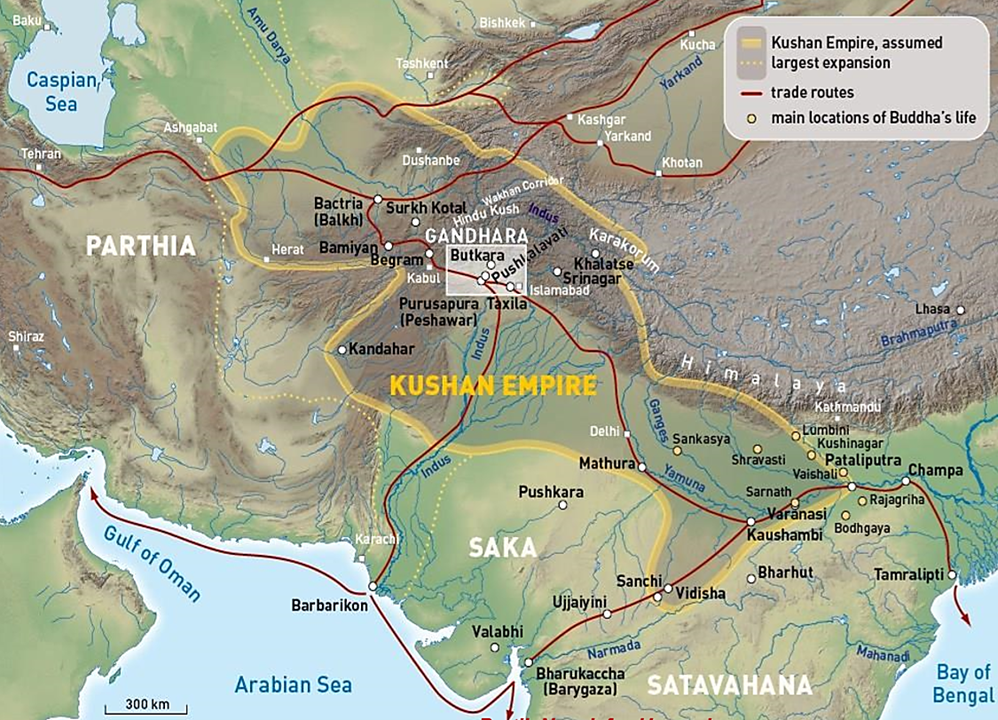
Territory of Magadha and the Maurya Empire between 600 and 180 BCE, including Chandragupta’s overthrow of the Nanda Empire (321 BCE) and gains from the Seleucid Empire (303 BCE), the southward expansion (before 273 BCE), and Ashoka’s conquest of Kalinga (261 BCE).[9]
Mantri
Mantri-parishad
Mantriparishad adhyakha

The same animation, modified in accordance with Kulke and Rothermund (see text). Hermann Kulke and Dietmar Rothermund believe that Ashoka’s empire did not include large parts of India, which were controlled by autonomous tribes.[49]
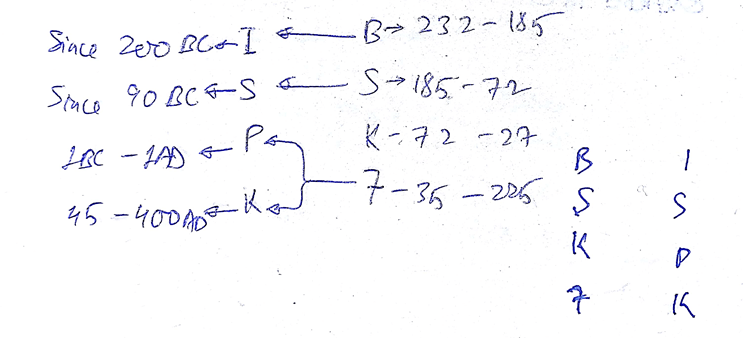
POST- MAURYAN INDIA (200BCE–300CE)
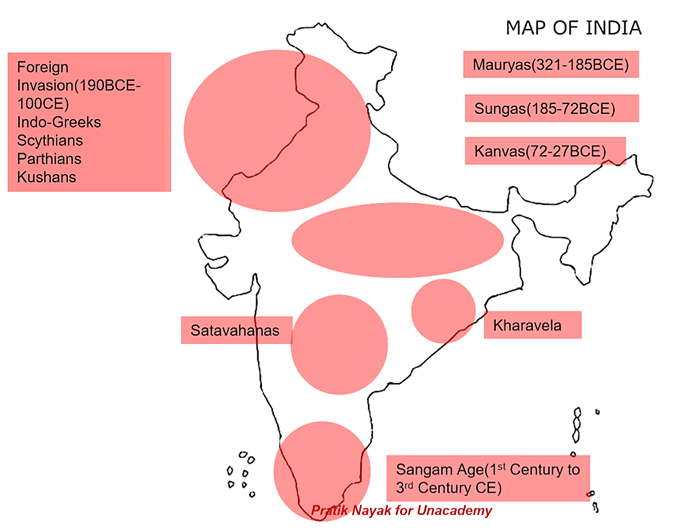
After Ashok’s death–> weak rulers–> Provinces declared independence–> Maurya swere replaced by Sungas–>
- Kalinga became independent
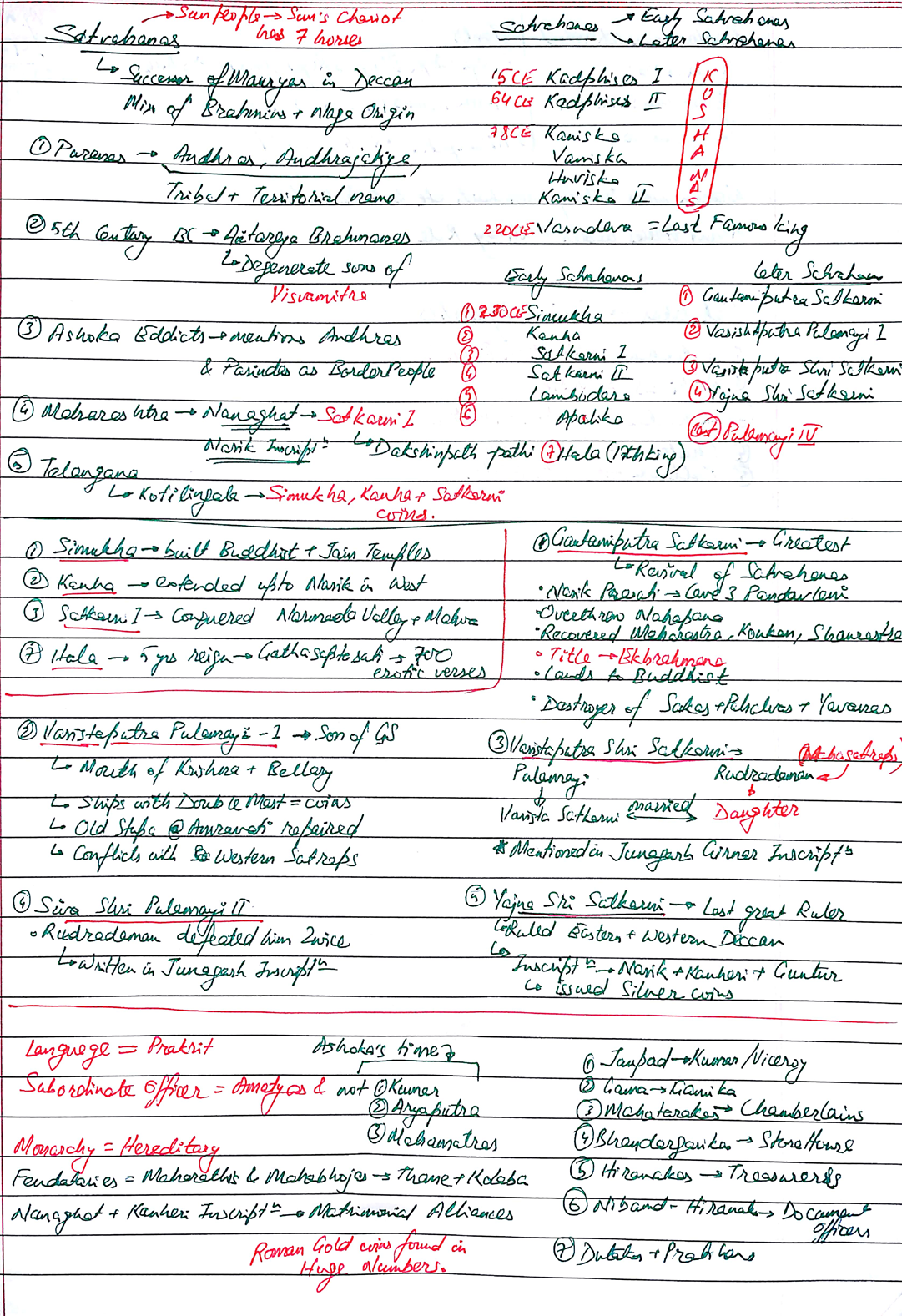
- Satvahana in deccan region
- northwest invasion
INDIGENOUS DYNASTIES:
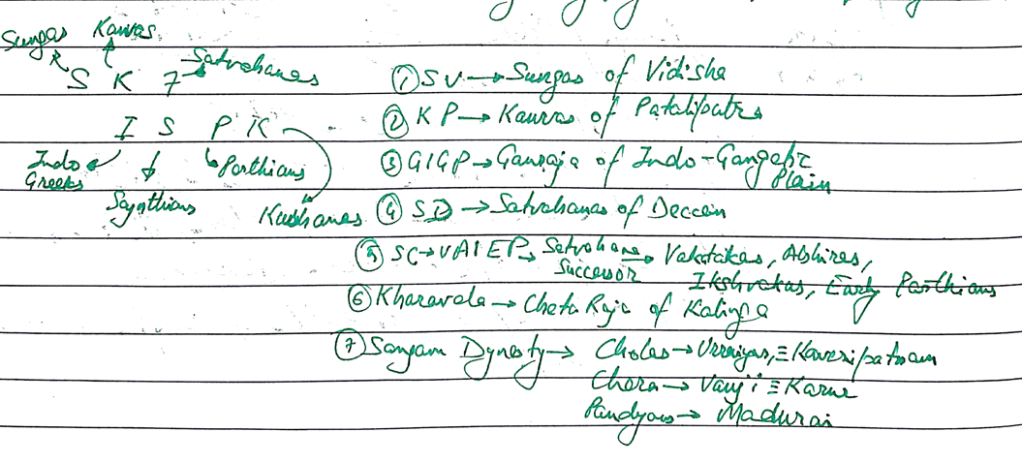
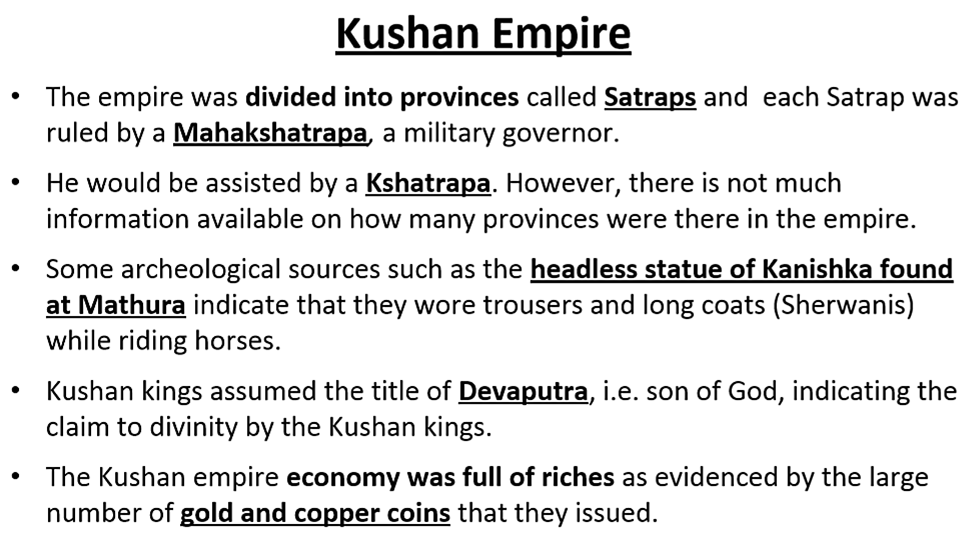
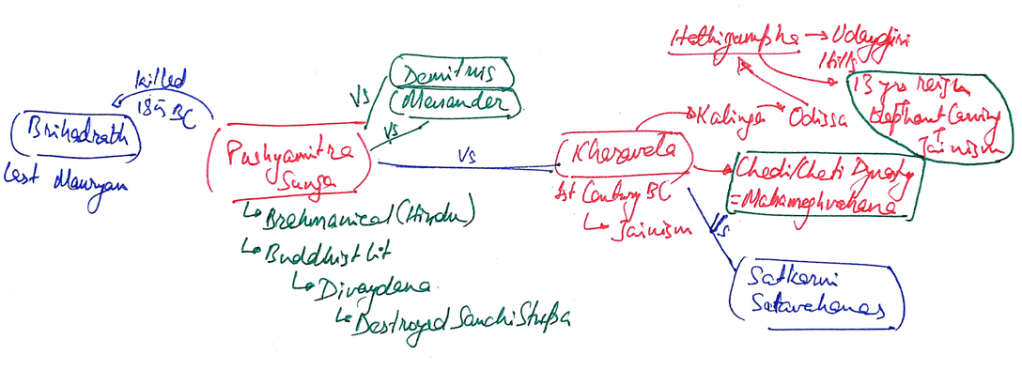
• Sungas of Vidisa: Pyshyamitra
• Kanvas of Pataliputra: Vasudeva
• Ganarajyas of Indo-Gangetic divide
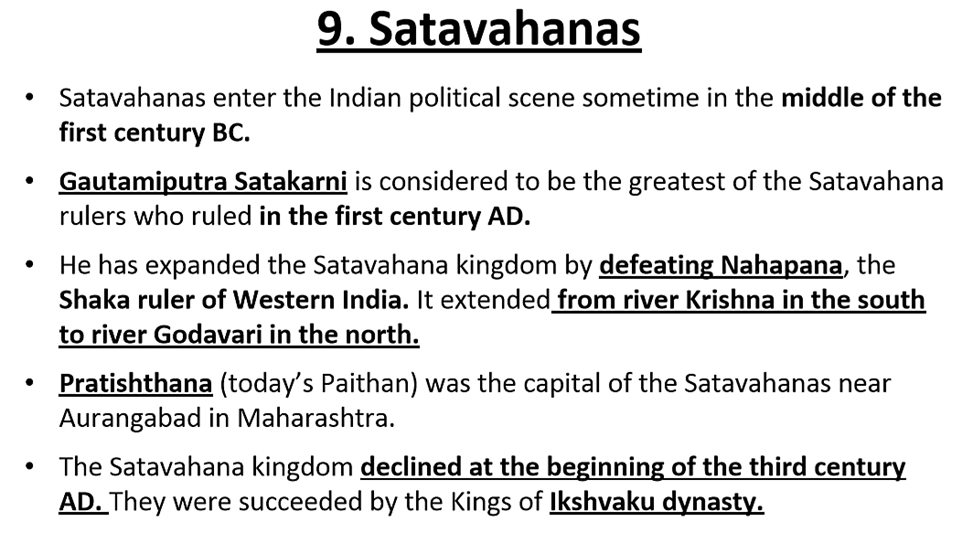
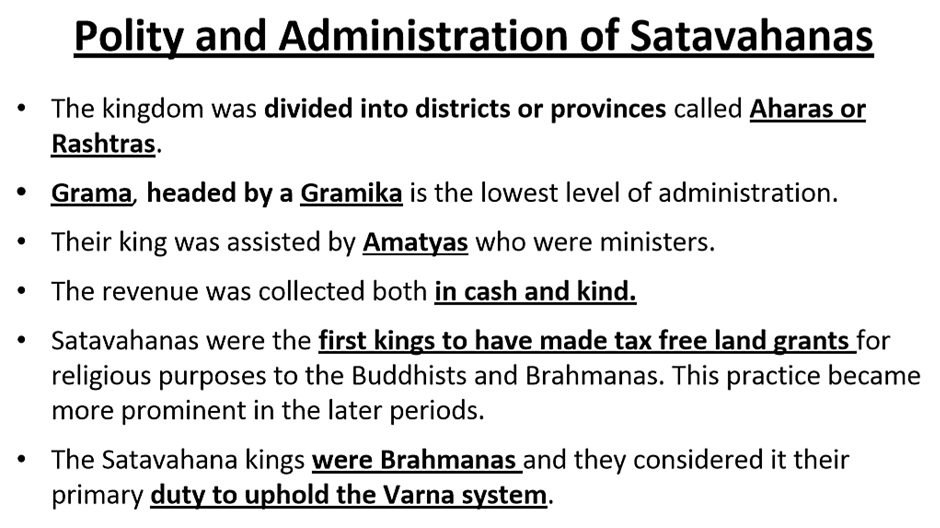
• Satavahanas of Deccan (Dhanyakatak &
Pratisthana): Sri Satakarni (Nanaghat Inscription) &
Gautamiputra Satakarni (Nasik Inscription)
• Satavahana Successors:
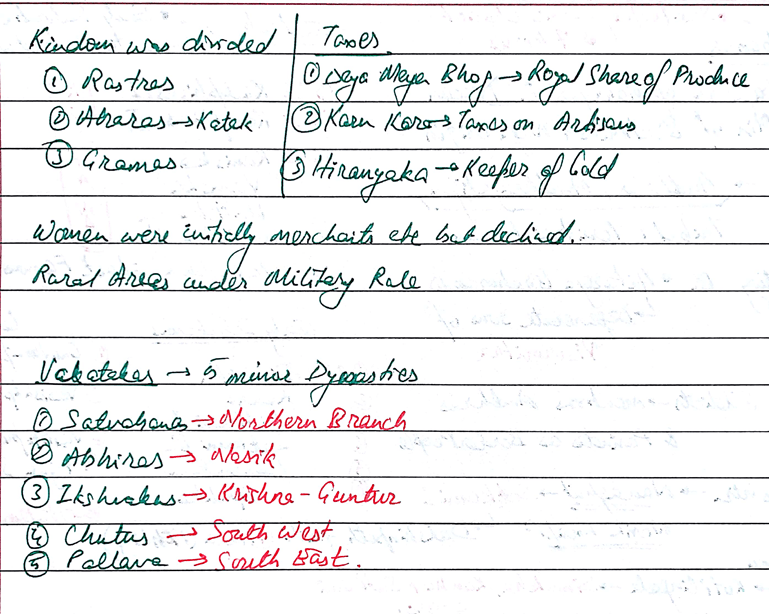
• Vakatakas, Abhiras, Ikshvakus, Early Pallavas, etc.
• Chetas of Kalinga:
• Kharavela (Hathigumpha Inscription)
• Sangam Dynasties of South:
• Cholas of Uraiyur (later Kaveripattinam or Puhar);
• Pandyas of Madurai;
• Cheras of Vanji or Karur
What is Sangam ?
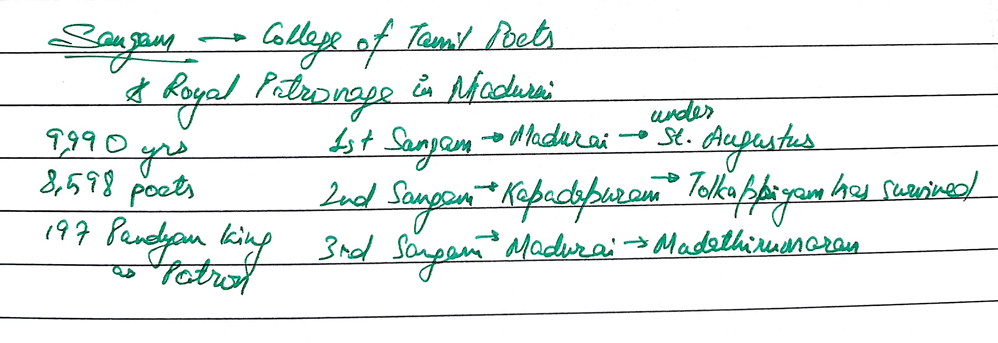
A college (sangam) of Tamil poets
under royal patronage in Madurai.
It refers to three sangams → lasted, at long intervals, for 9,990 years altogether and included 8,598 poets (including a few gods of the Saiva sect) as members and
197 Pandyan kings as patrons.
Gupta period– 320- 550 CE
Post-Mauryan Developments- 200- 300 CE
Founder of Sungha
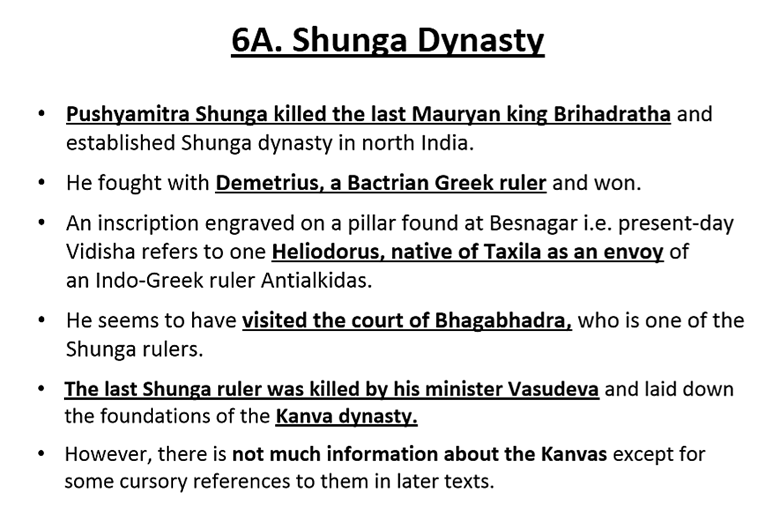
1.Pushyamitra Sunga
General / commander-in-chief under the Mauryas
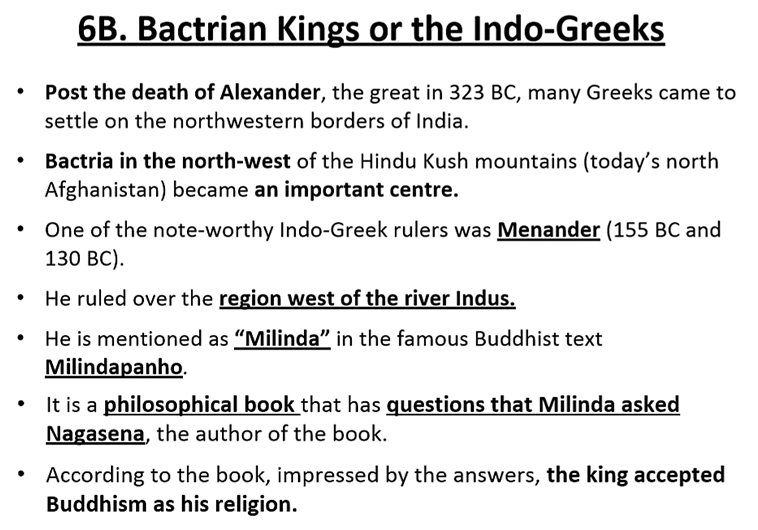
Defeated bactrian king Demetrius+ Menander
fought a campaign Protected against Kharavela of Kalinga
Initially ruled @ Vidisha
Buddhist lit–> Divayadana–> Destroyed Sanchi Stupa
Malvikagnimitram → Mentions about conflict between Sungas & Yajasena( Vidarbha
Patanjali
→ Contemporary of Pushyamitra Sunga
2.Agnimitra Sunga
Repaired the Stupa @ Sanchi
Constructed 2 new stupas also Barhaut & Sanchi
Malvikagnimitram → Hero of this work by Kalidasa
5/6th = Bhagbhadra/Bhagvata
Source→ Besnagar Pillar Inscription
Besnagar Pillar Inscription → By Heliodorus = greek ambassador in Sunga court
Inscription → The king describes himself as Bhagvata (worshipper of Lord Krishna) Garuda → Vishnu’s Vehicle
Last = Devbhuti
murdered by his minister Vasudeva Kanva
Q. Significance of Sungas??
defended the Gangetic valley revived Brahmanism and horse sacrifice
promoted the growth of Vaishnavism and the Sanskrit language
new form of art→ relief sculpture at Barhaut Contemprary of Indian way of life attitude towards the mundane world
Harshacharita → Mentions about the story of Kanva
| Travellers | Reign of Rulers | Contribution and Misc. |
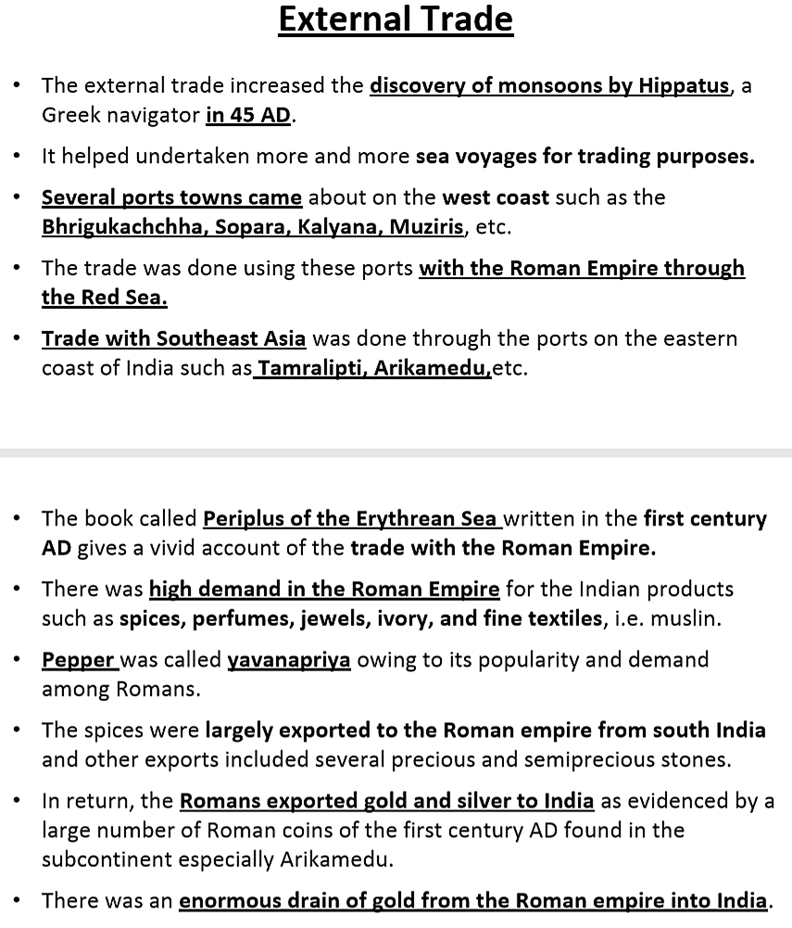
| Deimachos Period: (320-273 BC) Who: Greek Ambassador | Came India in the reign of Bindusara. | – |
| Megasthenes Period: (302-298 B.C.) Who: Greek ethnographer & ambassador. | Ambassador of Seleucus Nicator, who visited in the court of Chandragupta Maurya. | Wrote an interesting book Indica. |
| Ptolemy Period: 130 A.D. Who: From Greece and Geographer. | – | Wrote “Geography of India” which gives the description of Ancient India. |
| Fa-Hien Period: (405-411 A.D.) Who: Chinese Buddhist Monk | Came to India in the reign of Chandragupta II Vikramaditya. | – Visited the birth place of Buddha, Lumbini. – His Travelogue “Records of Buddhist Kingdoms”. – Wrote Fo-Kyo-Ki. |
| Hiuen-Tsang Period: (630-645 A.D.) Who: Chinese Buddhist Monk | Visited India during the reign of Harshavardhana. | – Came through Tashkent and Swat Valley. – Book is “Si-Yu-Ki or the records of western world”. |
| I-tsing Period: ( 671- 695 A.D.) Who: Chinese traveller | Visited India in connection with Buddhism. | – His works are Biographies of Eminent Monks. – Gives useful information about the social, religious and cultural life of the people of this country. |
| Al-Masudi Period: (957 A.D.) Who: Arab Traveller | – | Gives an extensive account of India in his work “Muruj-ul-Zahab”. |
| Al- Beruni or Abu Rehan Mahamud Period: (1024-1030 A.D.) Who: Muslim Scholar and Polymath | Came along with Mahmud Ghazni during one of his Indian raids. | – First Muslim Scholar to study India also known as founder of Indology. – Wrote “ Tahqiq-i-Hind/Kitab-ul-Hind. |
| Marco Polo Period: (1292-1294 AD) Who: Venetian Traveller | Visited South India in 1294 A.D during the reign of Pandyan ruler of Madurai, Madverman, Kulshekhara (1272-1311) | His work “The Book of Sir Marco Polo” which gives an invaluable account of the economic history of India. |
| Ibn Batuta Period: (1333-1347 A.D.) Who: Morrish traveller | Visited India during the reign of Muhammad-Bin-Tughlaq. | His book “ Rehla” (the travelogue) |
| Shihabuddin al-Umari Period: (1348 A.D.) Who: Came from Damascus | – | He gives a vivid account of India in his book “ Masalik albsar fi-mamalik al-amsar” |
| Nicolo Conti Period: (1420-1421 A.D.) Who: Venetian traveller | Came during the rule of Devraya I of Sangam Dynasty of Vijayanagar empire. | Given a graphic account of Vijayanagaras capital. |
| Abdur Razzaq Period: (1443-1444 A.D.) Who: Persian traveller, Ambassador of Shahrukh of Timurid dynasty. | – Came during the rule of Devraya II of Sangam dynasty of Vijaynagar Empire. – Came in India at Zamorin’s Calicut. | Given a brief account of this countryside, in his Matla us Saddin wa Majuma ul Baharain. |
| Athanasius Nikitin Period: (1470- 1474 A.D.) Who: Russian merchant | Visited South India in 1470. | -He describes the condition of the Bahmani kingdom under Muhammad III (1463-82). – His narrative “ The journey beyond 3 seas” |
| Duarte Barbosa Period: (1500-1516 A.D.) Who: Portuguese traveller | – | He has given a brief description of the government and the people of Vijayanagar Empire. |
| Domingo Paes Period: (1520-1522 A.D.) Who: Portuguese traveller | Visited the court of Krishnadeva Raya of Vijayanagar Empire. | – |
| Fernao Nuniz Period: (1535-1537 A.D.) Who: Portuguese merchant | Came during the rule of Achyutdeva Raya of Tuluv dynasty of vijayanagar Empire. | Wrote history of the empire from its earliest times of the closing years of Achyutdeva Raya’s reign. |
| John Hughen Von Linschotten Period: (1583 A.D.) Who: Dutch traveller | – | Given a valuable account of the social and economic life of South India. |
| William Hawkins Period: (1608-1611 A.D.) Who: Ambassador of James I, king of England. | Came in India at the reign of Jahangir,the great Mughal Emperor. William finch came with him. | – |
| Sir Thomas Roe Period: (1615-1619 A.D.) Who: Ambassador of James I, king of England. | Came in India at the reign of Jahangir,the great Mughal Emperor. | – |
| Edward Terry Period: (1616 A.D.) Who: Ambassador of Thomas Roe. | – | Describe about Indian social (Gujarat) behaviour. |
| Franciso Palsaert Period: (1620-1627 A.D.) Who: Dutch traveller stayed at Agra. | – | Gave a vivid account of the flourishing trade at Surat, Ahmadabad, Broach, Cambay, Lahore, Multan etc. |
| Peter Mundy Period: (1630-34 A.D.) Who: Italian traveller | Came in the reign of the Mughal Emperor, Shahjahan. | Gives valuable information about the living standard of the common people in the Mughal Empire. |
| John Albert de Mandesto Period: (1638 A.D.) Who: German traveller | Reached Surat in 1638 A.D. | – |
| Jeen Baptiste Tavernier Period: (1638-1663 A.D.) Who: French traveller | Visited India 6 times in the reign of Shahjahan and Aurangzeb. | – |
| Nicolao Manucci Period: (1653-1708 A.D.) Who: Italian traveller | He got service at the court of Dara Shikoh. | – |
| Francois Bernier Period: (1656- 1717 A.D.) Who: French physician and Philosopher. | Danishamand Khan, a noble of Aurangzeb was his patron. | – |
| Jean de Thevenot Period: (1666 A.D.) Who: French traveller | – | Given an account of cities like Ahmadabad, Cambay, Aurangabad and Golconda. |
| John Fryer Period: (1672-1681 A.D.) Who: English traveller | Given a vivid account of Surat and Bombay. | |
| Gemelli Careri Period: (1695 A.D.) Who: Italian traveller who landed at Daman. | – | His remarks on the Mughal emperor’s military organisation and administration are important. |
 MY BOX