New Island rules – IPZ 2019
MoEFCC–> notified Island Protection Zone (IPZ) 2019 for Andaman and Nicobar.
Changes in the IPZ are aligned with the Niti Aayog’s proposal for holistic development in the Islands.
IPZ 2019
- It allows eco-tourism projects 20 meters from the high tide line (HTL) in smaller islands like Baratang, Havelock, and Car Nicobar.
- In case of larger islands, 50 meters from the HTL is permitted.
- It allows for eco-tourism activities like mangrove walks, tree huts and nature trails in island coastal regulation zone(ICRZ) IA (ICRZ 2018: ICRZ IA, provides areas classified as the most eco-sensitive region of the islands which includes turtle nesting grounds, marshes, coral reefs etc)
- The notification also allows for construction of roads, roads on stilts by reclaiming land in exceptional cases for defense installations, public utilities or strategic purposes in eco-sensitive zones.
- In case construction of such roads pass through mangroves, a minimum three times the mangrove area destroyed during the construction process shall be taken up for compensatory plantation of mangroves elsewhere.
- High tide line (HTL) is defined as line up to which highest high tide reaches in spring tides.
- It is delineated by walking over or remote sensing data or by helicopter survey.
- The Low Tide Line(LTL) is the limit up to which the lowest low tide recedes during spring tide.
Mt. Makalu
Indian Army has launched its maiden expedition to Mount Makalu in Mar-May 2019.
Mt. Makalu is fifth highest Peak on the Earth with its height 8,463m. Mt. Makalu resides in the eastern Himalayas range just 19 Km southeast of the giant Mt. Everest on the border of Nepal and China.
It is four-sided, pyramid-shaped mountain, lies around 20 Km southeast of Mount Everest, the highest mountain in the world, in the Mahalangur Himalaya.
Makalu-Barun National Park
Makalu lies within Nepal’s Makalu-Barun National Park and Conservation Area, a 580-square-mile parkland that protects pristine ecosystems from tropical rainforests to alpine tundra above 13,000 feet.
- The remote Barun Valley below Makalu is particularly important and managed as a Strict Nature Reserve to preserve its unique qualities and ecosystems.
- Botanists have identified 3,128 species of flowering plants, including 25 species of rhododendron.
- Many animals also live here, with over 440 bird species and 88 mammal species, which includes a red panda, snow leopard, and the rare Asian golden cat.
Energy Transition Report by WEF
World Economic Forum has recently published Fostering Effective Energy Transition 2019
- The report contains the Energy Transition Index (ETI), which compares the energy sectors of 115 countries and analyses their readiness for energy transition.
Access to energy has improved and currently, less than 1 billion people are living without access to electricity. On average, 135 million people gained access to electricity each year between 2014 and 2016
lack of readiness among the world’s largest emitters.
Coal consumption increased in 2018, after declining for three years along with an increase in commodity prices and slower-than-needed improvements in energy intensity this has contributed to the slowdown in Energy Transition.
- India is amongst the countries with high pollution levels and has a relatively high CO2 emission intensity in its energy system.
- Despite this, India has made significant progress in improving energy access in recent years.
- India has made fast progress towards universal electrification due to strong political commitment, a stable policy regime, use of grid expansion and decentralized generation sources, and a supportive environment for investment in infrastructure.
- Global coal consumption grew in 2017 due to an increase in demand in the Asia-Pacific region, including in India and China.
Energy Transition Index
- Energy transition index ranks countries on how well they are able to balance energy security and access with environmental sustainability and affordability.
- ETI has ranked 115 economies covering 40 indicators.
- Sweden is at the top followed by Switzerland and Norway in the top three.
- Among major economies, the United Kingdom (UK) is ranked seventh. Singapore has been ranked thirteenth, while Germany, Japan, and the US have bagged the seventeenth, eighteenth and the twenty-seventh place respectively.
- India has moved up two places from last year to rank 76th on a global energy transition index.
- China is ranked lower than India at the 82nd position.
- India is the second best in the BRICS bloc of emerging economies, with Brazil being the best at 46th place globally.
- However, India is the only amongst the five economies to improve its rank since last year.
4th Meet of UN Environment Assembly
4th meet of UN Environment Assembly (UNEA)
was recently held in Nairobi, Kenya. Theme= “Innovative solutions
for environmental challenges and sustainable consumption
and production.”
India piloted resolutions on 2 important global
environmental issues relating to Single-use Plastics
and Sustainable Nitrogen management.
The final deceleration of the meet asked to significantly
reduce single-use plastic products by 2030.
GOI has pledged in 2018 to
eliminate single-use plastics from India by 2022.
GOI has amended the Hazardous and
Other Wastes (Management and Transboundary Movement)
Rules, 2016 to include prohibition on the import of solid
plastic waste in special economic zones (SEZ) and by
export-oriented units (EOUs).
The amendment has been done keeping into
consideration the ‘Ease of Doing Business’ and boosting
‘Make in India’ initiative by simplifying the procedures
under the Rules while upholding the principles of
sustainable development and ensuring minimal impact
on the environment.
India’s imports of solid plastic waste quadrupled to
48,000 tonnes in Fiscal Year 2017-18 from 2016-18.
India had banned the import of plastic waste –
particularly PET bottles –in 2015 because of an inability
to recycle them.
However, the Centre allowed agencies in special
economic zones (SEZ) to import them in 2016. It was
the legal loophole.
European Parliament Bans Single-Use Plastics
EU member states will have two years to implement the directive, i.e. the ban will come into force by 2021 in all EU member states.
- By 2025, plastic bottles should be made of 25% recycled content, and by 2029, 90% of them should be recycled.
- The ban targets the top 10 disposable plastic products including plates, balloon sticks, food and beverage containers made of expanded polystyrene and all products made of oxo-degradable plastic.
- Tobacco companies will be required to cover the costs for public collection of cigarette stubs, which are the second most littered single-use plastic item.
EU recycles only 25% of the 25 million tonnes of plastics waste it produces every year.
- Growing concerns about plastic pollution in oceans and stories of dead whales with plastic in their stomachs. Marine litter has come under the spotlight because 85% of it is plastic. E.g.: Great Pacific Grabage Patch
- China’s decision to stop processing waste have prompted the bloc to take more drastic steps to tackle the issue.
President’s Visit To Croatia
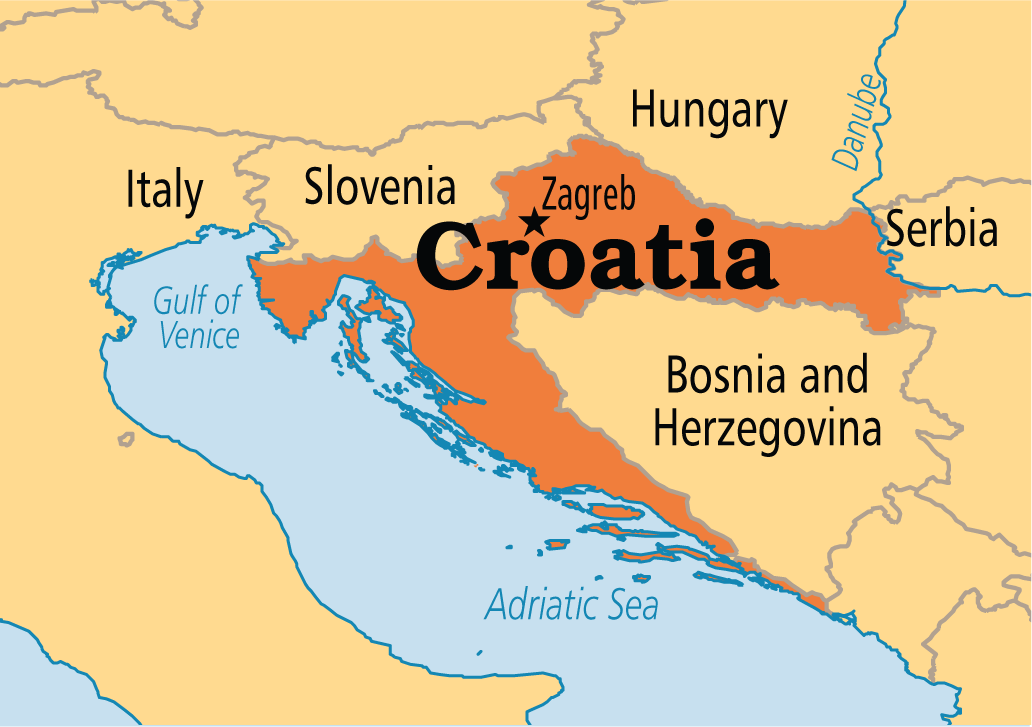
During the first leg of his three-nation tour to Croatia, Bolivia, and Chile, President of India completed his visit to Croatia.
- India and Croatia signed 4 MoUs: 2 in culture, 1 each in tourism, and sports.
- President of India was also conferred with Croatia’s highest civilian award – the Grand Order of the King of Tomislav.
- The two countries also agreed to work together to develop a strong global response to defeat terrorism in all its forms and manifestations.
India-Croatia Relations
- Relations between India and Croatia have been friendly since the days of the former Yugoslavia.
- The Breakup of Yugoslavia occurred as a result of a series of political upheavals and conflicts during the early 1990s.
- Disintegration gave birth to six new countries namely: Bosnia and Herzegovina, Croatia, Macedonia, Montenegro, Serbia, and Slovenia.
- Josip Broz Tito who was president of Yugoslavia for more than three decades maintained close relations with the then Indian leadership.
- Indian PM Jawaharlal Nehru and Tito were also pioneers of the Non-Aligned Movement.
Non-Aligned Movement
- The Non-Aligned Movement was formed during the Cold War as an organization of States that did not seek to formally align themselves with either the two superpower blocs United States or the Soviet Union but sought to remain independent or neutral.
- Key role in this process was played by:
- Gamal Abdel Nasser, Head of State of Egypt
- Kwame Nkrumah, President of Ghana,
- Jawaharlal Nehru, Prime Minister of India,
- Ahmed Sukarno, President of Indonesia
- Josip Broz Tito, President of Yugoslavia,
- These leaders later became the founding fathers of the movement.
- The basic concept for the group originated in 1955 during discussions that took place at the Asia-Africa Bandung Conference held in Indonesia.
Turing Award, 2018 by by the Association for Computing Machinery (ACM)
- The 2018 Turing Award has been given to a trio of researchers who laid the foundations for the current boom in Artificial Intelligence (AI).
- Yoshua Bengio + Geoffrey Hinton+ Yann LeCun — sometimes called the ‘Godfathers of AI’ — have been recognized with the annual prize for their work developing the AI subfield of deep learning.
Employee Stock Purchase Scheme
- Recently the Public Sector Banks have raised or are in the process of raising around Rs 5,000 crore from employees through the employee stock purchase scheme (ESPS).
- An employee stock purchase scheme (ESPS) is a company-run program in which participating employees can purchase company shares at a discounted price.
- Companies often reward their employees with their stock, either in the form of employee stock option plans (Esops) or employee stock purchase schemes (ESPSs).
- Esops are stock options granted to employees over a vesting period, where the employee is given the right to purchase the company’s shares at a predetermined price or the exercise price.
- ESPSs allow employees to use their salary to purchase the stock of the company, usually at a discounted price. Unlike Esops, ESPS holders do not have any option, but are mandated to pay the exercise price usually by way of monthly deductions from their salary.
WEF annual meeting- 2019
World Economic Forum Annual Meeting 2019 held in Davos, Switzerland in January 2019–> Theme= Globalization 4.0
- Globalization is a phenomenon driven by technology and the movement of ideas, people, and goods.
- Globalization 4.0 is latest stage of globalization which involves cutting-edge new technologies like artificial intelligence that powers forward with the explosion of information technology.
- Globalization 1.0
- It was pre-World War I globalization, which was launched by a historic drop in trade costs.
- This globalization came with almost no government support.
- There was no global governance.
- Globalization 2.0
- It is the post-World War II phase where trade in goods was combined with complimentary domestic policies.
- The market was in charge of efficiency while the government was in charge of justice.
- It saw the establishment of institute-based, rule-based international governance, specifically the UN, IMF, World Bank, GATT/WTO, International Labor Organization etc.
- Globalization 3.0
- It created a new world of manufacturing in which high-tech was combined with low wages.
- This was achieved through establishment of global supply chains as factories crossed international borders.
- It was variously called New Globalization, Hyper globalization, Global value chain evolution.
Globalization 4.0
- Major turbulence for Service Sector: While Globalization 1.0, 2.0 and 3.0 were mainly a concern of people who made/manufactured products for a living (since globalization focused on things that we made), Globalization 4.0 is going to hit people in the service sector.
- Closely integrated with Industry 4.0: Ever-faster data connection speeds and new artificial intelligence tools like machine translation, big data are opening up services jobs in rich countries like architecture, accounting, and web design to competition from practitioners in emerging economies.
- Newer modes of Migration: Due to faster data connection as well as nature of work which may involve no physical presence there may be a global tele-migration in which the skilled migrants never have to leave home.
WEF annual meeting- 2020
50th edition of the WEF, held in January 2020 focussed on establishing stakeholder capitalism as a way of addressing the world’s greatest challenges, ranging from the societal divisions created by income inequality and political polarisation to the climate crisis we face today.
Based in Geneva, Switzerland, WEF is a not-for-profit International organization established in the year 1971.
Theme of WEF 2020 is Stakeholders for a Cohesive and Sustainable World.
Protectionism is the biggest problem that the world is facing and the 50th summit of WEF is being held in this backdrop
Because of the US-China trade war, there has been a distinct fall in investment flows and trade flows. World trade faced renewed headwinds in 2018 as trade tensions and economic policy uncertainty rose sharply.
India+ World Trade
FDI: India needs to attract more FDI. India needs to get a place for manufacturing exports and if there are tariff and non-tariff barriers they need to be breached. Reforms are needed such as better infrastructure, land-labor reforms and lesser regulations.
Matching up to the 6 key themes: India’s performance in regards to attracting FDI will depend on how these five selling points match with the 6 key themes that WEF has outlined, namely: Economy, Ecology, Technology, Society, Geopolitics and Industry.
Focussing on exports: Almost 40% of the world’s GDP is contributed by the US and China. The simple formula to increase GDP of a country is to increase consumption, plus private investments, plus government expenditures, plus exports, minus imports.
- For India, to grow fast and achieve the objective of a $5 trillion economy it needs to step up exports and get a bigger share in the world exports.
2nd Global Energy & Carbon Dioxide Emissions
International Energy Agency (IEA) has released its 2nd Global Energy and CO2 Status Report.
1st time that the IEA assessed the impact of fossil fuel use on global temperature increases.
- It found that CO2 emitted from coal combustion was responsible for over 0.3°C of the 1°C increase in global average annual surface temperatures above pre-industrial levels.
- This makes coal the single largest source of global temperature increase.
Global energy consumption in 2018 increased at nearly twice the average rate of growth since 2010, driven by a robust global economy (expanded by 3.7% in 2018) and higher heating and cooling needs in some parts of the world.
- China, the United States, and India together accounted for nearly 70% of the rise in energy demand. These countries also accounted for 85% of the net increase in emissions.
- Emissions declined for Germany, Japan, Mexico, France and the United Kingdom.
- Weather conditions in 2018 were also responsible for increase in global energy demand as average winter and summer temperatures in some regions approached or exceeded historical records.
CO2 emissions stagnated between 2014 and 2016, even as the global economy continued to expand.
- Natural as which emerged as the fuel of choice for the year 2018, accounting for nearly 45% of the increase in total energy demand.
- Demand for all fuels rose, with fossil fuels meeting nearly 70% of the growth for the second year running.
- Nuclear also grew by 3.3% in 2018, mainly as a result of new capacity in China and the restart of reactors in Japan. Worldwide, nuclear generation met 7% of the increase in energy demand.
- India’s energy demand outpaced global demand growth in 2018.
- India emitted 2,299 million tonnes of carbon dioxide in 2018, a 4.8% rise from 2018 led by coal (power generation) and oil (transport), the two biggest contributors to pollution.
- Although the nation’s per capita release remained low at 40% of the global average.
- India’s emissions growth in 2018 was higher than that of the United States and China — the two biggest emitters in the world — and this was primarily due to a rise in coal consumption.
Odissi
- It is one of the pre-eminent classical dance forms of India which originated in the Hindu temples of the eastern coastal state of Odisha in India.
- It is a dance of love and passion touching on the divine and the human, the sublime and the mundane.
- Odhra Magadha, mentioned in Natya Shastra can be identified as the earliest precursor of present day Odissi dance.
- The techniques of dance movement are built around the two basic postures of the Chowk and the Tribhanga.
- The chowk is a position imitating a square – a very masculine stance with the weight of the body equally balanced.
- The tribhanga is a very feminine stance where the body is deflected at the neck, torso and the knees.
- An Odissi orchestra essentially consists of a pakhawaj player (usually the Guru himself), a singer, a flutist, a sitar or violin player and a manjira player.
Mankading
- Recently, in a cricket match of the Indian Premier League 2019 (IPL-2019) a batsman was dismissed in a run out popularly called ‘Mankading’.
- Mankading’ is a method of run out where a bowler dismisses a non-striker by hitting the bails before bowling when the latter is outside the crease.
- It is named after an Indian bowler Vinoo Mankad (awarded Padma Bhushan in 1973). Vinoo Mankad, in the India’s tour of Australia in 1947/48 ran out Bill Brown not once but twice.
- This infuriated the Australian media, and running someone out in this way is now referred to around the world as “Mankading”.
- While perfectly legal, some contend that by convention, a bowler should at least warn a batsman who persists in backing up too far before dismissing him in that fashion.
- According to rules of Cricket:
- Non-striker leaving his/her ground early: If the non-striker is out of his/her ground from the moment the ball comes into play to the instant when the bowler would normally have been expected to release the ball, the bowler is permitted to attempt to run him/her out.
- Whether the attempt is successful or not, the ball shall not count as one in the over.
- The Laws of Cricket were amended several times after this incident, but it was decided to retain this form of run out to disallow batsmen from stealing runs.
- There have been instances where the bowlers refrained from using this method, like the 1987 World Cup match between Pakistan and West Indies.
GENDER WAGE GAP
Oxfam India has recently released a report titled ‘Mind the Gap: The State of Employment in India.’
Pay level: In 2015, 92%of women and 82% of men were earning a monthly wage less than Rs.10,000, far below the Seventh Central Pay Commission (2013) recommendation of Rs.18,000 per month.
- Women on an average are paid 34% less than similarly qualified male workers for performing same tasks.
- Based on National Sample Survey Office (2011-12) estimates–>women are paid less.
- Over-representation of women in unpaid care work: The report pointed out that if unpaid care and household activities are included in the NSSO’s definition of work, the Female Labour Force Participation Rate (FLFPR) in 2011-12 would rise from 20.5 % to 81.7%, more than that of men.
- Divergences in FLFPR:
- Caste Factor: Muslim women are concentrated in household manufacturing, Schedule Caste (SCs) in construction and services such as waste collection while non-SCs generally work in education and health services.
- Education sector accounts for over 1 in 7 urban women workers.
Oxfam India is an arm of Oxfam International that is registered as ‘Non-profit’ under Section 8 of the Indian Companies Act, 2013.
National Sample Survey Office (NSSO)
- It is an office under Ministry of Statistics and Programme Implementation (MoSPI).
- It is responsible for conduct of large scale sample surveys in diverse fields such as social,economic,industrial etc, on All India basis.
World’s Longest Salt Cave
Israeli researchers have claimed that they have discovered the world’s longest salt cave near the dead sea.
- The cave named Malham, stretching over 10 kilometers (6.25 miles) runs through Mount Sodom, Israel’s largest mountain, and spills out to the southwest corner of the adjacent Dead Sea.
- In the cave, thousands of salt stalactites hang from the ceilings, and some of the walls have salt crystals.
STATE OF THE GLOBAL CLIMATE: WMO
- 2018 = 4th warmest year on record.
- CO2 concentrations have continuously increased in 2018.
- Mean Global Mean Sea Level for the period from January to July 2018 has been 2 to 3 mm higher than for the equivalent period in 2017
- 90% of the energy trapped by greenhouse gases, goes into the oceans. Ocean Heat Content provides a direct measure of the energy that accumulates in the upper layers of the ocean.
- For each 3-month period in 2018, the ocean heat content in the upper 700m and upper 2000m were either the highest or second highest on record.
- Past decade, the oceans absorbed around 25% of CO2 emitted by humans lowers the pH of the ocean= Acidification–> o.1pH decrease in surface sea water–> affecting mollusks and reef-building corals,
- The extent of Arctic sea ice was below average throughout 2018 and was at record-low levels for the first two months of the year.
Non-Convertible Debentures
- Debentures are long-term financial instruments that are issued by companies to borrow money.
- Some debentures have a feature of convertibility into shares after a certain point of time at the discretion of the debenture holder.
- The debentures which cannot be converted into shares are called non-convertible debentures (or NCDs).
- There are two types of NCDs-secured and unsecured.
- A secured NCD is backed by the assets of the company. If the company fails to pay the obligation, the investor holding the debenture can claim that through liquidation of those assets. Contrary to this, there is no backing in unsecured NCDs if company defaults.
India-Oceania Relations
- India’s trade relation with Oceania has been dominated by Australia and New Zealand.
Australia=~ US$15.6 billion in 2016.
New Zealand=~ US$ 1.91 billion.. ( 11th largest bilateral trading partner (2017))
India also has a significant trade relationship with the Pacific island nations with Fiji and Papua New Guinea dominating the relations. India’s trade with the Pacific Islands stood at US$ 228 million in 2012.
Pacific Island Forum (PIF)
- The PIF was formed in 1999 as a successor to the earlier South Pacific Forum set up in 1971.
- Regional cooperation has grown steadily under the aegis of the PIF.
- India is a dialogue partner of the Pacific Island Forum (PIF).
Forum for India–Pacific Islands Cooperation (FIPIC)
- Forum for India–Pacific Islands Cooperation (FIPIC) was launched during the visit of Prime Minister of India to Fiji in November 2014.
- Member Countries – India and 14 Pacific Island countries, namely Fiji, Cook Islands, Kiribati, Marshall Islands, Micronesia, Nauru, Niue, Palau, Papua New Guinea, Samoa, Solomon Islands, Tonga, Tuvalu, and Vanuatu.
Water: Leaving No One Behind
- The UN defines safe water as that which is free from contamination, accessible on the premises and available when needed.
- Water is crucial for human survival, healthy ecosystems, socio-economic development and also for food and energy production.
- Though nearly 70% of the world is covered by water, only 2.5% of 70%= fresh water.
- <1% of the freshwater= easily accessible in lakes and rivers.
- 1/3 Of the remaining fresh water = underground water supplies or well springs while the other
2/3 are locked away in ice caps or glaciers.
Water Discrimination-> Age and Gender are the foremost reason for discrimination
Other reasons for water discrimination include race, ethnicity, religion, birth, caste, language and nationality.
Global Water Crisis–> 844 million people lack access to clean water. Out of this, 159 million people depend on surface water to meet their basic needs.
Over 2 billion people live without access to improved sanitation.
Each year, at least one million people are killed by water, sanitation and hygiene related disease.
In 2017, water played a major role in conflict in at least 45 countries.
Day Zero Instances
- Day Zero is a situation when taps in a region start running dry.
- The Capital of South Africa ‘Cape Town’, last year, launched a countdown to the day when tap water would be cut-off to millions of residents as a result of a three year drought.
- Brazil’s Sao Paulo faced its own Day Zero in 2015. The city turned off its water supply for 12 hours a day forcing many businesses and industries to shut down.
- In 2008, Barcelona in Spain had to import tankers full of fresh water from France.
U.N. Initiatives to Save Water
- The United Nations Water Conference (1977),
- the International Drinking Water Supply and Sanitation Decade (1981-1990),
- the International Conference on Water and
- the Environment (1992) and the Earth Summit (1992) – all focused on the vital resource, Water.
- The ‘Water for Life’ International Decade for Action 2005-2015 helped around 1.3 billion people in developing countries gain access to safe drinking water and drove progress on sanitation as part of the effort to meet the Millennium Development Goals.
- The most recent initiative is the 2030 Agenda for Sustainable Development that aims to ensure availability and sustainable management of water for all by the year 2030
Water Crisis in India
- India tops the list of countries with the most number of people living with water scarcity.
- As many as 1 billion people in India live in areas with physical water scarcity, of which 600 million are in areas of high to extreme water stress.
- Approximately 330 million people from 302 districts were affected by droughts in 2016.
- Over 21% of the country’s diseases are water related. In 2015, India lost over 1 lakh children under the age of five to diarrheal diseases.
- As per a report by NITI Aayog, Bengaluru will soon be among one of the 11 cities in the world to run out of ground water.
- The report also states that the ‘Day Zero’ will hit Bengaluru and 20 other major cities (including Delhi) in India by the year 2020 affecting an estimated 100 million people.
India-Specific Reasons
- Though India receives about 1.3m rainfall every year but distribution of the same over space and time is a problem.
- India gets about 95% of its rainfall during monsoons.
- North East India receives about 30ms of rainfall every year, one of the highest in the world.
- But parts of Rajasthan and some other parts of India receive less than 200mm, making these places one of the driest places in the world.
- Thus distribution of water over time and geography of India becomes difficult.
- Overexploitation and contamination of groundwater.
- Lot of lakes, rivers and streams getting drying up.
- Pollution of surface water.
- Lack of efficiency in water management.
| 2018 | January | General | Statistics | India ranks 177 out of 180 in Environmental Performance Index, among the bottom five countries, and plummeting 36 places from 141 in 2016.[41] |
| 2019 | Air pollution | Program | India launches ‘The National Clean Air Programme’ with tentative national target of 20%-30% reduction in PM2.5 and PM10 concentrations by 2024, considering 2017 as the base year for comparison. It would be rolled out in 102 cities that are considered to have air quality worse than the National Ambient Air Quality Standards.[45] | |
| 2019 | March | General | Statistics | According to Greenpeace, 22 of world’s 30 most polluted cities are in India.[46] |
| 2019 | June | Air pollution | Research | The Centre for Science and Environment, an environment think tank, reports that life expectancy in India has gone down by 2.6 years due to deadly diseases caused by air pollution. The report reveals that outdoor and household air pollution together are causing deadly diseases.[47] |
| 2019 | June | Air pollution | Research | Study reports on air pollution killing more than 100,000 children under five every year.[48] |
| 2020 | Air pollution | Program | India is expected to advance the date for stricter fuel and emission norms by this time, so new vehicles sold after it would be far cleaner.[43] | |
| 2030 | Air pollution | Policy | India pledges a 33-35% reduction in the “emissions intensity” of its economy by the time, compared to 2005 levels.[26] | |
| 2030 | Air pollution | Policy | All new urban buses are planned to be fully electric by the time.[26] |
Venezuela Humanitarian Aid Operation
- The International Federation of Red Cross and Red Crescent Societies (IFRC) will channel humanitarian aid to the crisis-hit Venezuela, potentially helping ease chronic hunger and disease.
- The first supplies would include medical equipment, surgical kits and power generators, following two major blackout.
- Country’s hyperinflationary crisis has made food and medicine unaffordable for most citizens, fueling widespread malnutrition
International Federation of Red Cross and Red Crescent Societies
- The International Federation of Red Cross and Red Crescent Societies (IFRC) is a global humanitarian organization, which coordinates and directs international assistance following natural and man-made disasters in non-conflict situations.
- It was founded in 1919 in Paris in the aftermath of World War I.
- It is headquartered in Geneva, Switzerland.
- It is the world’s largest humanitarian network which is guided by seven Fundamental Principles: Humanity, impartiality, neutrality, independence, voluntary service, universality and unity.
Indian Red Cross Society
- Established in 1920 under the Indian Red Cross Society Act and incorporated under Parliament Act XV of 1920.
- President of India is designated the President of the Indian Red Cross Society and Union Health Minister is the Chairman of the Society.
Fakim Wildlife Sanctuary
- Recently, a forest guard at the Fakim Wildlife Sanctuary in Nagaland, has been awarded Earth Day Network Star, for the protection of forests and wild animals in and around Fakim sanctuary.
- The award is given by a U.S.-based international environment organisation that engages with green groups in 195 countries.
- The Fakim Wildlife Sanctuary in located Kiphire district of Nagaland. It is spread over 642 hectares.
- It was established in the year 1983, and it lies along the international border with Myanmar.
- Many wildlife animals such as leopards, tigers, wild buffaloes, hoolock gibbons and mithun are found.
- Hornbill, the most popular bird in Nagaland (It can be noted that Blyth’s Tragopan is the State Bird of Nagaland) is also abundantly found in the Fakim Wildlife Sanctuary.
DRDO’s Bio-Digester
Bio-digester consists of a bio-toilet attached with bio-digester tanks that converts human faeces into biogas and reusable water via anaerobic microbial inoculum (a material used for inoculation).
customised based on the requirements of the local conditions, and can operate in temperatures ranging from minus (-) 20 degrees to 50 degrees.
Raisina Dialogue
Raisina Dialogue is a multilateral conference held annually in New Delhi, India. Since its inception in 2016, the conference has emerged as India’s flagship conference on geopolitics and geo-economics. The conference is hosted by the Observer Research Foundation, an independent think tank, in collaboration with the Ministry of External Affairs of India.
Theme for the 2019 conference was “New Geometrics | Fluid Partnerships | Uncertain Outcomes“. The theme represents a logical progression from the previous edition, which focused on Managing Disruptions and Transition.
“A World Reorder” is indeed an appropriate and timely theme.
2020— Hosted by ORF + MEA–> 5th edition of Raisina Dialogue is being held in New Delhi.
1st edition in 2016.
Title= Navigating the Alpha Century”.
A session will be held on the Indo-Pacific, including military or naval commanders from the “Quadrilateral or Quad (Australia, India, Japan, and the United States)”. It will also have a French Defence official on the panel this year.
Coffee GI tag
New and emerging concerns in Indian Ocean neighbourhood
Article = ‘New and emerging concerns in Indian Ocean neighbourhood’… published in ‘Raisina Debates in ORF’ on 25th March, 2019.
The article talks about growing Chinese influence in the Indian Ocean Region and challenge it poses for India’s maritime security
Advisory opinion by Hague ICJ–> Chagos Islands in the Indian Ocean belonged to Mauritius, and not to the UK.
Sri Lanka, Maldives and India are the other shared stake-holders in rule based system prelevant in IO.
ISSUE–> Britain detached the Chagos Islands from Mauritius in 1965 3 years before Mauritian independence, calling it British Indian Ocean Territory (BIOT).
ndigenous inhabitants of BIOT were deemed unnecessary by both London and Washington. In a shameful episode, officials knowingly misrepresented the Chagossians as migrant workers and forcefully deported them. Ever since, the Chagossians have campaigned for a restoration of their right to return.
ICJ advisory opinion that Chagos Islands belongs to Mauritius and not to the UK change the geopolitical tilt in the region from favouring US to a more tentative position.
Despite Mauritius’ declaring–> allow US to continue using American military base in Diego Garcia, there is still ambiguity as to how the Mauritius will react in the decades to come. A lot depends on the relative political and economic power of the US, China and India, at any given point, in the medium to long term.
Aspirations of the Chinese Navy to register its presence in the region, and then follow it up by projecting power as part of its ‘Far Seas’ operating philosophy can be seen in Hambantota, where China is in possession of Sri Lankan real estate, for developing a port and Special Economic Zone.
Maldives= BUffer zone surrounding India’s maritime strategic space
= another island is caught somewhere in between, which has shared a strenuous relation with India in the recent past and has received generous aids from China, a feature of the so called ‘debt trap’ policy.
The concept of strategic buffer zones in the naval domain is enshrined in great power politics and any nation getting a head start in it can safely avoid anti-access and area denial tactics from their adversaries.
New Delhi should look to operationalise logistical agreements with France and the United States, in order to upgrade naval relations and allow its own bases to be used for logistical support by the French and American navies.
 MY BOX