Court katcheri
Supreme Court (SC) asserted that it was time to define the limits of sedition.
- Protected 2 Television channels from any coercive action by the Andhra Pradesh government for their reportage of the COVID-19 pandemic in the State.
- 3-judge SC Bench pointed out indiscriminate use of the sedition law against critics, journalists, social media users, activists and citizens for airing grievances about the governments’ COVID-19 management, or even for seeking help to gain medical access.
The ambit and parameters of the provisions of Sections 124A (sedition), 153A and 505 of the Indian Penal Code 1860 would require interpretation.
- Right of the electronic and print media to communicate news, information and the rights, even those that may be critical of the prevailing regime in any part of the nation.
- Besides, the SC had categorically told the States not to initiate penal action against the critics of COVID-19 management measures in an earlier order.
- ‘Right to be forgotten’ is the right to have publicly available personal information removed from internet search, databases, websites or other public platforms from public access.
- In 2017, the Supreme Court recognised the right to be forgotten as being under the ambit of the right to privacy under the Constitution.
Context:
- The Delhi High Court recently ordered the removal of one of its own judgments from easy access
Delhi High Court granted bail to 3 students of Jawaharlal Nehru University and Jamia Millia Islamia arrested under the Unlawful Activities (Prevention) Act (UAPA) in connection with the northeast Delhi riots in 2020.
court criticised the Delhi Police for casually invoking provisions of UAPA against the three accused noting that the line between the constitutionally guaranteed “right to protest” and “terrorist activity” had been blurred.
- e fact that the definition of ‘terrorist act’ in UAPA is wide and somewhat vague, the phrase ‘terrorist act’ cannot be permitted to be casually applied to criminal acts that fall squarely within the definition of conventional offences.
- The court cautioned that imposing extremely grave and serious penal provisions engrafted in sections 15, 17 and 18 of the UAPA upon people would undermine the intent and purpose of the law.
The government has concluded that there had been concerning lapses in the conduct and protocols followed for the Nagaland bat study.
Accessing justice online
E-Courts Project was conceptualized on the basis of the “National Policy and Action Plan for Implementation of Information and Communication Technology (ICT) in the Indian Judiciary – 2005” submitted by e-Committee, Supreme Court of India with a vision to transform the Indian Judiciary by ICT enablement of Courts.
- E-committee is a body constituted by the GOI in pursuance of a proposal received from the Hon’ble CJI.
- monitored and funded by the Department of Justice, Ministry of Law and Justice. to get district courts.
- The e-Courts project envisages:
- To develop, install & implement decision support systems in courts.
- To automate the judicial processes to the extent possible.
- Phases I and II of the e-Courts project had dealt with the digitisation of the judiciary, i.e., e-filing, tracking cases online, uploading judgments online, etc.
Future plan + aspects
- Phase III of the e-Courts project continues with its commitment to the digitization of court processes, and plans to upgrade the electronic infrastructure of the judiciary.
- The vision document also envisages–> large-scale data collection exercise–> used for future policymaking + make suitable interventions.
- draft document proposes a 360-degree approach to data collection, wherein a 360-degree profile of each person would be created by integrating all of their interactions with government agencies into a unified database
- Phase III proposes an “ecosystem approach” to justice delivery, under which it suggests a “seamless exchange of information” between various branches of the State, such as between the judiciary, the police and the prison systems through the Interoperable Criminal Justice System (ICJS).
In a first for the Maldives, Foreign Minister Abdulla Shahid has been elected the President of the UN General Assembly for 2021-22.
- resident-elect raised his voice against vaccine nationalism stating that it would destroy countries’ efforts to eradicate the pandemic.
- disparity in vaccination coverage in developed countries and the rest of the world unacceptable.
- Human Rights would be a central theme at the UNGA
- refrain from taking sides on contentious issues such as Jammu and Kashmir and remain impartial.
- He thanked India and acknowledged the fact that it was one of the first countries that came out in his support.
Central government has hiked the minimum support price (MSP) for common paddy for the coming Kharif season.
Cabinet Committee on Economic Affairs decides all this.
- 4% higher than last year’s price.
- The Centre said the higher rate of returns being promised for Oilseeds, Urad, Tur (OUT) was a deliberate policy move.
- The differential remuneration is aimed at encouraging crop diversification.
- Concerted efforts were made over the last few years to realign the MSPs in favour of oilseeds, pulses and coarse cereals.
- This was to encourage farmers to shift to larger area under these crops and adopt the best technologies and farm practices, to correct the demand-supply imbalance.
- Added focus on nutri-rich nutri-cereals is to incentivise its production in the areas where rice-wheat cannot be grown without long term adverse implications for groundwater table.
SouthAsian healthcare burden
- WHO prescribed standard of 1 doctor for 1000 people, India’s public healthcare sector has been operating at 0.08 doctors per 1,000 people.
- India has only half a bed available for every 1,000 people, which is inadequate even for normal scenarios. Bangladesh and Pakistan have a bed to patient ratio of 0.8 and 0.6,
- India spends a little over 1% of the Gross Domestic Product (GDP) on the health sector. While India has the world’s third-largest military expenditure, its health budget is the fourth-lowest.
- Booming private medical sector at the cost of the public health sector
- Ideally, out-of-pocket expenditure should not surpass 15% to 20% of the total health expenditure, it is 62.67%, 73.87% and 56.24%, for India, Bangladesh and Pakistan respectively.
The rare subspecies of the male Koklass pheasant called the Pucrasia macrolopha meyeri has been photographed for the first time in India
Koklass pheasant is described as a resident bird of the Western Himalayas.
The bird has a distinctive golden ring and its emerald green head distinguishes it from the female.
- Of the 1,293 species of birds, over 900 are found in the Northeast parts of India.
- The rare Mandarin duck showed up after a century in Assam’s Maguri Motapung wetland in February 2021 and was also spotted at Siikhe lake, Ziro in Arunachal Pradesh.
- In January 2021, the rare Indian golden oriole was spotted in Assam.
- A pair of black-necked cranes was also sighted on the outskirts of the Panbari range of Manas National Park, for the first time in Assam.
Health
Close the vaccination gap, in global lockstep
There is a huge vaccination gap between advanced economies and developing countries.
- While the advanced countries like the U.S. have been able to vaccinate a substantial proportion of their adult population and hold large stockpiles of vaccines, only 2.1% of Africans have received at least one dose of a COVID-19 vaccine by the end of May 2021
- Increasing mutations:
- Economic disruption and its impact:
- Widening existing inequalities:
- Fuel geopolitical tensions:
Efforts at ensuring universal vaccination:
EU:
- In 2020, the EU supported the research and development of vaccines on a large scale and contributed significantly to the new generation of mRNA vaccines.
- e EU has also been the main contributor to the COVAX facility, with around one-third of all COVAX doses delivered so far having been financed by the EU.
- The European industrial partners have committed to deliver 1.3 billion doses of vaccines before the end of 2021 to low-income countries at no-profit, and to middle-income countries at lower prices.
India:
- India’s “Vaccine Maitri” is an example of global solidarity on ensuring universal vaccination.
Multilateral institutions:
- The International Monetary Fund has proposed a $50 billion plan to vaccinate 40% of the world population in 2021 and 60% by mid-2022.
Due to surplus grain, exports in a pandemic year crossed 13 mn tonnes for rice, an all-time high, and 2 mn tonnes for wheat, the highest since 2014-15
- Last fiscal year which ended on March 31, 2021 recorded 92 million tonnes (mt) of rice and wheat was distributed from the central pool.
- It includes 60.32 mt under the National Food Security Act and other regular welfare schemes.
- Besides 31.52 mt under the Pradhan Mantri Garib Kalyan Anna Yojana (PMGKAY), Atmanirbhar Bharat Package (for returning migrant labourers) and assorted programmes launched in the wake of the Covid-19-induced lockdown.
More in the news:
- The total grain channelled through the public distribution system (PDS) in 2020-21 was nearly 50% higher than in normal years.
- 2020-21 also saw exports of 19.81 mt valued at $9.36 billion (Rs 69,331.45 crore).
- In which rice exports were an all-time-high 13.09 mt non-basmati (Rs 35,448.24 crore) and 4.63 mt basmati (Rs 29,849.40 crore)
- The 2.09 mt (Rs 4,033.81 crore) for wheat was also the highest since 2014-15.
Rome Declaration:
- The Rome Declaration was adopted at the Global Health Summit 2021.
- The Global Health Summit was organised by Italy in its role as president of the G20 in partnership with the European Commission.
- The Rome Declaration is made up of 16 mutually agreed principles. These principles aim at guiding joint action to prevent future health crises and to build a safer, fairer and more equitable and sustainable world.
- Scientific research has claimed that the SARS-CoV-2 is zoonotic in nature.
- Zoonosis is an infectious disease that can be transmitted from animals to people or, more specifically, a disease that normally exists in animals but that can spread to humans and cause illness.
- The first possible source heard of in relation to the COVID-19 epidemic was the wet market in Wuhan, China.
- Given the similarity of SARS-CoV-2 to bat SARS-CoV-like coronaviruses, it is likely that bats serve as reservoir hosts for many viruses.
- The Malayan pangolins illegally imported into China also contain coronaviruses similar to SARS-CoV-2.
- Apart from the animal-to-human transmission, there is also the threat of transmission of diseases from the plant kingdom as well.
- Human immune systems are equally unprepared for drug-resistant diseases that jump from plants to humans.
Intensive livestock farming.
- The emergence of avian influenza was linked to intensive poultry farming.
- Japanese encephalitis was linked to irrigated rice production and pig farming in South East Asia.
- The Nipah virus was linked to the intensification of pig farming and fruit production in Malaysia
- ASIMOV Robotics, a start-up based in Kerala, has developed KARMI-Bot robot.
- KARMI-Bot robot could be deployed at the isolation ward for COVID-19 patient
The UDID Project was launched in 2016 by the Department of Empowerment of Persons with Disabilities, Ministry of Social Justice & Empowerment, Govt. of India.
- The chief objective of the project is to create a national database for Persons with Disability (PwD) and to issue a Disability Identity Card to such persons.
- The project is expected to improve the ease with which government benefits can be delivered uniformly to PwDs.
Disabilities Covered
The list of disabilities covered under the project are mentioned below:
- Blindness
- Cerebral palsy
- Low vision
- Locomotor disability
- Leprosy-cured
- Mental retardation
- Mental illness
- Hearing impairment
Foreign-made vaccines norms eased–
- (DCGI) waived the requirement of conducting bridging clinical trials and testing of every batch of vaccine by the Central Drugs Laboratory (CDL), Kasauli for foreign-made vaccines.
he decision applies to vaccines that have the approval of following
US+ UK+EU+ Japan+ WHO Emergency Use Listing.
- The following public enterprises that are being supported by the Department of Biotechnology under Atmanirbhar Bharat 3.0 Mission Covid Suraksha:
- Haffkine Biopharmaceutical Corporation Ltd, Mumbai;
- Indian Immunologicals Ltd, Hyderabad and
- Bharat Immunologicals & Biologicals Ltd.
- 3rd stimulus package of Rs. 900 Crore by the Government of India for the Mission COVID Suraksha – The Indian COVID-19 Vaccine Development Mission.
- The above-mentioned amount is Phase-I of the COVID Suraksha Mission for a period of 12 months.
- The grant is provided to the Department of Biotechnology, for the Research and Development in the field of Covid-19 vaccinations.
MONEY
NSO–> National Income–> India’s GDP contracted by 7.3% in 2020-21.
- This is the 1st full-year contraction in the Indian economy in the last four decades since 1979-80, when GDP had shrunk by 5.2 per cent.
- 4% growth = GDP in 2019-20, prior to the COVID-19 pandemic.
- 4.1% rise in GVA in 2019-20
- 6.2% shrank= Gross Value Added (GVA) in 2020-21.
- Only 2 sectors recorded positive GVA growth
- +3.6% = agriculture, forestry and fishing
- +1.9%= electricity, gas, water supply and other utility services
- According to economists, these numbers would moderate growth prospects for 2021-22 through the base effect, even as the burden of the virus is hurting economic activity.
- The combination of the second wave and the revised base effect may imply a lower GDP growth for the Indian economy for 2021-22.
Fiscal Deficit:
- Higher tax collections helped arrest fiscal deficit (excess of government expenditure over revenue) at 9.3 % of the GDP in FY21 as against 9.5% projected previously.
- Before the outbreak of the pandemic, the fiscal deficit had soared to a 7-year high of 4.6% of GDP in 2019-20 mainly due to poor revenue growth.
- The government has pegged the fiscal deficit during the current 2021-22 fiscal at 6.8 per cent of GDP.
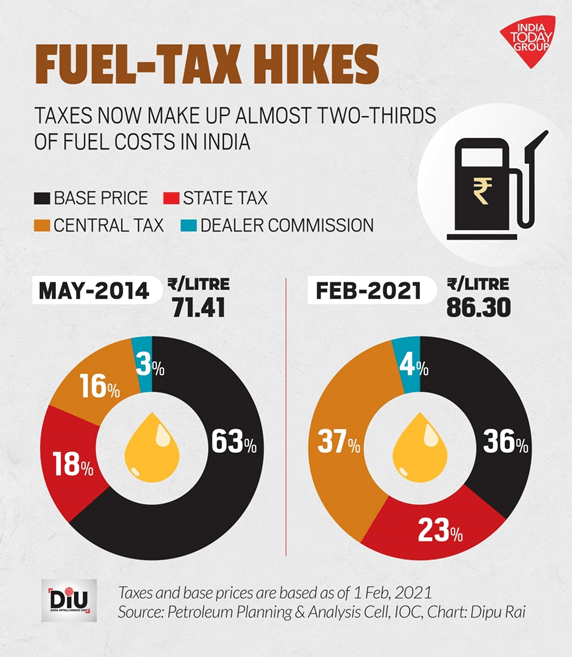
Central taxes on petrol and diesel rose by over 307% in last 6 yrs, allowing the Union government to mop up a sum of Rs 2.94 lakh crore through taxes be April 2020- Jan 2021.
central excise duty on petrol and diesel rose by a 307.3%
with collections from petrol alone growing at 206% and diesel 377%
- The United States had recently announced a 25% tariff on $2 billion of imports from six countries, namely India, Austria, Italy, Spain, Turkey, and the United Kingdom.
- The tariff was subsequently suspended for up to 180 days to give space for ongoing international tax negotiations to continue.
- Proposed tariff was aimed as a retaliatory measure against the concerned countries’ imposition of a digital services tax impacting the tech corporations based in the U.S.
- The Finance Bill, 2021 of India had introduced an amendment imposing a 2% digital service tax on trade and services by non-resident e-commerce operators with a turnover of over ₹2 crore.
- A “Section 301” investigation initiated by the previous U.S. administration had found digital services taxes imposed by each of these countries to be discriminatory against U.S. tech firms.
- Under Section 301 of the Trade Act of 1974, the Office of the United States Trade Representative (USTR) enjoys a range of responsibilities and authority to investigate and take action.
Why petrol and diesel prices are continuing to rise in India
Petrol has crossed the Rs 100 mark in at least six states as a result of a Rs 4.9 per litre hike in its price since the beginning of May.
The Indian Express
The price of crude oil has risen sharply in 2021 on the back of a recovery in global demand as the world economy recovers from the Covid-19 pandemic.
- The price of Brent crude has risen from $51.8 –> $71 per Barrel (37.1% inc)
- current petrol prices > prices in FY14 when the average price of India’s crude basket was $105.5 per barrel.
- 2010– price of petrol was decontrolled
- 2014– price of diesel was decontrolled
- June 2013–> India’s avg crude basket was at $101 per barrel,
- petrol was retailing at Rs 63.09 per litre or about Rs 76.6 per litre, when adjusted for the depreciation in the value of the rupee against the US dollar.
- October 2018–> the avg cost of India’s crude oil basket was at $80.1 per barrel, the price of diesel peaked at Rs 75.7 per litre.
Increasing central and state taxes on petrol and diesel are the key reason.
The price of crude oil is only 3.5% higher than at the beginning of 2020, before the Covid-19 pandemic led to a sharp fall in the demand for crude oil.
- Delhi–> central + state taxes= ~57% of pump prices of petrol and ~51.4% of the pump price of diesel.
- 2020–> Central Govt had hiked the excise duty on petrol by Rs 13 per litre and on diesel by about Rs 16 per litre to shore up revenues as the pandemic led to a sharp fall in economic activity.
- Rajasthan, West Bengal, Assam and Meghalaya have reversed hikes in state levies imposed during the pandemic, the central government has not cut central taxes despite calls from the RBI that taxes on auto fuels should be cut to curb inflation.
- Central levies account for 71.8% of total taxes on diesel and 60.1% cent of total taxes on diesel in the national capital.
U.S. proposal to impose a global minimum tax on foreign income earned by U.S. corporations aimed to disincentivise American companies from moving their commercial functions out of US.
- BEPS strategies aim at exploiting gaps and mismatches in tax rules to avoid paying tax.
- Developing countries suffer from BEPS disproportionately. BEPS practices cost countries USD 100-240 billion in lost revenue annually.
- May 2019–>BEPS–> the Inclusive Framework agreed to a Programme of Work for Addressing the Tax Challenges of the Digitalisation of the Economy.
- The Programme of Work is divided into two pillars:
- Pillar One addresses the allocation of taxing rights between jurisdictions and considers various proposals for new profit allocation and nexus rules based on the concepts of “significant economic presence”.
- Pillar Two (also referred to as the “Global Anti-Base Erosion” or “GloBE” proposal) calls for the development of a coordinated set of rules to address ongoing risks from structures that allow MNEs to shift profit to jurisdictions where they are subject to no or very low taxation.
Pillar Two proposal aims to provide jurisdictions with the right to “tax back” where other jurisdictions have either not exercised their primary taxing right or have exercised it at low levels of effective taxation and in this direction recommends a global minimum corporate tax.
The recent U.S. proposal is similar to Pillar Two, except for the rate of the effective minimum tax. While the OECD was considering a 10-12% rate, the U.S. has proposed a 21% rate.
Despite India’s 60 million MSMEs making enormous contribution to India’s employment and its gross domestic product (GDP), most of these are operating way below their potential because of a gap in loans and funding.
- Arvog, which offers debt, equity and funding, has announced digital micro loans amounting to 250 crore rupees to MSMEs.
- Meanwhile, London-based CreditEnable, an AI-driven SME credit business, has ramped up its activities in India to help improve access to finance for SMEs during COVID-19.
Kahani ki ghar ghar ki
- The GOI–> Atmanirbhar Bharat Initiative–> wants to reduce the dependence on imported items in defence.
- The domestic industry is given the opportunity to manufacture for fulfilling the needs of the armed forces.
Defence Ministry has notified the second negative import list.
- negative import list has been renamed as the ‘positive indigenisation list’.
- The 108 items in the list can now be only purchased from indigenous sources.
- The new list takes the total number on the list to 209.
- Indigenisation of defence purchases is planned to be implemented progressively with effect from December 2021 to December 2025.
The Union Cabinet has approved a plan to corporatise the Ordnance Factory Board (OFB)
- OFB which has 41 factories will be corporatised into seven fully government-owned corporate entities on the lines of Defence Public Sector Undertakings (DPSU).
- Once implemented, the OFB, the establishment of which was accepted by the British in 1775, will cease to exist.
- Currently, the OFB headquartered in Kolkata functions as a department under the Department of Defence Production.
- OFB is a government agency that is controlled by the department of defence production (DDP) under the Ministry of Defence (MoD).
- It is involved in research, development and production in the areas of air, land and sea.
- It is also involved in testing and logistics. OFB comprised 41 ordnance factories and 9 training institutes.
- It is called the “Fourth Arm of Defence” and also the “Force Behind the Armed Forces” of India.
- OFB is the 35th largest defence equipment manufacturer in the world, 2nd largest in Asia, and the largest in India.
- Inland Vessels Bill, 2021 will replace the Inland Vessels Act, 1917.
- Draft Inland Vessels bill proposes to streamline and regulate how vessels travel in the inland water fields of India.
- A total of 4,000 km inland waterways have been operationalised.
- The Bill will regulate the safety, security and registration of inland vessels.
- A key feature of the Bill is a unified law for the entire country, instead of separate rules framed by the States.
CCEA= Cabinet Committee on Economic Affairs has approved the proposal to hike subsidy rates for phosphorus and potassium-based fertilizers by 140%.
- The move is aimed at providing relief to farmers as the Kharif sowing season begins.
- It is a one-time measure as part of COVID-19 relief.
Fertilizer Subsidy:
- For urea, the Centre sets a fixed maximum retail price.
- For non-urea fertilizers, prices are decontrolled and the Centre fixes nutrient-based subsidy rates
- The Star labelling Programme has been formulated by the Bureau of Energy Efficiency, under the Energy Conservation Act, 2001.
- Presently, the program covers a star rating for 26 appliances/equipment including refrigerators and air conditioners.
- The objectives of the labelling program are to provide the consumer with an informed choice about energy-saving and thereby the cost-saving potential of the marketed household and other equipment.
Centre informed the Supreme Court that the States and the Union Territories have purchased nearly 3.7 lakh tonnes of foodgrains from the Food Corporation of India.
- The purchases have been made to supply to migrants without ration cards and others outside the protective cover of the National Food Security Act (NFSA).
In the light of the recent announcement by the Defence Minister on archiving, declassifying and compiling war histories, here is a compilation of a few operations of significance in Indian history.
https://byjus.com/free-ias-prep/upsc-exam-comprehensive-news-analysis-june15-2021/
A year into the Non-Cooperation Movement, Mahatma Gandhi announced the Tilak Swaraj Fund. The Fund, a homage to Bal Gangadhar Tilak on his first death anniversary, aimed at collecting Rs 1 crore to aid India’s freedom struggle and resistance to British rule.
International
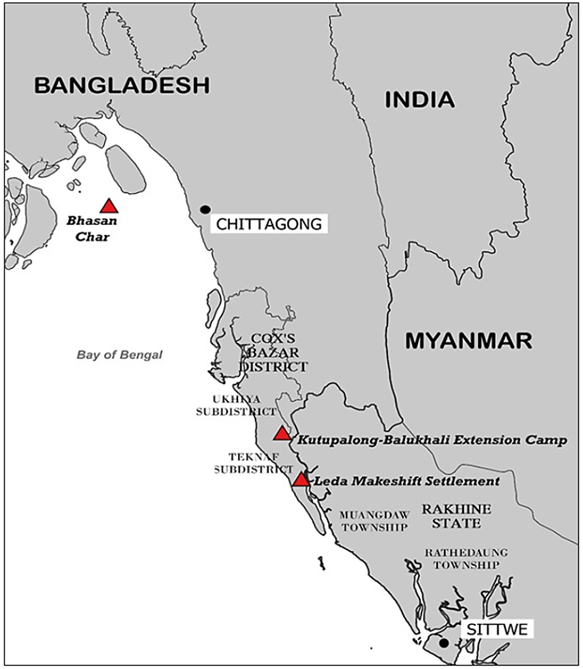
Thousands of Rohingya protest at Bhashan Char
- protest coincided with an inspection visit by officials from the United Nations refugee agency (UNHCR).
- 2017–> Rohingya refugees who fled Myanmar have been made to live in refugee camps near the Bangladesh-Myanmar border.
- About 8,50,000 people live in poor and cramped conditions in the Cox Bazar region in Bangladesh.
- December 2020–> the Rohingyas were moved to the Bhashan Char island from vast camps on the mainland.Bangladesh has shifted 18,000 out of a planned 1,00,000 refugees to the low-lying silt island of Bhashan Char from the Cox’s Bazar region.
- Bhasan Char is vulnerable to going under water from tides and flooding.
- Much of it gets submerged during the monsoon.
- Located near the mouth of the river Meghna where it flows into the Bay of Bengal, Bhasan Char surfaced only in 2006 from the sediment deposited by the river.
China will for the first time allow couples to have a third child.
2016–>2 Children policy.
2021–> It comes in the backdrop of the release of China’s once-in-a-decade population census that pointed to an alarming decline in births.
Forecasts say the population in China could peak in the next couple of yearins and most likely by 2025, when India will become the world’s most populous country.
The Permanent Court of Arbitration (PCA) in The Hague admitted that both India and Italy had concurrent jurisdiction in the matter but concluded that the marines’ immunity precluded India’s jurisdiction.
- India is entitled to get compensation in the Italian Marines case but can’t prosecute them; they will not be tried in India, and will face criminal proceedings in Italy.
- 2012, when the Italian oil tanker Enrica Lexie, traveling off the coast of Kerala was approached by an Indian fishing vessel.
- Italy had approached the International Tribunal for the Law of the Sea, an arbitral tribunal under the International Court of Justice in 2015, and the matter was heard by the Permanent Court of Arbitration in July 2019.
- The National Investigating Agency (NIA) had invoked the Suppression of Unlawful Acts against Safety of Maritime Navigation and Fixed Platforms on Continental Shelf Act, 2002
India and Sri Lanka have signed an agreement for a $100-million loan from the Export Import Bank of India to support Sri Lanka’s efforts to expand solar power coverage.
Govt of Taiwan,–> >= 28 Chinese air force aircraft, including fighters and nuclear-capable bombers, entered Taiwan’s air defence identification zone (ADIZ).
- It is the largest reported incursion to date.
- Taiwan has complained of repeated missions by China’s air force concentrated in the southwestern part of its air defence zone near the Taiwan-controlled Pratas Islands.
G7 accommodates Indian stand on need for Internet curbs
47th edition of the “Group of Seven (G7)” summit was held at Carbis Bay, southwest England.
India had the largest number of Internet shutdowns in 2020. In the present, the Indian Government will be expected to walk the talk on its commitments at the G-7 outreach, especially in the areas of information clampdowns.
- India voiced concerns about some clauses in the joint communiqué on Open Societies which condemned rising authoritarianism, net shutdowns, manipulation of information, and rights violations.
- These are the areas where the Indian government has often been criticised.
- India’s External Affairs Minister who had participated in the G-7 Foreign Ministers meeting had said that “open societies and personal freedoms require careful nurturing. Must be on guard against fake news and digital manipulation.”
- The ‘Open Societies Statement’ was adopted at the end of a G7 outreach session titled ‘Building Back Together—Open Societies and Economies’ where India’s Prime Minister was invited as a lead speaker.
- The joint statement was signed by the G-7 countries, and India, South Korea, Australia and South Africa.
- The British Prime Minister Boris Johnson termed them “Democracies 11”.
European Parliament has adopted a resolution urging the EU Commission to consider a temporary withdrawal of the GSP+ status given to Sri Lanka.
- e resolution notes the continuing discrimination against and violence towards religious and ethnic minorities while voicing serious concern about the 20th Amendment passed in 2020, and the resulting decline in judiciary independence, the reduction of parliamentary control, and the excessive accumulation of power with the presidency.
- This has put the spotlight back on Sri Lanka’s human rights situation.
- Sri Lanka regained the GSP+ in 2017, on Colombo’s commitment to implement 27 international conventions on human rights, labour conditions, protection of the environment and good governance.
- The status effectively removes import duties on goods from Sri Lanka entering the EU.he European Union’s “Generalized Scheme of Preferences” (GSP) allows developing country exporters to pay lower duties on their exports to the EU.
- This gives them vital access to EU markets and contributes to their economic growth.
- EU’s GSP removes import duties from products coming into the EU market from vulnerable developing countries.
TULSA MASSACRE- May-June 97
Tulsa was the affluent, predominantly African American neighbourhood of Greenwood, founded by descendants of slaves.
It had earned a reputation as the “Black Wall Street” of the U.S.
There were widespread killings and damage to property in Tulsa, Oklahoma, targeting relatively well-to-do African Americans by rampaging white mobs
- The Tulsa “Race Riot” Commission was formed to investigate the events in 1997 and officially released a report in 2001.
- The U.S President has now recognised the massacre. By doing so, he became the 1st sitting American head of state to recognise the incident.
The Ministry of Commerce press note amending the FDI policy.
evised FDI policy makes prior government approval mandatory for FDI from countries which share a land border with India. AIMED @ CHINA.
Though well intended, the policy outlined in the press note released by the Department for Promotion of Industry and Internal Trade may have some unintended consequences.
Quick nod likely for China investments
Revision of FDI policy in the face of COVID-19 crisis.
- The Centre plans to fast-track the review of some investment proposals from neigbouring countries.
- A senior Indian government source has stated that the government will try to approve any investment proposal in a non-sensitive sector within 15 days when the stake being bought is not significant.
- Sectors such as telecom, financial services and insurance were likely to be deemed more sensitive than others such as automobiles and renewable energy.
- Sectors which are already under severe financial distress and do not concern national security could also receive faster approvals.
The Union Cabinet approved the Model Tenancy Act.
Details:
- The model Act, if passed by the States and UTs, would prescribe the norms for lease agreements, deposits, dispute handling and other aspects of rental properties.
- States and Union Territories can adopt the Model Tenancy Act by enacting fresh legislation or they can amend their existing rental laws.
- Separate rent authorities, courts and tribunals will be set up in districts to protect the interests of both the owner and the tenant.
New database for missing persons
- The Interpol has launched a new global database named ‘I-Familia’ to identify missing persons.
- This would make use of the DNA of relatives to identify missing persons or unidentified human remains around the world.
2 LIGO observatories are active in the U.S. LIGO-India is a planned advanced gravitational-wave observatory to be located in India as part of the worldwide network. This is being planned at Hingoli District, Maharashtra.
- INDIGO or IndIGO is a consortium of Indian gravitational-wave physicists
India abstained in the voting on the resolution at the UNHRC.
Resolution was titled “Ensuring respect for international human rights law and humanitarian law in Occupied Palestinian Territory including East Jerusalem and in Israel”.
- The resolution was adopted with the vote of 24 members.
- The passing of the resolution led to the setting up of an independent commission of inquiry to investigate the violation of international law by Israel.
Burkina Faso is a landlocked countryin West Africa and is bordered by Mali to the northwest, Niger to the northeast, Benin to the southeast, Togo and Ghana to the south, and the Ivory Coast to the southwest.
- June 7 was proclaimed as the World Food Safety Day in 2018 by the United Nations General Assembly.
- The theme of World Food Safety Day 2021 is ‘Safe food today for a healthy tomorrow’.
The Indian Sugar Mills’ Association (ISMA) has said that to achieve the target of 88.5% ethanol blending, it is important to increase the blending level to at least 12% in surplus States and adjoining ones.
 MY BOX