Kaleshwaram Project
Kaleshwaram lift irrigation project is aimed to make Telangana drought proof by harnessing the flood waters of the Godavari. The project is an under-construction multi-purpose irrigation project on the Godavari River in Kaleshwaram, Bhoopalpally, Telangana.
•The project starts at the confluence point of Pranahita River and Godavari River.
Pranahita river is a confluence of various other smaller tributaries like Wardha, Penganga and Wainganga Rivers.
Godavari is India’s 2nd longest river after the Ganga. Its source is in Trimbakeshwar, Maharashtra..mouth at Bay of Bengal.
Major tributaries of the river are classified as the
left bank tributaries
Purna, Pranhita, Indravati and Sabari river and
right bank tributaries
Pravara, Manjira, Manair.
Kakayita (Rejuventaion) + Bhagirathi (drinking water) prjct launched by Telangna
Washi paper
•Washi is an ultra-thin paper which was once used for everything from writing and painting to lampshades, umbrellas, and sliding doors. Due to its flexible and durable characteristics, it is used to preserve ancient text and documentaries in Japan.
•Washi paper has a 1,300-year history and it has received UNESCO Intangible Cultural Heritage status.
UNESCO List of Intangible Cultural Heritage
UNESCO, the United Nations Educational, Scientific and Cultural Organization, has added reggae to its list of cultural institutions worthy of protection and preservation from Jamaica.
UNESCO has recognised the “Nuad” Thai massage as part of its Representative List of the Intangible Cultural Heritage of Humanity.
- The form of massage is one among over 20 elements that have been chosen for inclusion in the list this year. The other elements include Irish harping, Portugal’s Carnival of Podence, traditional Turkish archery and Slovakia’s wire craft and art.
Operation Sankalp
Indian Navy has launched ‘Operation Sankalp’ in the Persian Gulf and the Gulf of Oman as a measure to assure the safety and security of the Indian vessels, following the recent maritime incidents in the region.
In Gulf of Oman, where 2 oil tankers of USA were attacked recently.
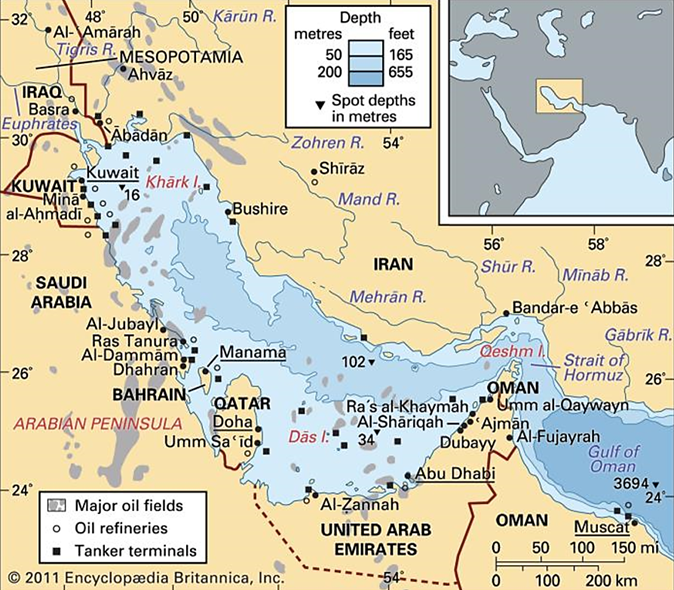
Persian Gulf= Arabian Gulf= a shallow marginal sea of the Indian Ocean that lies between the Arabian Peninsula and the southwestern Iran.
minimum of 55 km in the Strait of Hormuz.
It is bordered on the north, northeast, and east by Iran; on the southeast and south by part of Oman and the United Arab Emirates; on the southwest and west by Qatar, Bahrain, and Saudi Arabia; and on the northwest by Kuwait and Iraq.
2/3 of the world’s estimated proven oil reserves and 1/3 of the world’s estimated proven natural gas reserves.
The Gulf of Oman= northwest arm of the Arabian Sea, lies between the eastern portion of the Arabian Peninsula (Oman) and Iran.
It is 560 km long and connects with the Persian Gulf through the Strait of Hormuz. It is a shipping route for the oil-producing area around the Persian Gulf.
Kutiyattam
Kapila Venu recently played a composition “Parvati Viraham”, part of the age-old repertoire of Kutiyattam, at Jawaharlal Nehru University in Delhi.
traditional theatre forms of Kerala and is based on Sanskrit theatre traditions.
e word “kuti” in Malayalam language primarily means “combined” or “together”, and “attam” means “acting”: therefore, the word “kutiyattam” means “combined acting”.
e, netra abhinaya (eye expression) and hasta abhinaya (the language of gestures) are prominent. They focus on the thoughts and feelings of the main character.
Kutiyattam is performed by a community of male actors called Chakyars and female performers called Nangiars, assisted by drummers called Nambiars.
Pakarnattam is an aspect of Kutiyattam that involves embodying and emoting male and female roles. Switching between the masculine and feminine and interpreting multiple roles at the same time is considered a challenging skill within the repertoire.
includes the plays of almost all the major playwrights in Sanskrit
notable exceptions are Kalidasa and Bhavabhuti, whose plays are not traditionally part of its repertoire.
Kutiyattam has been declared as among the Masterpieces of the Oral and Intangible Heritage of Humanity by UNESCO.
- Tradition of Vedic chanting
- Ramlila, the traditional performance of the Ramayana
- Kutiyattam, Sanskrit theatre- Kerala, traditionally performed in theatres called as Kuttampalams
- Mudiyettu, ritual theatre and dance drama of Kerala
- Rammana,– Bhumiyal devta Saloor-Dungra..UK Garhwal Himalayas.
- Chhau dance- eastern India that enacts episodes from epics including the Mahabharata and Ramayana.
- Kalbiela— Rajasthan. ‘Khanjari’ percussion instrument and the ‘Poongi’
- Yoga– unifying the mind with body and soul for greater spiritual, mental and physical well-being.
- Buddhist chanting of Ladakh: recitation of sacred Buddhist texts in the trans-Himalayan Ladakh region, Jammu and Kashmir.
- Sankirtana, — set of arts performed to mark religious occasions and various stages in the life of the Vaishnava people of the Manipur plains.
- Kunbh Mela – festival of a sacred pitcher where the piligrims bathe
- Nawrouz— Persian New year celebrated worldwide.. dance, public rituals involving water and fire, traditional sports and the making of handicrafts
- Traditional brass and copper craft of utensil making – The craft of the Thatheras of Jandiala Guru constitutes the traditional technique of manufacturing brass and copper utensils in Punjab.
National Health Mission and Janani Suraksha Yojana
JSY = safe motherhood intervention under NHM. 100% centrally sponsored– cash assistance with delivery + post delivery.
Reducing maternal and neonatal mortality. especially with weak socio-economic status i.e. women from Scheduled Castes, Scheduled Tribes and BPL households
LPS=Low Performing States– UP, Uttarakhand, Bihar, Jharkhand, Madhya Pradesh, Chhattisgarh, Assam, Rajasthan, Odisha, and Jammu and Kashmir.
Performance-based incentives to women health volunteers known as ASHA for promoting institutional delivery among pregnant women.
JSY= Janani Suraksh a Yojana; April 2005
NHM= National Health Mission; 2013 – march 2020
ASHA= Accredited Social Health Activist
NHM
- The main programmatic components include Health System Strengthening in rural and urban areas for – Reproductive-Maternal- Neonatal-Child and Adolescent Health (RMNCH+A), and Communicable and Non-Communicable Diseases. The NHM envisages achievement of universal access to equitable, affordable & quality health care services that are accountable and responsive to people’s needs.
- The National Health Mission seeks to ensure the achievement of the following indicators:
- Reduce Maternal Mortality Rate (MMR) to 1/1000 live births
- Reduce Infant Mortality rate (IMR) to 25/1000 live births
- Reduce Total Fertility Rate (TFR) to 2.1
- Prevention and reduction of anaemia in women aged 15–49 years
- Prevent and reduce mortality & morbidity from communicable, non- communicable; injuries and emerging diseases
- Reduce household out-of-pocket expenditure on total health care expenditure
- Reduce annual incidence and mortality from Tuberculosis by half
- Reduce the prevalence of Leprosy to <1/10000 population and incidence to zero in all districts
- Annual Malaria Incidence to be <1/1000
- Less than 1 per cent microfilaria prevalence in all districts
- Kala-azar Elimination by 2015, <1 case per 10000 population in all blocks
Petition filed for non Nagas protection in Dimapur ILP by curbing extension of ILP- 1873
Anaemia in women
NFHS–IV (2015-16), the prevalence of anaemia among women aged 15 to 49 years is 53% and among adolescent girls aged 15-19 years is 54%.
Anaemia
- It is a condition in which the number of red blood cells or their oxygen-carrying capacity is insufficient to meet physiologic needs, which vary by age, sex, altitude, smoking, and pregnancy status.
- Iron deficiency is the most common cause of anaemia, although other conditions, such as folate, vitamin B12 and vitamin A deficiencies, chronic inflammation, parasitic infections, and inherited disorders can all cause anaemia.
- In its severe form, it is associated with fatigue, weakness, dizziness and drowsiness. Pregnant women and children are particularly vulnerable.
Under NHM–
Anaemia Mukt Bharat(AMB)
Weekly Iron and Folic Acid Supplementation (WIFS)
Health management information system & Mother Child tracking system
Universal screening
Pradhan Mantri Surakshit Matritva Abhiyan (PMSMA)
Operationalization of Blood Bank.
National Family Health Survey (NFHS-4)
- The National Family Health Survey (NFHS) is a large-scale, multi-round survey conducted in a representative sample of households throughout India.
- All National Family Health Surveys have been conducted under the stewardship of the Ministry of Health and Family Welfare, Government of India, with the International Institute for Population Sciences, Mumbai, serving as the nodal agency.
- ICF International (formerly Macro International), Maryland, USA, provided technical assistance for all four surveys conducted as on date.
Rashtriya Gokul Mission
Govt Sanctioned funds for Rashtriya Gokul Mission for setting up of 21 Gokul Grams as Integrated Cattle Development Centres.
Till now- 4 Gokul grams (Varanasi, Mathura, Patiala, and Phora)
2 components–
1. National program for bovine breeding
2. National mission for bovine productivity
Development and conservation of indigenous breeds
Indigenous breed improvement program
Enhance milk production and productivity.
Distribute disease free high genetic merit bulls for natural service
Rashtriya Gokul Mission will be implemented through the “State Implementing Agency (SIA viz Livestock Development Boards).
Initiatives under Rashtriya Gokul Mission–
Gopal Ratna Award-individual farmers
Kamdhenu Ratna- Award- Society, NGO,
Gokul Gram
National Kamdhenu Breeding Centre: (NKBC)
“E-Pashu Haat”- Nakul Prajnan Bazaar
Pashu Sanjivni
Advanced Reproductive Technology:
National Bovine Genomic Center
Why conservation of Indigenous breeds is the need of the hour?
Indigenous bovines are robust and resilient and are particularly suited to the climate and environment of their respective breeding tracts and productivity of indigenous breeds is less likely to be impacted by the adversities of climate change. The milk of indigenous animals is high in fat and SNF content (The substances in milk other than butterfat and water in the form of casein, lactose, vitamins, and minerals which contribute significantly to the nutritive value of milk)
Arogyapacha: ‘Miracle Plant’
Arogyapacha (Trichopus zeylanicus)= highly potent medicinal plant endemic to the Agasthya hills — Genetic make-up decoded by University of Kerala
Kani tribes traditionally used it for fatigue.
•Studies have also proved its varied spectrum of pharmacological properties such as antioxidant, aphrodisiac, anti-microbial, antiinflammatory, immunomodulatory, anti-tumour, anti-ulcer, antihyperlipidemic, hepatoprotective and anti-diabetic
Kani Tribe= Nomadic people= Indigenous to tropical forests of the Agasthyamalai hills of the Western Ghats, a mountain range in Kerala. Population ~25,000.
The tribal physicians = Plathi – are the exclusive holders of the traditional medicinal knowledge of the tribe. According to Kani tribal customs, only the Plathi have the right to transfer and disseminate their traditional medicinal knowledge.
Agasthya hills Agasthya hill is a 1,868-metre (6,129 ft) tall peak within Neyyar Wildlife Sanctuary, in the Western Ghats of Kerala. The peak lies on the border of Kerala and Tamil Nadu. This peak is a part of the Agasthyamala Biosphere Reserve which lies on the border between the states of Kerala and Tamil Nadu.
•The peak is named after Hindu sage Agastya, who is considered to be one of the seven rishis(Saptarishi) of Hindu Puranas. It is a pilgrimage centre for devotees.
The Thamirabarani River is a perennial river which originates from the eastern side of the range and flows into the Tirunelveli district of Tamil Nadu.
•In Tamil traditions, Agastya is considered as the father of the Tamil language and the compiler of the 1st Tamil grammar called Agattiyam. The Malayalam language is considered to be born from Agasthya.
•Agasthyamala Biosphere Reserve is among 20 new sites added by UNESCO to its World Network of Biosphere Reserves in March 2016.
Methane in the Martian Air
NASA’s Curiosity Rover discovered high amounts of methane in the Martian air.
•The Curiosity rover has found 21 parts per billion of methane, or 3x the 2013 finding. Variation by seasonal effect.
Trace Gas Orbiter, a newer European spacecraft launched in 2016 with more sensitive instruments, did not detect any methane at all in its first batch.
The ExoMars Trace Gas Orbiter (TGO)
•The orbiter is the 1st in a series of joint missions between the European Space Agency (ESA) and Roscosmos, the Russian space agency.
•It was designed to search for trace gases in the Martian atmosphere such as methane, water vapor, nitrogen oxides and acetylene.
A 2nd mission, ExoMars 2020, is planned for launch in 2020
Imphal Museum
Btiz + Japan inaugurated the Imphal Peace Museum at foothill s of Red Hill to commemorate the 75th anniversary of the Battle of Imphal.
•The inauguration was attended by Manipur Revenue minister, Japanese Ambassador to India, High Commissioner of UK and Chairman of The Nippon Foundation (TNF).
•The museum is constructed by the support of The Nippon Foundation (TNF), a non-profit grant-making organization in collaboration with Manipur Tourism Forum and Manipur Government.
The Battle of Imphal saw some of the fiercest fighting of World War II at Maibam Lokpa Ching popularly known as Red Hill.
•In 1944, Japanese armies attempted to destroy the Allied forces at Imphal and invade India but were driven back into Burma with heavy losses
The Japanese defeat at Kohima and Imphal was the largest up until that time, with many of the Japanese deaths resulting from starvation, disease and exhaustion suffered during their retreat.
•Imphal, the capital of Manipur, it is some 70 miles to the west of the Burmese border. To the north of Imphal are the Naga Hills and to the south the Chin Hills.
Wild Yak (Bos grunniens)
Giant Mammoth and Woolly Rhino which used to live with the yak about 18,000-20,000 years ago were not able to adapt to these changes and thus went extinct.
Wild Yak’s dung was analysed to know the vegetation and climate of the past and the connections they have to extinct the woolly rhino and mammoth.
Yak was able to modify its diet according to the climatic change of the past. e animals mostly depend on the regional flora and studies can throw light on the past vegetation of an area,
Wild Yak
- The Yak (Bos grunniens) is endemic to the Tibetan Plateau and the adjacent high-altitude regions.
- Yaks belong to the Bovini tribe, which also includes bisons, buffaloes, and cattle.
- It can tolerate temperatures as low as -40 degrees Celsius
- IUCN Red list status: Vulnerable
- Listed under Appendix I of CITES
- Indian WildLife (Protection) Act of 1972: Schedule II
- The most serious threat to the Wild Yak’s survival is casual and market hunting. The Yak is hunted for its meat, horns, and other materials.
Superbugs can be transmitted via Plants
•Researchers at the University of Southern California have found that anti-microbial resistant bacteria or superbugs can be transmitted to humans through plants.
•Antibiotic-resistant infections are a threat to global public health, food safety and an economic burden
•To prevent these infections, it is critical to understand how these bacteria are transmitted
Superbugs can asymptomatically hide in (colonise) the intestines for a long time while escaping and causing an infection
Superbug: It is a term used to describe strains of bacteria that are resistant to the majority of antibiotics commonly used today. Resistant bacteria that cause pneumonia, urinary tract infections and skin infections.
•It is facilitated by the inappropriate use of medicines, for example, using antibiotics for viral infections such as the flu.
New Biomarker for Malaria Detection
ICMR–> Jabalpur based NIRTH identified Glucose Dehydrogenase as a new biomarker for malaria parasite.
NIRTH= National Institute of Research in Tribal Health
Biomarker •Biomarkers are key molecular or cellular events that link a specific environmental exposure to a health outcome. •Biomarkers play an important role in understanding the relationships between exposure to environmental chemicals, the development of chronic human
diseases, and the identification of subgroups that are at increased risk for disease.
Currently, tests used for diagnosing malaria are based on a gene, Histidine-rich Protein 2 (HRP2), replete with amino acid Histidine.
•The studies have shown that this gene is often absent in some strains of the malaria parasite. Consequently, significant levels of malaria infection were going undetected.
Niti aayog’s health index
NITI Aayog in its Annual Health Index–> Kerala =1 in overall performance in health indicators
The 2nd edition of NITI Aayog’s report focuses on measuring the overall performance and incremental improvement in the states and union territories (UTs) over 2 year period (2016-17 and 2017-18 with 2015-16 as the base year and 2017-18 as the reference year.
The health index has been developed by NITI Aayog, with technical assistance from the World Bank, in consultation with the Ministry of Health and Family Welfare
Overall performance– Kerala >Andhra Pradesh > Maharashtra
UTs–> Chandigarh =1 overall performance, while Dadra and Nagar Haveli have shown significant improvement.
Improvemnts–> , Haryana,> Rajasthan,> Jharkhand (HaRJa) are at the top while
Uttar Pradesh, Bihar, Odisha, Madhya Pradesh, and Uttarakhand have been shown as the worst performers.
Manouria Impressa: Arunachal Pradesh
Tortoise named ‘Manouria impressa’ has been discovered in Arunachal Pradesh. Manouria is a genus of tortoises. •Manouria impressa is one of the only 4th species of forest dwelling tortoise occurring in Southeast Asia.
•Previously, the tortoise was believed to be restricted to western Myanmar, along with pockets of habitat in Thailand, Laos, Vietnam, Cambodia, and southern China, and south through Peninsular Malaysia.
•The species was last found in Gwa in Myanmar.
•The species is threatened by poaching primarily for traditional medicine and pet trade.
•It is listed on CITES Appendix II, and has been classified as Vulnerable by the IUCN Red List.
Asian Forest Tortoise
•Asian forest tortoise (Manouria emys), also known as Asian brown tortoise, is a species of tortoise found in India (Assam), Bangladesh, Burma (or Myanmar), Thailand, Malaysia and Indonesia (Sumatra, Borneo).
•It is the largest tortoise in mainland Asia.
•This is a relatively rare turtle, listed on CITES Appendix II, and classified as Endangered by the IUCN Red List.
State Divide in Unemployment
The Periodic Labour Force Survey (PLFS) for 2017-18 reflects huge variations among the states in terms of the unemployment rate. The survey reflects the overall unemployment rate in India at 6.1%.
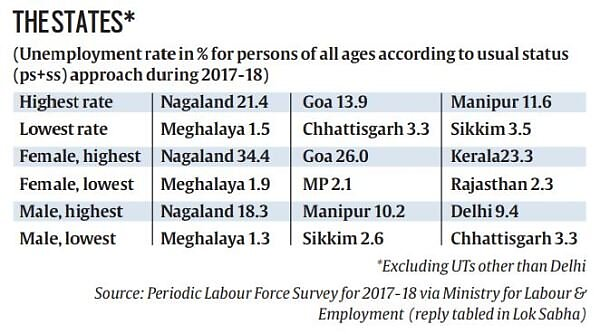
PLFS= Periodic Labour Force Survey
NSSO Launched–> PLFS in 2017.
• Objective–>
- CWS will project key labour force factors– WPR, LFPR, UR in urban areas in every 3 months
WPR= WOrker Population ratio
LFPR= Labour Force Participation Ratio
UR= Unemployment Rate - For both rural and urban areas, level estimates of all important parameters in both usual status and CWS will be brought out annually.
Key Employment and Unemployment Indicators
- Labour Force Participation Rate (LFPR): LFPR is defined as the percentage of persons in the labour force (i.e. working or seeking or available for work) in the population.
- Worker Population Ratio (WPR): WPR is defined as the percentage of employed persons in the population.
- Proportion Unemployed (PU): It is defined as the percentage of persons unemployed in the population.
- Unemployment Rate (UR): The unemployment rate is calculated by dividing the number of unemployed by the number in the labour forces, that is, the sum of employed and unemployed.
- Activity Status- Usual Status: The activity status of a person is determined on the basis of the activities pursued by the person during the specified reference period. When the activity status is determined on the basis of the reference period of the last 365 days preceding the date of survey, it is known as the usual activity status of the person.
- Usual Principal Status and Subsidiary Status (PS+SS): The Usual Principal Status and Subsidiary Status approach is an extension to the principal status approach.
- If a person has engaged in any economic activity for a period of 30 days or more during the preceding 365 days a person is considered as employed under this approach.
- Activity Status- Current Weekly Status (CWS): The activity status determined on the basis of a reference period of last 7 days preceding the date of the survey is known as the current weekly status (CWS) of the person.
Elections of Rajya Sabha
The Election Commission has announced election dates for six Rajya Sabha seats of Tamil Nadu.
Composition of the house: Article 80 –provisions for members of the Rajya Sabha. Currently, it has 245 members, including 233 elected members and 12 nominated. As per the constitutional limit, the Upper House strength cannot exceed 250.
•The number of Rajya Sabha members a state can send depends on its population. Hence, the number of elected seat changes as states are merged, bifurcated or new ones are created.
•Tenure of members: Every Rajya Sabha MP has a tenure of 6 years and elections to 1/3 seats are held every 2 years.
•According to Section 154 of the Representation of the People Act 1951, a member has chosen to fill a casual vacancy will serve for the remainder of his predecessor’s term of office.
•Permanent house: The Rajya Sabha meets in continuous sessions, and unlike the Lok Sabha, is not subjected to dissolution. However, the Rajya Sabha, like the Lok Sabha can be prorogued by the President.
•To win a Rajya Sabha seat, a candidate should get a required number of votes. That number is found out using the below formula. Required vote = Total number of votes / (Number of Rajya Sabha seats + 1 ) + 1.
https://myrantbox.school.blog/polity_sid/
Legislative Council
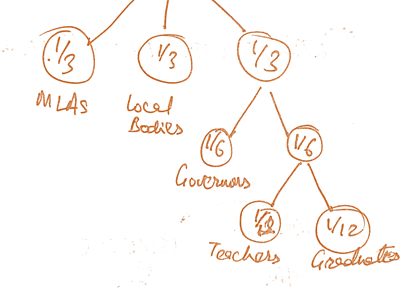
MOre details on Legislative counci + Assembly
‘Jal Hi Jeevan Hai’ Scheme
launched by the Haryana government.
•To encourage farmers to adopt crop diversification and sow crops consuming less water like Maize, Arhar etc. instead of water guzzling crops such as paddy so as to conserve water.
Continuous paddy growing in the State, about 1m of water table is depleting per year .
• Rs200 at the time of registration + Rs1800 after verification after 2 months. Free of cost hybrid seeds would also be provided.
India’s Non-permanent Seat at the UNSC
•All the countries in the AsiaPacific Group at the United Nations have unanimously supported India for a nonpermanent seat at the UN Security Council (UNSC) for a 2-year term in 2021-22.
The Asia-Pacific Group consists of 55 members states
India has been a non-permanent member of the UNSC 7 times, the most recent was for the year 2011-12.
Binding Nature-While other organs of the United Nations make recommendations to member states, only the Security Council has the power to make decisions that member states are then obligated to implement under the Charter.
•The Council is composed of 15 Members: 5 permanent- FUUCR;
10 keeps changing every 2 yrs. seats are distributed on a regional basis.
Buddhist Relic Unearthed in Andhra Pradesh
It is a limestone pillar, which is carved with half lotus medallions at the centre and top portions on all 4 sides.
•It belongs to the Amaravati school of Art of the Ikshvaku times.
Buddhist monastery of which this pillar might be part of a Shilamandapa where Buddhist teachers offer regular discourses on the Dhamma of the Buddha.
•The exploration was undertaken under ‘Preserve Heritage for Posterity’, an awareness campaign launched by the Cultural Centre of Vijayawada and Amaravati (CCVA), to bring to limelight artefact which remained in neglect in different parts of Andhra Pradesh.
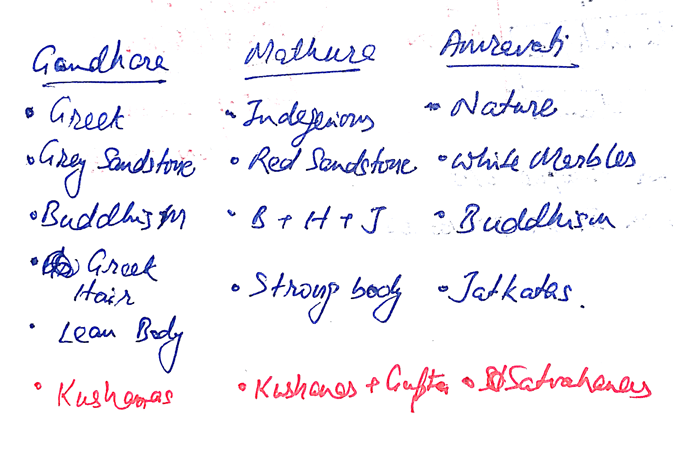
Amaravati School of Art
•Amaravati school of art evolved and flourished for nearly 6 centuries commencing from 200-100 BC in India itself, i.e. it has no outside influence.
•It was patronized first by the Satavahanas and later by the Ikshvakus.
•The material used is a distinctive white marble and Amaravati sculptures have a sense of movement and energy with profound and quiet naturalism in human, animal and floral forms.
•Both religious (mainly Buddhist) and secular images were present in this style.
National Policy on Biofuels – 2018
NPBF approved by the Government envisages an indicative target of 20% blending of ethanol in petrol and 5% blending of bio-diesel in diesel by 2030.
“Basic Biofuels” = 1G bioethanol & biodiesel–> Conventional biofuels–> made from things like sugar, starch, or vegetable oil–> all food products–> made from a feedstock that can also be consumed as a human food.
“Advanced Biofuels” = 2G ethanol, Biodiesel, Municipal Solid Waste (MSW) to drop-in fuels–> produced from sustainable feedstock= non-food crops =non-edible food crop portion–> considered as wastes, e.g. stems, husks, wood chips, and fruit skins and peeling.
3G biofuels, bio-CNG, Butanol etc. produced from micro-organisms like algae–> e algae can be grown using land and water unsuitable for food production, therefore reducing the strain on already depleted water sources.
4th Gen= crops that are genetically engineered to take in high amounts of carbon are grown and harvested as biomass–> fuel is pre-combusted and the carbon is captured. Then the carbon is geo-sequestered, meaning that the carbon is stored in depleted oil or gas fields or in unmineable coal seam–> carbon negative as their production pulls out carbon from environment.
to enable extension of appropriate financial and fiscal incentives under each category.
Scope of raw materials: The Policy expands the scope of raw material for ethanol production by allowing use of Sugarcane Juice, Sugar containing materials like Sugar Beet, Sweet Sorghum, Starch containing materials like Corn, Cassava, Damaged food grains like wheat, broken rice, Rotten Potatoes, unfit for human consumption for ethanol production.
Protection to farmers: Farmers are at a risk of not getting appropriate price for their produce during the surplus production phase. Taking this into account, the Policy allows use of surplus food grains for production of ethanol for blending with petrol with the approval of National Biofuel Coordination Committee.
Viability gap funding: With a thrust on Advanced Biofuels, the Policy indicates a viability gap funding scheme for 2G ethanol Bio refineries of Rs.5000 crore in 6 years in addition to additional tax incentives, higher purchase price as compared to 1G biofuels.
Boost to biodiesel production: The Policy encourages setting up of supply chain mechanisms for biodiesel production from non-edible oilseeds, Used Cooking Oil, short gestation crops.
 MY BOX