Issue of Tribal Women and Land Inheritance.
Not all women in the world possess land titles (Fact Sheet: Land Tenure & Women’s
Empowerment by E3/Land). Even where women do own the land, they have no control over it. Second, not holding a title to the land becomes an obstacle when
women apply for credit. Legally, women cannot use jointly owned property in a civil transaction or as collateral for a bank loan (Agarwal, 1994).
on the ground of right to livelihood being part of the right to life,
it was held that the immediate female relatives of the last male tenant could hold
the land as long as they remain dependent on it for earning their livelihood, for,
otherwise, it would render them destitute
Mundari Khunt-Kattidar
The descendants of the Munda founder of the village are called thus. He along with his lineage brothers owns the village including the land and the forest within its boundary. They do not pay tax but rent for the land.
According to the Settlement report of 1927 there were only 156 intact and 449 broken Mundari Khunt-Katti villages survived in RANCHI District. In the intact villages the land is under the control of the Mundas only whereas in the broken ones people who are not the descendant of the original founder, including non-tribals, have occupied land.
Bhuinhari Tenure
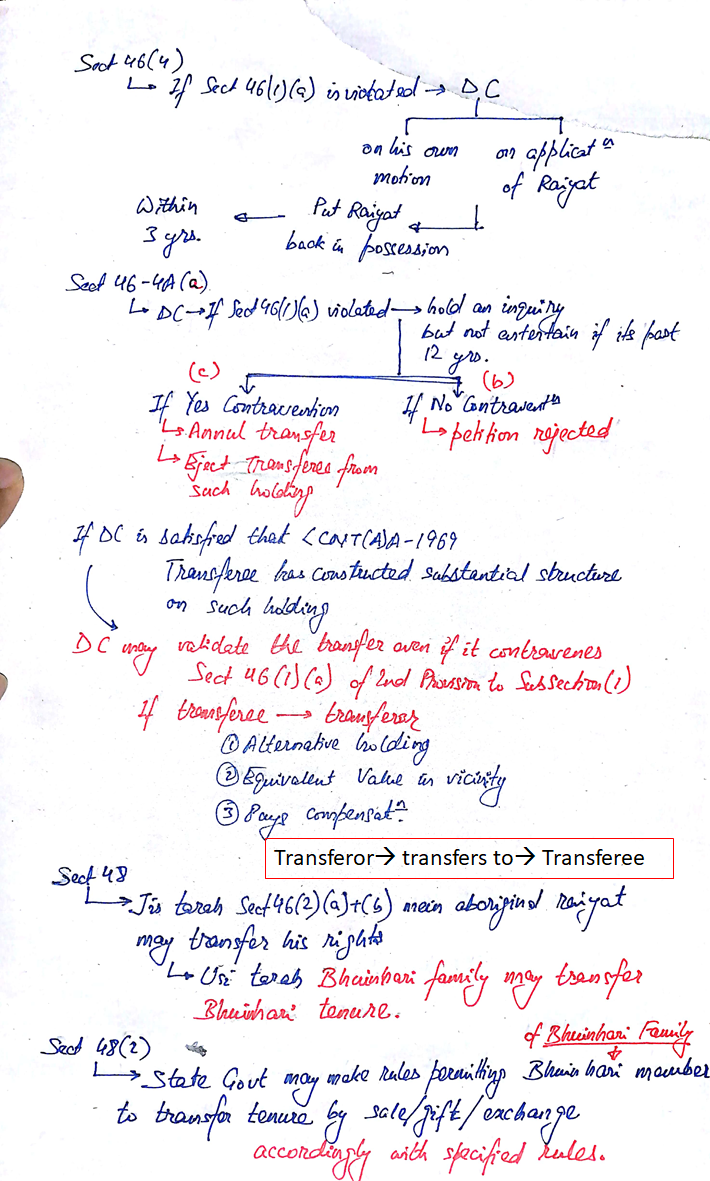
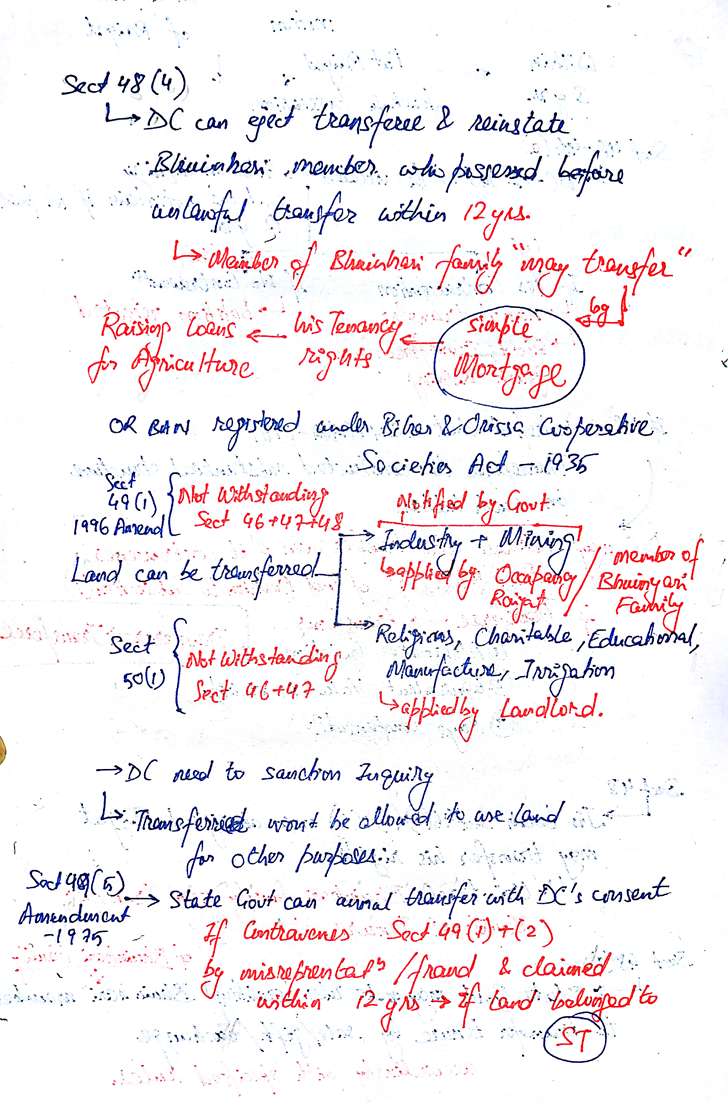
These are lands in non-Mundari areas, which have been reclaimed and brought under cultivation by original claimants of the village or their descendants. They enjoy the status of tenure-holders, and hold lands either rent free or at quit rent fixed in perpetuity. The total area of the Bhuinhari land according to the last Settlement was 215 sq. Miles.
Raiyats Holding Khunt-Katti Rights
In non-Mundari areas, excluding the villages covered by Bhuinhari land, the descendants of the original founders of the village in occupation of the land cleared from the forest are known as raiyats having Khunt-Katti rights. The number of Khunt-Katti tenancies recorded in the last survey was 938.
Raiyats
Excluding the above-mentioned privileged tribal tenures, there are other raiyati lands held by non-Khuntkattidar tribal and other castes. With the gradual breakdown of the tribal land system due to the invasion of the non-tribals in the region, these tribal tenures are gradually
ref- Land Rights in Jharkhand: an Analysis of Chhotanagpur
Tenancy Act
Dr. Ambrish Gautam
Assistant Professor, Amity University, Ranchi
The territory under the present state of Jharkhand was a part of a much larger topography of Great Central Indian Forests (Habib: 1982) that occupied whole of central India between the Gangetic plains in the north and the Deccan plateau in the south. Even before 13th century it was called Jharkhand (Mathew: 2003), the land of the forests, without, however, having any definite territorial identity. The region remained outside the pale of the empires and kingdoms of the plains till the emergence and consolidation of primary states, or jungle states, in the 17th century (Sinha: 1987).
Among them the largest one, the Chhotanagpur Raj was the first to be recognized by the Mughals. The other neighboring smaller ones were forced to be the part of the empire in the following years. All of them put together came to be known as Jharkhand, a Persian word, and became a part of the „Subah of Bangal‟.
administrative reform coupled with a new legislation always happened in response to popular revolts against the colonial rule. Rent Act of 1859 came in the wake of indigo riots, Bengal Tenancy Act 1885 came after the peasant revolt of 1872-73, and Chotanagpur Tenancy Act 1908 was not an exception to that rule. This was the final truce between the rulers and the rebelling indigenous peoples. The process that began with the Wilkinson‟s Rules found a mature shape in this Act.
i) “agricultural year” means the year prevailing in a local area for agricultural purposes, and such year shall be deemed to commence and terminate on such dates, respectively, as the [State] Government may, by [notification], direct:[Provided that where the State Government is the landlord, the year commencing from the first day of April shall be the agricultural year for the purposes of this Act;]
(ii) “bhugut bandha mortgage” means a transfer of the interest of tenant in his tenancy;for the purpose of securing the payment of money advanced or to be advanced by way of loan;upon the condition that the loan, with all interest thereon, shall be deemed to be extinguished by the profits arising from the tenancy during the period of the mortgage;
(x) “estate” means land included under one entry in any of the general registers of revenue-paying lands and revenue-free lands prepared and maintained under the law for the time being in force by the Deputy Commissioner; and includes Government ‘khas mahals’ and revenue-free lands not entered in any register;
(xi) “forest produce” includes the following, whether taken from a forest or not, that is to say,-
(a) wood, charcoal, caoutchouc, catechu, wood-oil, resin, natural varnish,, bark lac, ‘mahua’ flowers and myrobalans.
(b) trees and leaves, flowers and fruits and all other parts or produce not hereinbefore mentioned of trees,
(c) plant not being trees (including grass, creepers, reeds and moss) and all parts or produce of such plants,
(d) wild animals and skins, tusks, horns, bones, silk, cocoons, honey and wax, and all other parts or produce of animals, and
(e) peat, surface-oil rock and minerals (including iron-stone, coal clay, [sand and lime-stone] [* * *] when taken by any person for his own use [* * *];
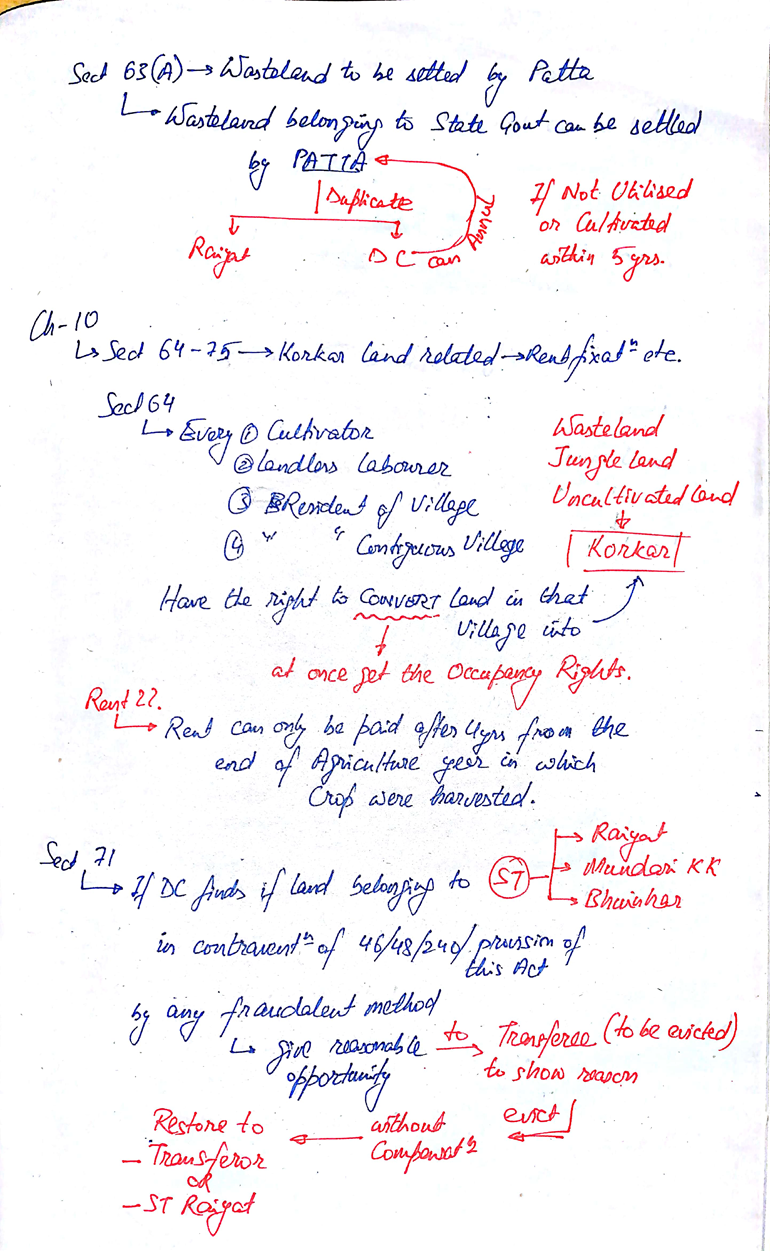
(xii) “holding” means a parcel or parcels of land held by a Raiyat, and forming the subject of separate tenancy;
(xiii) “korkad” means land by whatever name locally known such as ‘babhala khandwat, ‘jalsasan’ or ‘ariat’, which has been artificially levelled or embanked primarily for the cultivation of rice, and,-
(a) which previously was jungle, waste or uncultivated, or was cultivated upland, or which, though previously cultivated, has become unfit for the cultivation of transplanted rice, and
(b) which has been prepared for cultivation by a cultivator (other than the landlord), or by the predecessor-in-interest (other than the landlord); [* * *];
(xiv) “landlord” means a person immediately under whom a tenant holds, and includes the Government;
(xv) “movable property” includes standing crops;
(xxiii) “rent” means whatever is lawfully payable in money or kind by a tenant to his landlord on account of the use of occupation of the land held by the tenant and includes all dues (other than personal services) which are recoverable under enactment for the time being in force as if they were rent;
(xxiv) “resumable tenure” means a tenure which is held, subject to the condition that it shall lapse to the estate of the grantor and be resumable by him or his successor in title,-
(a) on failure of male heirs of the body of the original grantee in the male line, or
(b) on the happening of any definite contingency other than that referred to in sub-clause (a) of this clause;
(xxv) “Revenue Officer” in any provision of this Act, means any officer whom the [State] Government may appoint to discharge any of the functions of Revenue Officer under that provision;
(xxvi) “tenant” means a person who holds land under another person and is, or but for a special contract would be liable to pay rent for that land to that person;
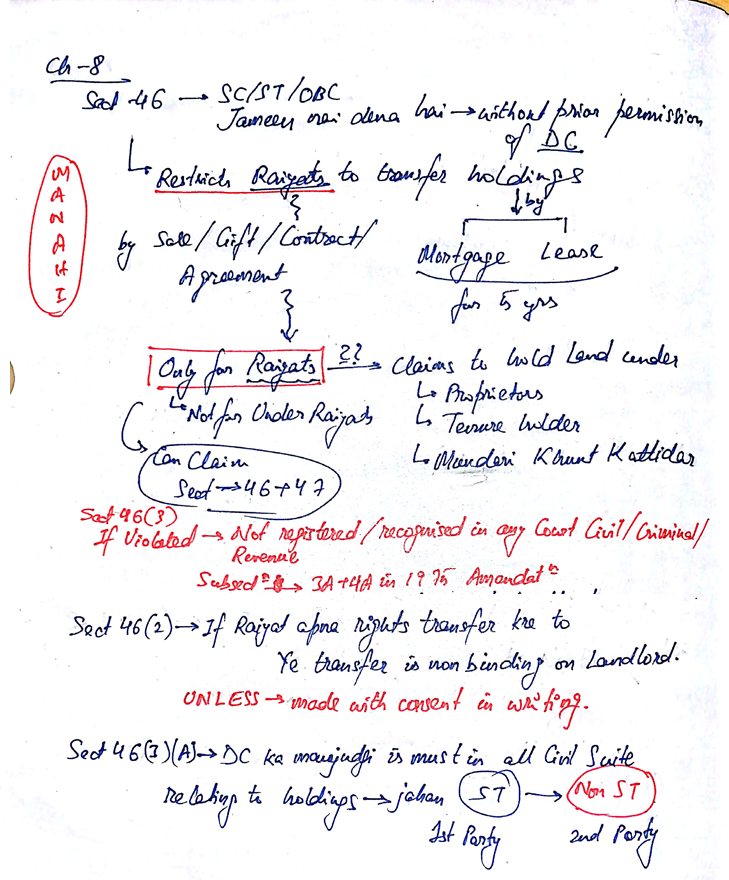
(xxvii) “tenure” means the interest of a tenure-holder, and includes an under tenure, but does not include a “Mundari khunt-kattidari” tenancy,
5. Meaning of a “tenure-holder” – “Tenure-holder” means primarily a person, who has acquired from the proprietor, or from another tenure-holder, a right to hold land for the purpose of collecting rents or bringing under cultivation by establishing tenants on it, and includes,-
(a) the successor-in-interest of persons, who have acquired such a right, and
(b) the holder of tenures entered in any register prepared and confirmed under the Chota Nagpur Tenures Act, 1869 (Ben. Act 2 of 1869),but does not include a Mundari khunt-kattidar.6. Meaning of “Raiyat” – (1) “Raiyat” means primarily a person who has acquired a right to hold land tor the purpose of cultivating it by himself or by members of his family, or by hired servants or with the aid of partners; and includes the successor-in-interest of persons who have acquired such a right, but does not include a Mundari-khunt-kattidar.Explanation. – Where a tenant of land has the right to bring it under cultivation, he shall be deemed to have acquired a right to hold it for the purpose of cultivation, notwithstanding that he uses it for the purpose of gathering the produce of it or of grazing cattle on it.(2) A person shall not be deemed to be a Raiyat unless he holds land either immediately under a proprietor or immediately under a tenure-holder or immediately under a Mundari-khunt-kattidar.(3) In determining whether a tenant is a tenure-holder or Raiyat, the Court shall have regard to,-
(a) local custom, and
(b) the purpose for which the right of tenancy was originally acquired.7. Meaning of “Raiyat having khunt-katti rights”. – (1) “Raiyat having khunt-katti rights” means a Raiyat in occupation of, or having any subsisting title to land reclaimed from jungle by the original founders of the village or their descendants in the male line, when such Raiyat is a member of family which founded the village or a descendant in the male line of any member of such family :Provided that no Raiyat shall be deemed to have khunt-katti rights in any land unless he and all his predecessors-in-title have held such land or obtained a title thereby virtue of inheritance from the original founders of the village.(2) Nothing in this Act shall prejudicially affect the rights of any person who has lawfully acquired a title to a khunt-kattidari tenancy before the commencement of this Act.8. Meaning of – “Mundari-khunt-kattidari” – Mundari-khunt-kattidar means a Mundari, who has acquired a right to hold jungle land for the purpose of bringing suitable portions thereof under cultivation by himself or by male members of his family, and includes,-
(a) the heirs male in the male line of any such Mundari when they are in possession of such land or have any subsisting title thereto, and
(b) as regards any portions of such land which has remained continuously in the possession of any such Mundari and his descendants in the male line, such descendants.
https://thewire.in/rights/local-tribes-protest-changes-jharkhand-land-laws
The state government has amended three sections and abolished one sub-section of the Chotanagpur Tenancy Act (CNT), while one section of Santhal Pargana Tenancy Act (SPT) has been amended.
Section 21 bars tribal land uses other than agriculture, construction of ponds, well and brick making. It has been amended empowering government to make rules for non-agriculture use of the agriculture land. For non-agriculture use of the land, a tax has to be paid that would be decided by the revenue officers.
Section 49 (1) has been amended to empower government to transfer tribal land for social welfare projects like hospital, schools, anganwadis (day care centres) and linear projects like pipelines, roads, etc. The cost of the transferred land shall not be less than the compensation fixed under the federal Land Acquisition Act.
Transfer of land
Section 49 (2) has been added to ensure that transferred tribal land shall be used only for the purpose mentioned during the time of transfer of land. If there is any change in the purpose or nature of the project, the land should be returned to the landowner. It also sets a deadline of five years for completion of the project. If the project in not completed within five years then the land would be returned to its lawful owner and land compensation money won’t be returned.
Section 71 (A) sub-section (2) that deals with tribal land transfer after compensation has been abolished. In Jharkhand there are around 64,000 cases pending under Schedule V. Schedule Area Regulation (SAR) courts have been set up in the state to deal with such cases.
Sukhdeo Bhagat, a former bureaucrat, points out that tribals are seeking compensation in these 64,000 cases and by abolishing 71(A)(2) these claims are likely to null and void. “These tribal families will lose their land and also their right to justified compensation,”
Section 13 of SPT Act has been amended to align with the motives CNT Act amendments. Section 13 has been amended to allow the government to use the tribal land for purposes other than agriculture.
Protecting tribal land
Jharkhand under Schedule V of constitution of India. It protects tribal land in 13 districts and three blocks in two other districts of the state. Under CNT and SPT Act tribal land cannot be transferred or sold to non-tribals. It also bars tribal land use from other than agricultural and allied activities. Governor is the custodian of tribal rights mentioned under Schedule V.
The amendments of 1996, Section 49 of the CNT Act allows land acquisition and transfer in schedule areas for industrial development and mining.
Land tenancy problem_2016
State govt was trying to amend land laws.
- Section 21 of the Chotanagpur Tenancy Act
- Section 13 of the Santhal Pargana Tenancy Act
that would have removed restrictions on the use of Adivasi land by owners or tenants for non-agricultural purposes.
Section 49(1) of the Chotanagpur Tenancy Act to insert a clause to permit the transfer of Adivasi land for linear projects “like road, canal, railway, cable transmission, pipelines, and schools, colleges, universities, panchayat buildings, hospitals, anganwadis” as well as any other “government purpose” as is notified by state government in the official gazette.
The amendments retain Section 71B of the Chotanagpur Tenancy Act that makes the violations of its provisions a criminal offence.
: “Once the land changes from agricultural to non-agricultural in records, the protections under Sections 46, 47, 48 of CNT [Chotanagpur Tenancy] Act and Section 20 of the SPT [Santhal Pargana Tenancy] Act will no longer apply.”
“These will then come under the Transfer of Property Act.”
FOR–> “The amendments are necessary as, right now, the government cannot get land even to build schools and anganwadis close to some villages in these areas because of existing restrictions,”
AGAINST–>“More than 40,000 anganwadis have been built in Jharkhand in as many villages, though it is another matter if the government makes them run properly or not,”
“We want to tell the government if they use Section 144 [prohibitory orders], we have Article 244 [Constitution’s section on governance of Scheduled Areas in the Fifth Schedule].”
The CNT Act was placed under the Schedule 9 of the Constitution to render it beyond judicial review. But it has been grossly violated since it has been passed.
Sect 49— permission requirement has been changed. Rather than deputy commissioners (as provided in the original Act), permission is needed from the revenue department.
Need for CNTA 1908
Mr. Slacke, the man who moved the Amending Bill of 1903, and the late Commissioner of Chota Nagpur:
“Owing to the non-recognition of their rights, the Mundaris
for more 3/4th of the century have been in a state of agitation,
which from the time has culminated in outbursts.”
He further meitioned.
1822— horde of middlemen was let loose over the country by the then Maharaja of Chota Nagpur. They were ignorant of and oblivious to the rights and customs of the aborigines.
Great Munda rebellion of 1832-
1833–
the immediate cause–> an attempt by the Thakur of the Sonpurgarh to destroy Khuntkatti rights in Bandgaon and Kochang in the district of Ranchi. The attempts to destroy the Khuntkattidars’ rights did not cease, and they were the cause of the disturbances between the Landlords and Tenants in that district in the year of the Mutiny.
1869— Eventually the Chota Nagpur Tenures Act of 1869 was passed and effected some improvement. But it omitted to deal with the all the privileged lands, as it took no notice of instant khuntkatti villages. The destruction of the khuntkatti tenancies went on.
1888-– Sardari-Larai began, and has not yet ceased. Utilizing the bitter feeling of the Mundaris, some of their fellow-clansmen-they came to be known afterwards as Sardars-persuaded the people that the Hindus had no right to the lands that the lands belonged
to the Mundaris, that no rent should be paid, and that the
Sovereign had given a decree to this effect. The outburst that occurred at the time was put down. but it again broke out in
1899-1900 under the leadership of Birsa, who styled himself as God.”
A khuntkattidar is the founder or the male descendant in the male line of the founder of the village in which are situated his khuntkatti lands. The tenancy is of 2 kinds, the difference between them merely one of area. It is either the tenancy of the whole brotherhood, the descendants of the original founder, or that of an individual member of the brotherhood over the lands in his immediate possessions.
When a Mundari wished to be found a new village he either alone or some of his kinsmen on the paternal side obtained the jungle
tract he desired. It was open to him or his male descendants acting jointly, to give portions to other Mundaris either to cultivate as Raiyats or to establish other khuntkatti villages. The system is one which originated long before the advent of the Hindus into Chota Nagpur.
Originally no rent was payable, but later rent and services came to existence.
Colonial rule and the inherent elements of commercialization
that brings alongwith itself affected the tribal societies in a
number of ways.
- Penetration of tribal areas by the outsiders such as moneylenders, traders, land grabbers, labour contractors, etc of the plains.
- It brought about and enforced the alien concept of private property.
- It forced the sale of land out of sheer desperation of those engulfed in the vicious cycle of debt.
- It ruthlessly exploited indigenous people as cheap indentured laborers.
- It led to alienation that was not just economic or material, but cultural, spiritual and related to community identity as well.
1868— Forest Department Act’
was passed which inhibited the tribal dependency on the forests, curtailing their pasture areas, collection of firewood, fodder, herbs, and other forest produce in commercially rich forest land, whereas, the British Empire had the full rights over those potent areas.
During 1893-94— all wastelands in villages, the ownership of which were vested in the Government, were constituted into protected forests under the Indian Forest Act VII of 1882. In Singhbhum as in Palamau and Manbhum the forest settlement operations were
launched and measures were taken to determine the rights
of the forest-dwelling communities. Villages in forests were marked off in blocks of convenient size consisting not only of village sites but also cultivable and wastelands insufficient for the needs of the khuntkatti villages. The Colonial interference brought with them countless adversaries of the tribal cultures penetrating into their lifestyles, spirituality and identity.
Concepts alien to the tribals such as ownership of land, accumulation of wealth, money and power began cropping up.
I would say there was no concept modern day Success or Winning on a professional level. The validation of power in terms of material richness, or other professional occupation was alien. But this doesn’t mean there wasn’t hierarchy system. The presence of patriarchy hints on the side of male dominance and size of lands managed and cattle maintained as could be seen in any old tribal system. The level of IQ needed to compete in modern system may not have been developed in large population and also there was no need to improve it in their local environment generation after generation made them unfit to understand or to follow new laws and rules brought in by modern system.
Me
CNTA- 1908
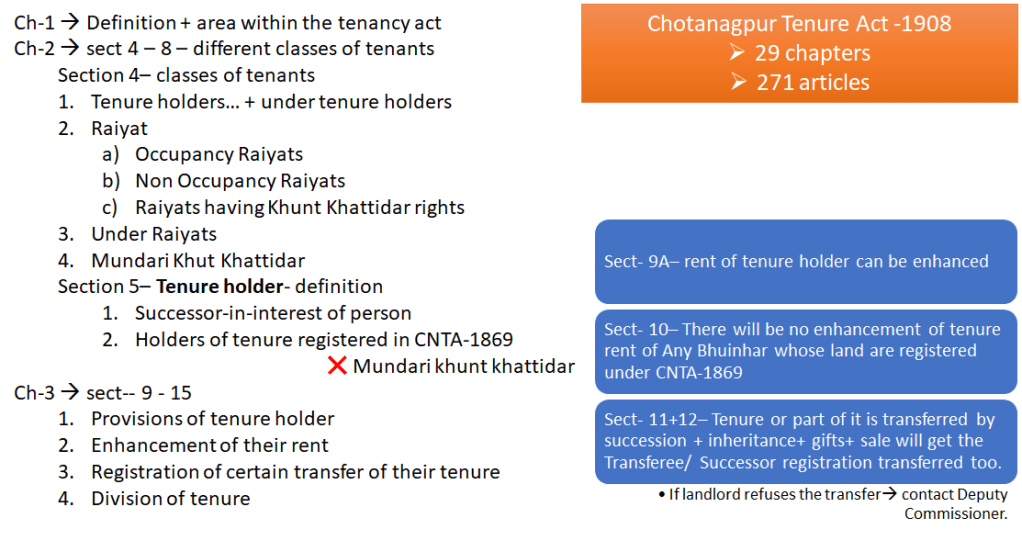
5. Meaning of a “tenure-holder”—
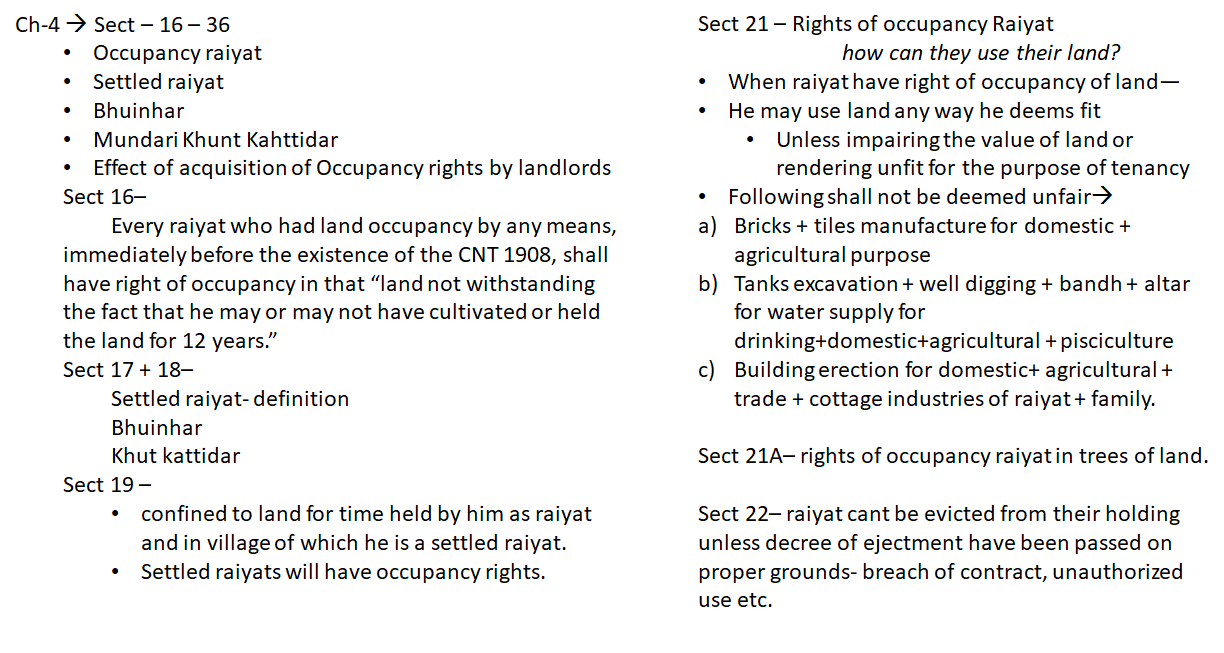
17– def of Settled Raiyat
18– some cases where Bhuinhar + Mundari Khunt Kattidar are Settled raiyats…
Lands cultivated by B+MKK apart from bhuinhari+ Khunt Kattidari lands + other landlord’s lands will be treated as Raiyats..
(a) village land – (manjhias+ bhetkheta) = eneterd in CNTenures Act 1869..+ Bhuinhari family had held it for continuous 12 yrs
(b) village land- (MKKk lands)= in any record-of-rights as finally published under this Act or under any law in force before.. where MKK male members have held for continiuous 12 yrs
19– Every person who is a settled Raiyat of a village within the meaning of Section 17 or Section 18 shall [subject to the provisions of Section 43] have a right of occupancy in all [* * *] for the time being held by him as a Raiyat in that village.
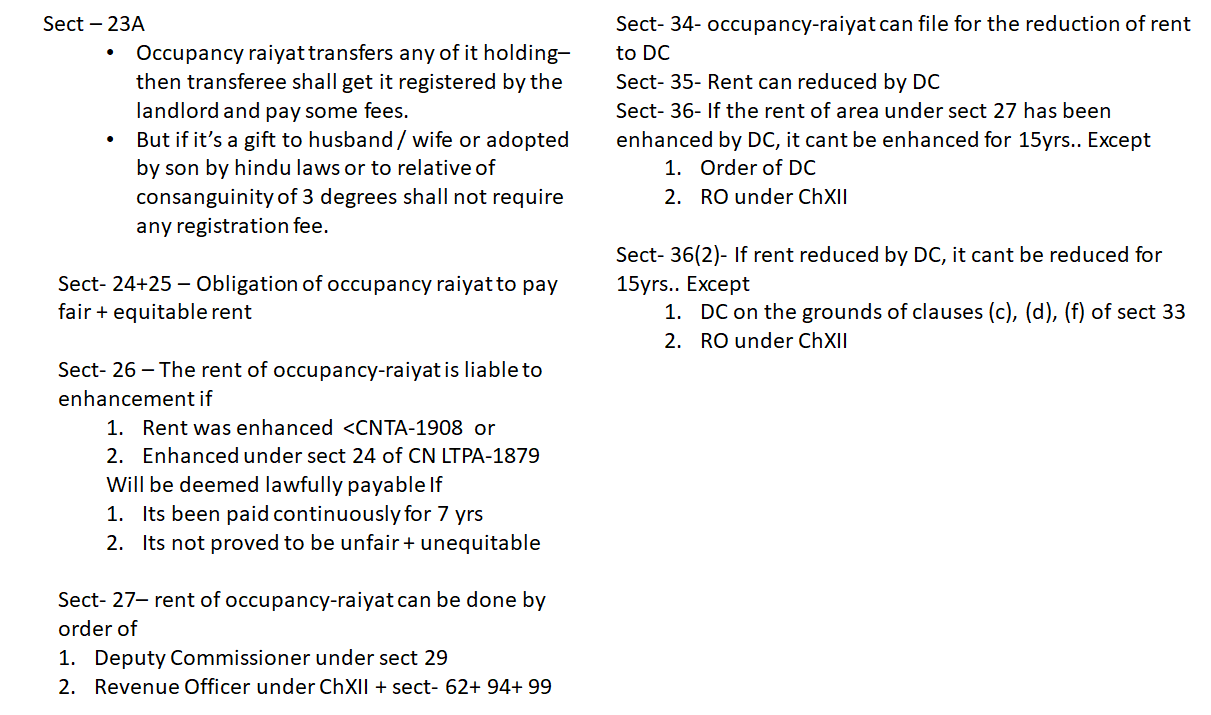
36– Bar to further Enhancement or Reduction of Rent.. If the rent is enhanced by DC under Sec29 of an area in Sec27.. or reduced under Sec35… then it won’t change for 15 yrs.. Except by the order of Dept Commissioner or Rev Officer(Ch12)
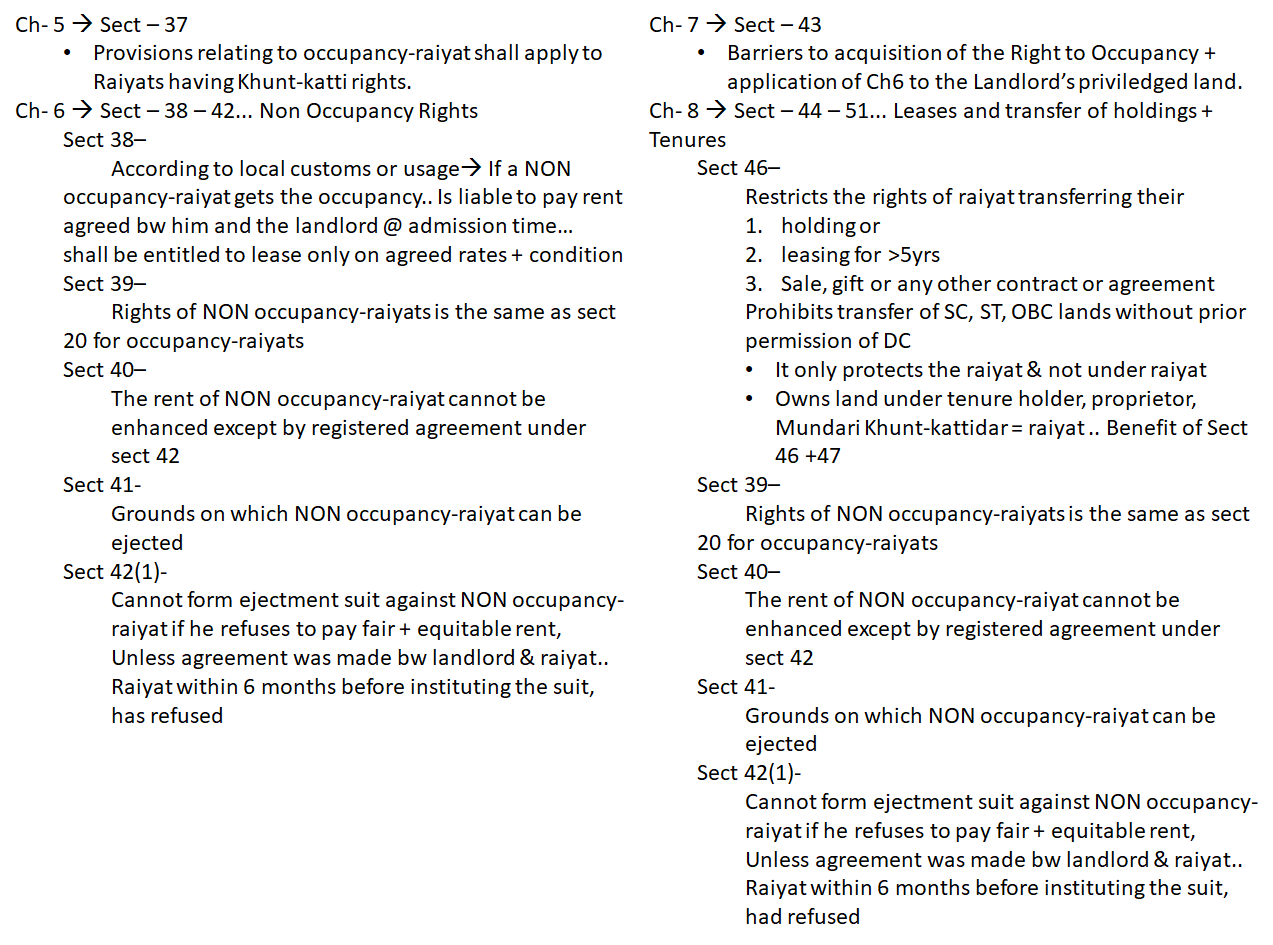
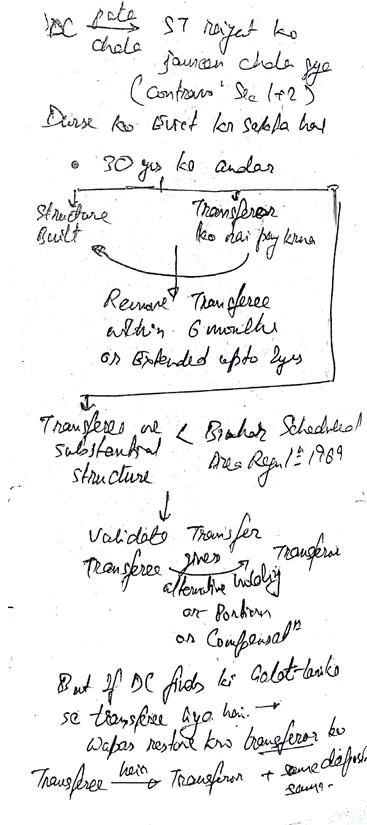
72– Istifanama.. Raiyat not bound by lease or other agreements may surrender for a fixed period @ end of any agricultural year with previous sanction of Deputy Commissioner…
Amendment 1947.. 5/1/1948– previous sanc of DC.. not required prior to that day
- Atleast 4 month’s notice period
- Indemnify landlord any less rent of the holding for the agri year.
73– landlord may kabja the land if raiyat voluntarily abandons it…
Landlord–> notice to DC –> publish notice–> if objection within 1month–> landlord can’t enter in holding unless the objection is cleared.
Raiyat–> apply to DC –> for recovery of possession– within 3yrs if occupancy raiyat or within 1 yr if non occupancy raiyat.
75– Every landlord of an estate, tenure or Mundari Khunt Kattidar tenancy have the right to make general survey of his land.. if resisted– can apply to DC
Ch 11- 76-79– Customs + contracts
Ch 12- 80-100– records of right free publication final publication Section 98 2013 code of rights are made it cannot be altered before 15 years
Ch13- 101-117– radial conditions the communication and appeal division procedures of the record under the records of right
 Ch14- 118-126– landlords privilege Lands
Ch15- 127-134–
Ch16- 135-229– judicial procedure in matters cognizable by the deputy commissioner
Ch16A- 229A– summary procedure for the recovery of rent under Bihar and Orissa public demand recovery act 1914
Ch17- 230-238– application of Indian limitation act and other related provisions
Ch18- 239-256– special provisions with respect to Munda recode kattidare provisions of transfer for certain purposes with their permission of competent authority.
Ch19- 257-271– supplementary provisions
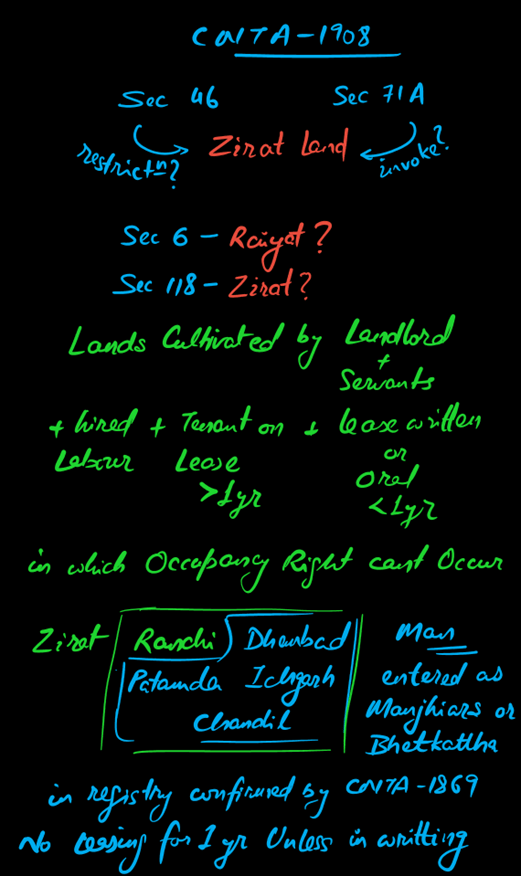
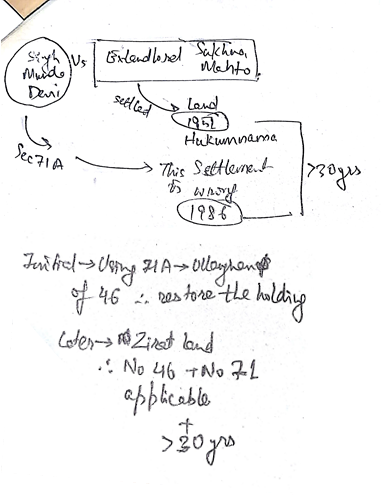
Ariat is a variety of korkar as defined in the Chota Nagpur Tenancy Act, 1908.
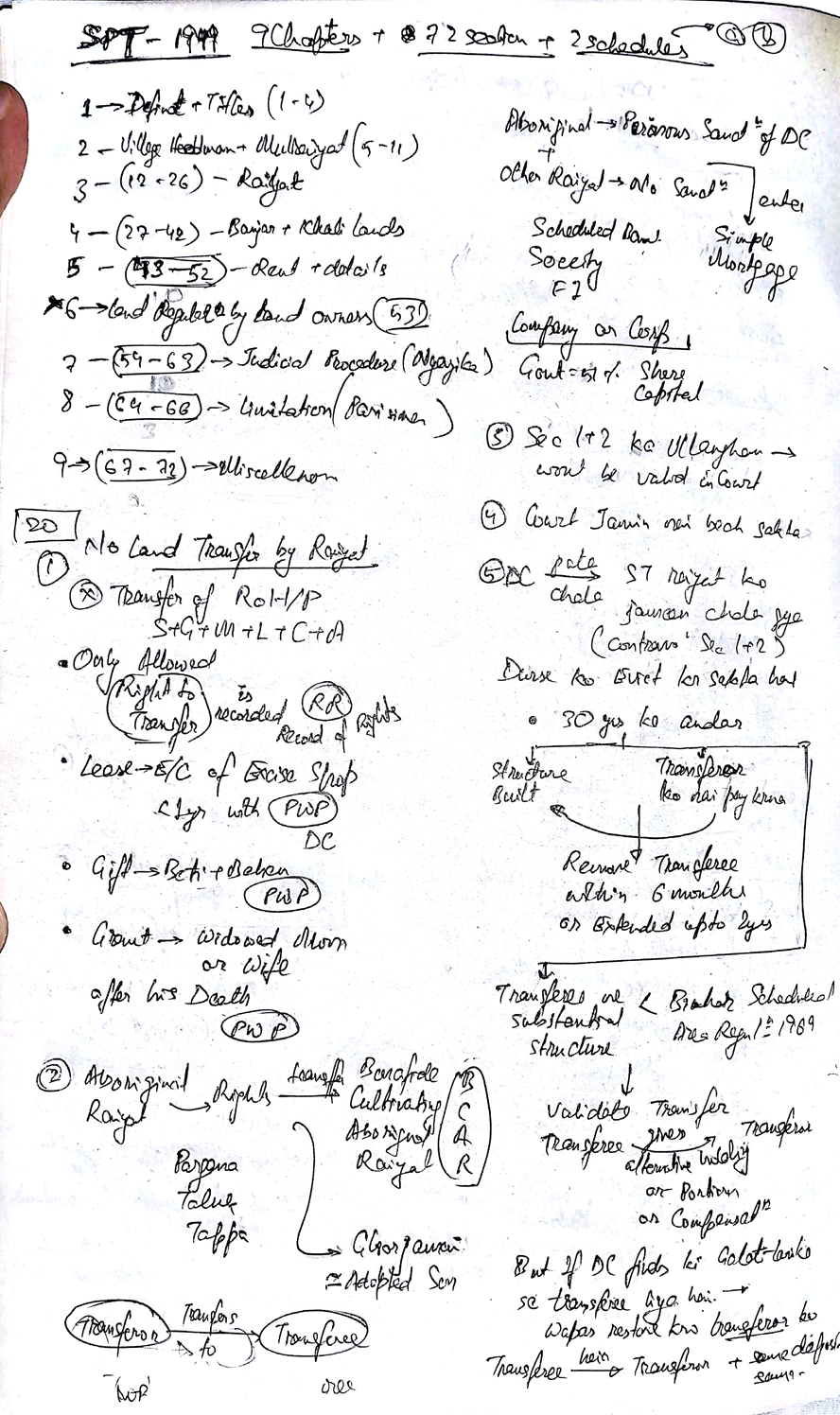
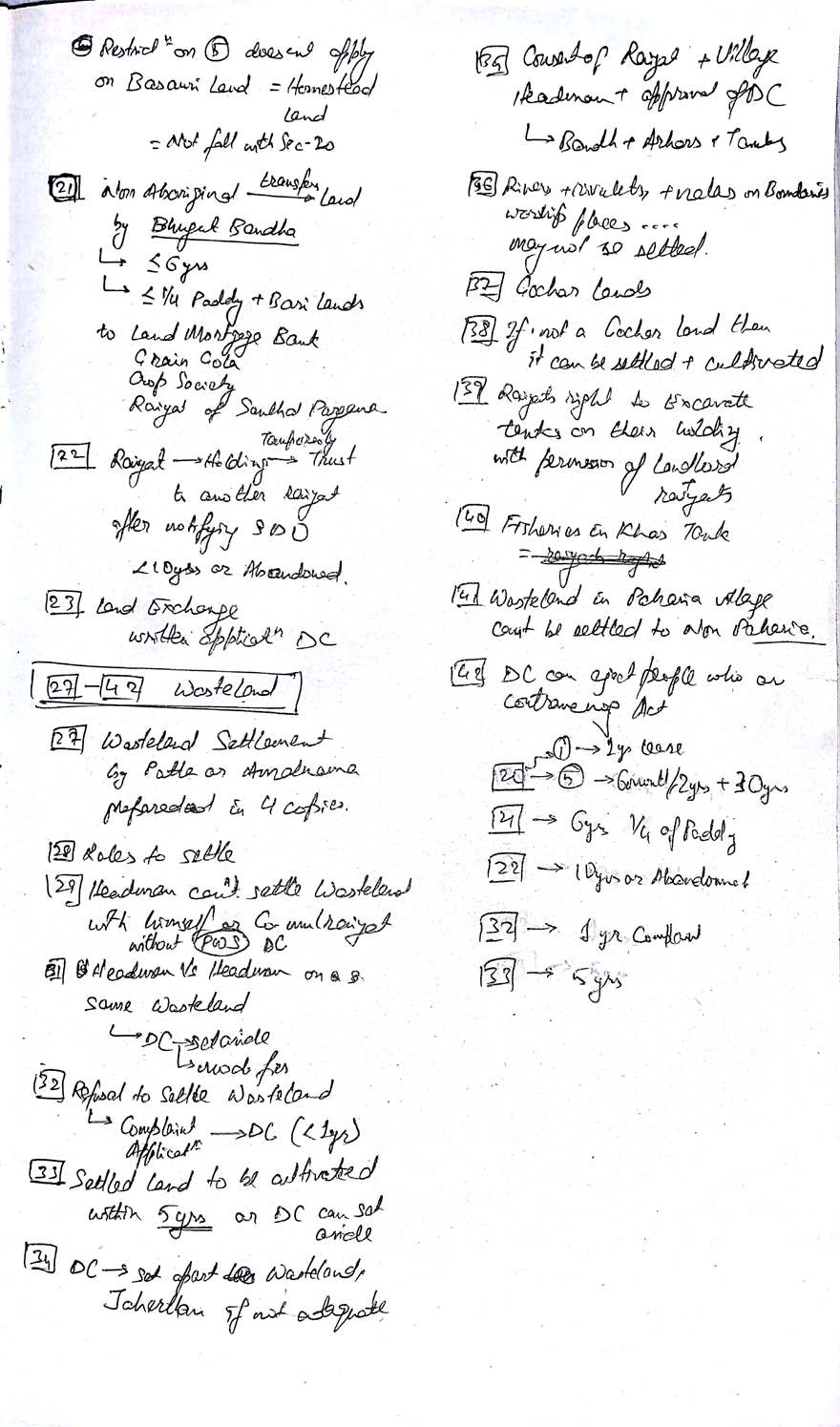
SPT 1949
It extends to the whole of Santal Parganas Division comprising of [Dumka,Sahibganj], Godda, Deoghar and Pakur.]
(i) ‘aboriginal’ means a person who belongs to an aboriginal or semi-aboriginal tribe or caste specified in Schedule B and includes a person belonging to such other aboriginal or semi-aboriginal tribe or caste as may, from time to time, be notified by the [State] Government in this behalf;
(ii) “Agricultural year” means, where the Bengali year prevails, the year commencing on the first day of Baisakh, where the Fails year prevails the year commencing on the first day of Asin, where any other year prevails for agricultural purposes, that year;
(iii) “bhugut-bandha or complete usufructuary mortgage” means a transfer of the interest of a raiyat in his holding or part of the holding for the purpose of securing the payment of money advanced or to be advanced by way of loan, upon the condition that the loan, with all interest thereon, shall be deemed to be extinguished by the profit arising from the holding or part of the holding during the period of the mortgage;
(iv) [“Commissioner’ means the Commissioner of the Santhal Parganas Division];
(v) “Community” means the social group to which a person belongs and for the purposes of this Act there shall be two such groups, aboriginal and non-aboriginal;
(vi) “Deputy Collector” includes an Assistant Collector and a Sub-Deputy Collector;
(vii) [“Deputy Commissioner” means the Deputy Commissioner of the [Dumka, Sahibganj], Godda, Deoghar, Pakur and includes],-
(a) Additional Deputy Commissioner, Sub-divisional Officer or Deputy Collector, empowered by the [State] Government to discharge any of the functions of Deputy Commissioner under this Act; and
(b) any Deputy Collector, whom, subject to the control of the State Government, the Deputy Commissioner may, by general or special order, authorize to exercise any of his functions under this Act;
(viii) “Holding” means a parcel or parcels of land held by a raiyat and forming the subject of a separate tenancy”
(ix) “khas village” means a village in which there is no mulraiyat nor for the time being any village headman irrespective of whether there was or was not previously a mulraiyat or village headman in the village;
(x) “landlord” means a person other than the village headman or mulraiyat entitled to receive rent and includes a proprietor, a tenure-holder, a ghatwal and the [Government];
(xi) “non-aboriginal” means a person who does not belong to any aboriginal or semi-aboriginal tribe or caste specified in Schedule B or to any other aboriginal or semi-aboriginal tribe or caste notified by the [State] Government under clause (i) of Section 4;
(xii) “prescribed” means prescribed by rules made by the State Government under this Act;
(xiii) “raiyat” means a person not being a landlord, who has acquired a right to hold land for the purpose of cultivating it by himself or by members of his family or by hired servants; and includes the successor in interest of a person who has acquired such a right;
(xxiii) “village headman” means the person appointed or recognised whether before or after the commencement of this Act by the Deputy Commissioner or other duly authorized officer to hold the office of a village headman whether known as pradhan, mustajur, manjhi or otherwise, but does not include a mulraiyat.
Sec5– appointment of village HEADMAN in khas village… application sent to DC.. consent of 2/3 of Jamabandi raiyats of the village.
Sec6– Village headman of khas village is done under legal heir system .. if headman dies–> landlord has to report to DC within 3months.
Sec7– Headman on appointment be granted a patta + may be required to execute a KABULIYAT.
Sec8– if person other than heir is appointed as Headman… Duty of landlord to supply him/her with original jamabandi docs or copies + records of rights within 3 months from date of appointment.
Sec9– Non-transferability of village headman’s office. – The village headman shall have no right to transfer his office in any way… traditional right of a mulraiyat to transfer his certain rights is confined to pvt holding +official holding called mulraiyat ka jote or mulraiyati jote.
Sec10– No land which is not recorded as such shall be recognised or treated as mulraiyat ka jote (private holding) or as mulraiyat jote (official holding). Any waste land which is reclaimed by a mulraiyat or a co-mulraiyat or any vacant holding which is found in the possession of or is settled with a mulraiyat or a co-mulraiyat shall be treated as non-transferable raiyati holding governed by the provisions of this Act relating to such raiyati holdings.
Bhuinhars+ Mundari Khunt Kattihdars is a tenure.
can transfer his land only to their kind.
Mulraiyat is an office headman. Its office is hereditary.
Both collects land revenue
Sec11– Headman’s reward fund.
Sec12– Classes of raiyats. – There shall be for the purposes of this Act the following classes of raiyats, namely, –
(a) Resident jamabandi raiyats, that is to say, persons recorded as jamabandi raiyats who reside or have their family residence in the village in which they are recorded.
(b) Non-resident jamabandi raiyats, that is to say persons recorded as jamabandi raiyats who do not reside or have their family residence in the village in which they are recorded.
(c) new raiyats, that is to say, person recorded as naya raiyats or nutan raiyats.
 MY BOX