The Treaty on Intermediate-Range Nuclear Forces in Europe (INF) contributed to the end of the cold-war and constitutes a pillar of European security architecture since it entered into force 30 years ago.
The INF Treaty is a bilateral agreement between the United States and the Soviet Union. It was the first treaty to reduce nuclear arms instead of establishing an arms ceiling. On 2nd August 2019 it came to an end after US gave suspension time for 6 months on 1st Feb 2019.
On 29th May 2019, Director of the Defence Intelligence Agency Lt. Gen. Robert Ashley declared that “Russia probably is not adhering to the nuclear testing moratorium in a manner consistent with the ‘zero-yield’ standard” imposed by the Comprehensive Test Ban Treaty (CTBT).
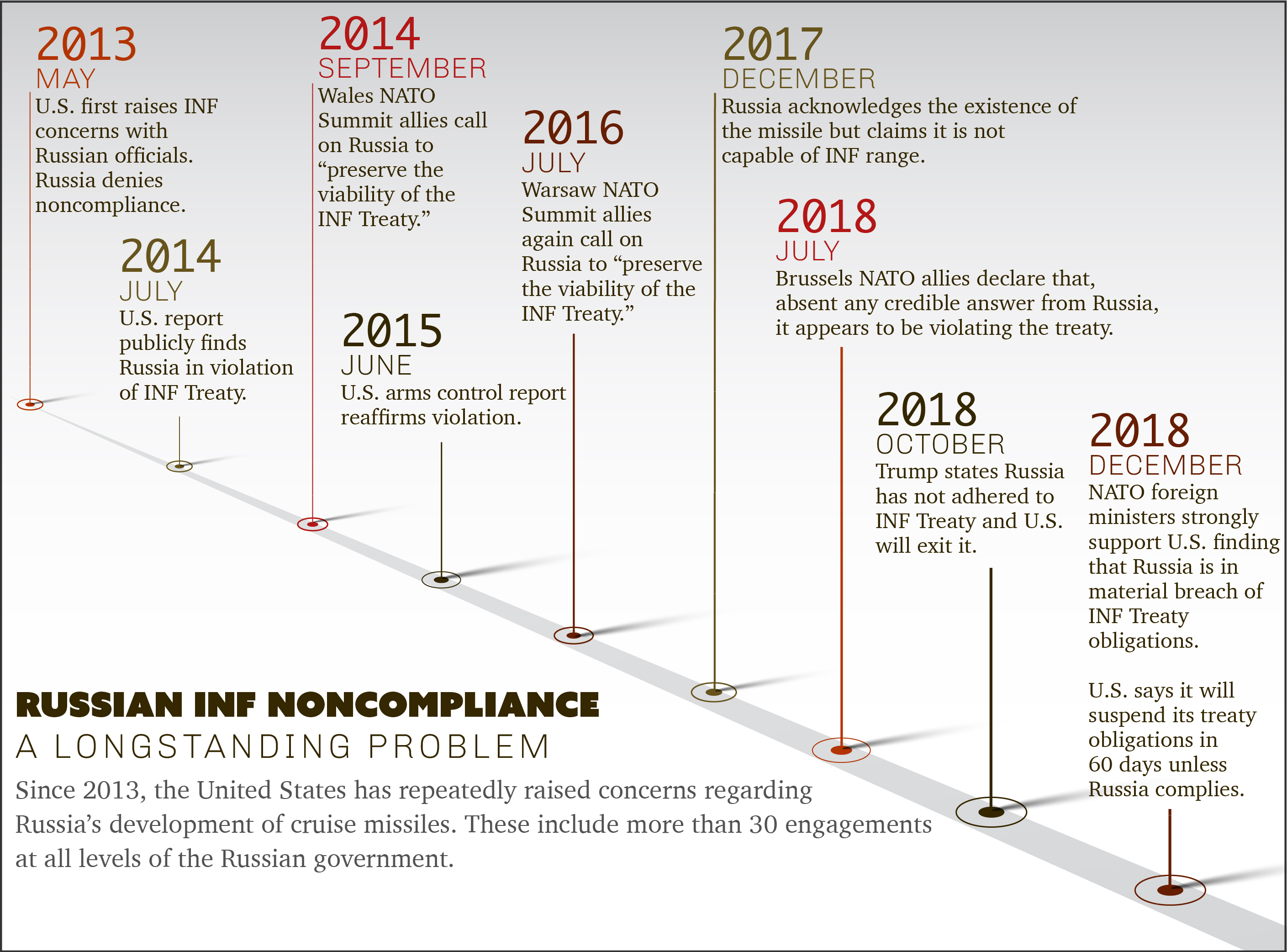
The US’s withdrawal was backed by several of its NATO allies, citing the years of Russia’s non-compliance with the INF treaty. In response to the withdrawal, Russian Deputy Foreign Minister Sergei Ryabkov invited the US and NATO “to assess the possibility of declaring the same moratorium on deploying intermediate-range and shorter-range equipment.
This moratorium request was rejected by Stoltenberg who said that it was not credible as Moscow had already deployed such warheads. On August 5, 2019, Russian president Vladimir Putin stated, “As of August 2, 2019 the INF Treaty no longer exists. Our US colleagues sent it to the archives, making it a thing of the past.”

On 18 August 2019, the United States conducted a test firing of a missile that flew over 500 km (310 mi) to its target. Such a test would not have been allowed under the treaty.
- Signed: 8 December 1987
- Entered into force: 1 June 1988
- Duration: Ceased to be in force on 2 August 2019, after the U.S. formally withdrew from the Treaty
- Parties: United States and Soviet Union (12 former republics of the USSR, six of which ― Russia, Ukraine, Belarus, Kazakhstan, Turkmenistan, and Uzbekistan ― had inspectable facilities on their territory).
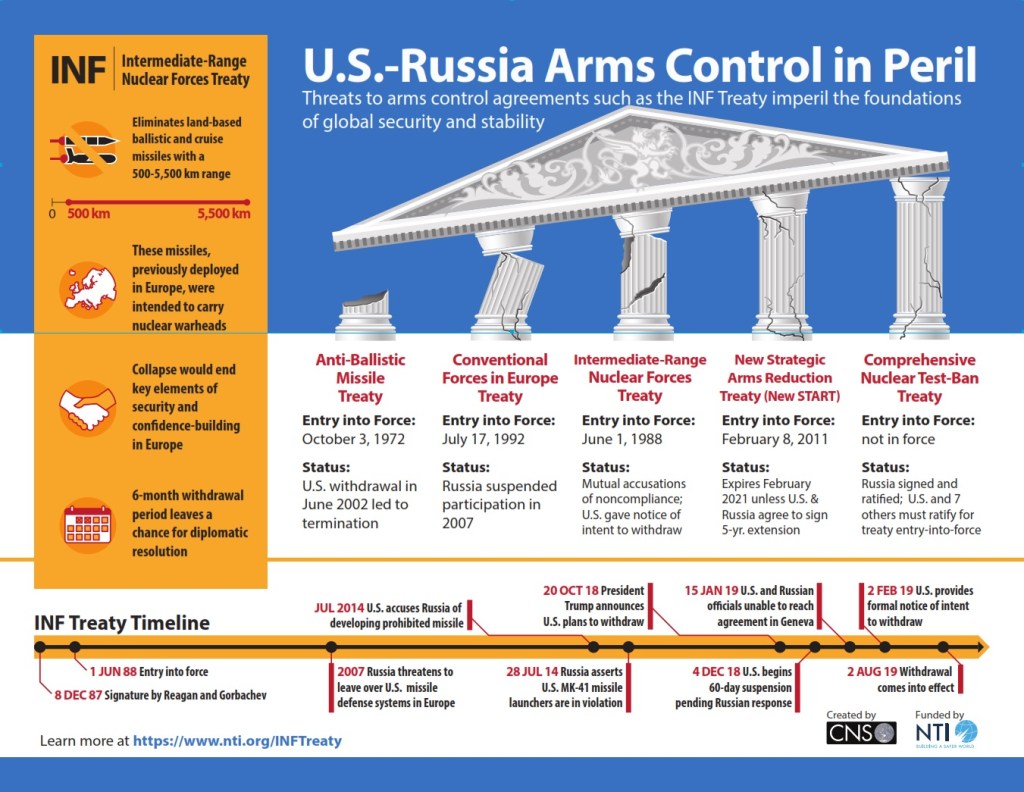
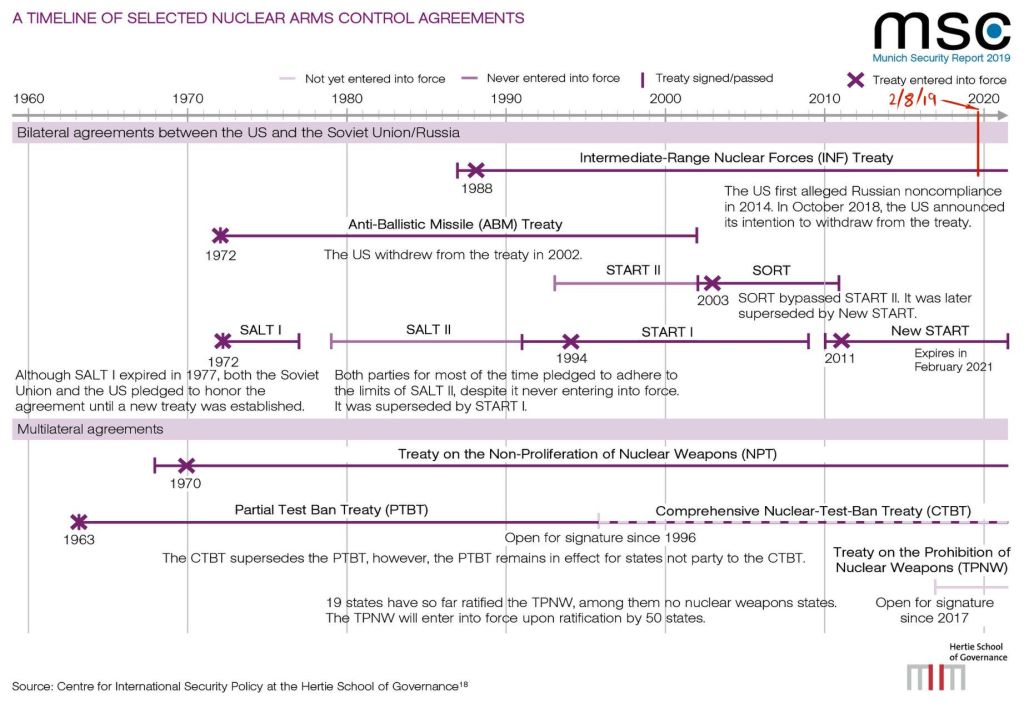
pic 1.. source: NTI (Nuclear Threat Initiative)
pic 2.. Source: Center of International Security Policy at the Hertia School of Governance…. edited the date 2/8/19 to update the timeline
The INF Treaty
- Great disarmament pact
- No nuclear warheads were dismantled and No air-launched and sea-launched missiles were not constrained.
- A bilateral agreement- the treaty did not restrict other countries (as age of bipolarity U.S. vs USSR)
- By 1991 –
- The USSR destroyed 1,846 missiles.
- The U.S. did the same with 846 Pershing and cruise missiles.
- Associated production facilities were also closed down.
- In keeping with Reagan’s dictum of ‘trust but verify’, the INF Treaty was the first pact to include intensive verification measures, including on-site inspections.
- In 2001, U.S. announced its unilateral withdrawal from the 1972 Anti Ballistic Missile Treaty (ABM Treaty).
- Russia believes U.S. took the 1st step with ABM treaty withdrawal.
- The U.S.’s 2017 National Security Strategy (NSS) and the Nuclear Posture Review (NPR) sought a more expansive role for nuclear weapons, in a break from the policies that had been followed since the end of the Cold War.
- Russia was seen as a ‘disruptive power’ pushing for a re-ordering of security and economic structures in Europe and West Asia in its favour.
- China was identified for the first time as a strategic competitor that was seeking regional hegemony in the Indo-Pacific region in the near-term and “displacement of the U.S. to achieve global pre-eminence in the future”.
- With the geopolitical shift to the Indo-Pacific, the U.S. believes that the INF Treaty was putting it at a disadvantage compared to China which is rapidly modernising and currently has 95% of its ballistic and cruise missile inventory in the INF range.
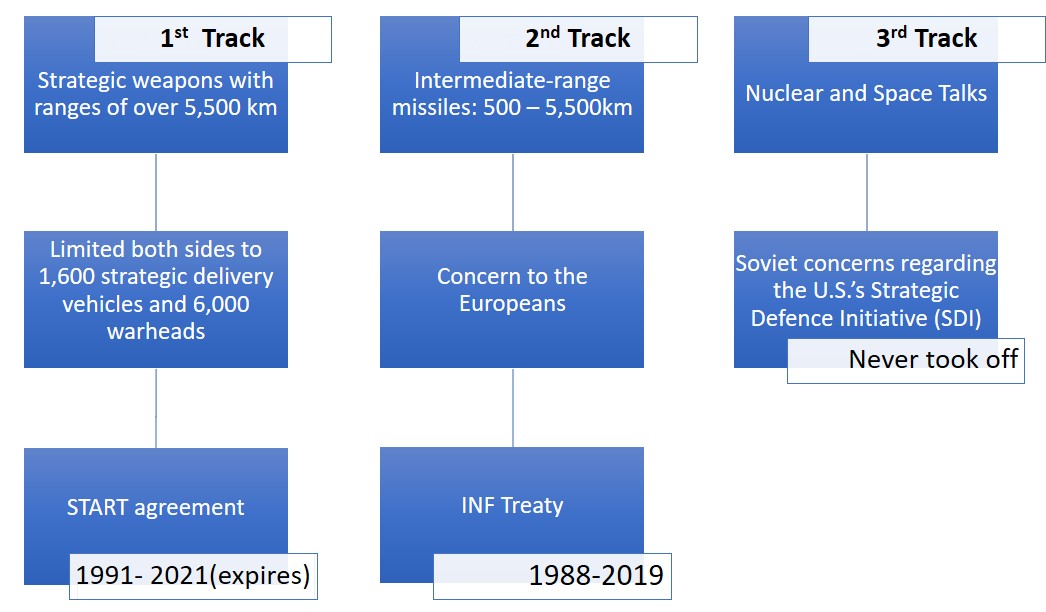
- The 2011 New START (successor to the START framework of 1991)
- limited both sides to 700 strategic launchers and 1,550 operational warheads.
- It lapses in February 2021 unless extended for a five-year period.
- Mr. Trump has indicated that a decision on the agreement will be taken in January 2021, after the 2020 election.
- If lapsed in 2021, for the first time since 1972, when the Strategic Arms Limitation Act (SALT) I concluded, strategic arsenals from the U.S. and Russia will not be constrained by any arms control agreement
Reference:
- nti.org –TREATY BETWEEN THE UNITED STATES OF AMERICA AND THE UNION OF SOVIET SOCIALIST REPUBLICS ON THE ELIMINATION OF THEIR INTERMEDIATE-RANGE AND SHORTER-RANGE MISSILES (INF TREATY)
- The Hindu –An end to arms control consensus by Rakesh Sood
- Center of International Security Policy at the Hertia School of Governance…. edited the date 2/8/19 to update the timeline
- Wikipedia
- Share America : What’s the INF Treaty? How is Russia breaching it by Christopher Connell
 MY BOX