- The Western Ghats is an extensive region spanning over 6 States, 44 districts and 142 taluks.
- India’s richest wilderness in 13 national parks and several sanctuaries.
- Recognised by UNESCO as one of the world’s 8 most important biodiversity hotspots, these forested hills are also sourcing to rivers, including the Godavari, Krishna and Cauvery.
- The Western Ghats acts as a huge water tank supplying water to 6 states. Now due yo leakage there is water shortage. Rivers are running dry now. Water is highly polluted.
Floods in kerala 2018 + 2019 both in august
Reason
High Precipitation due
- Anthropogenic development -Increase in greenhouse gasses (70% ↑ in 1970 – 2004) which disturbs hydrological cycle. + concretization of urban space
- Not adhering to create ESZ (economic sensitive zone) by Madhav Gadgil report + Kasturi Ranjan report
- Increase in house demand due to nuclear family + population density increase (860 person psqkm= kerala .. India= 382 ppsqkm)
- Increase infrastructure to support booming services.. Will convrt wetlands + paddy fields to plot lands.. Poor flood handling ability.
- Competitive Federalism.. Among states to get more investments + infrastructure development (Economy vs Ecology)
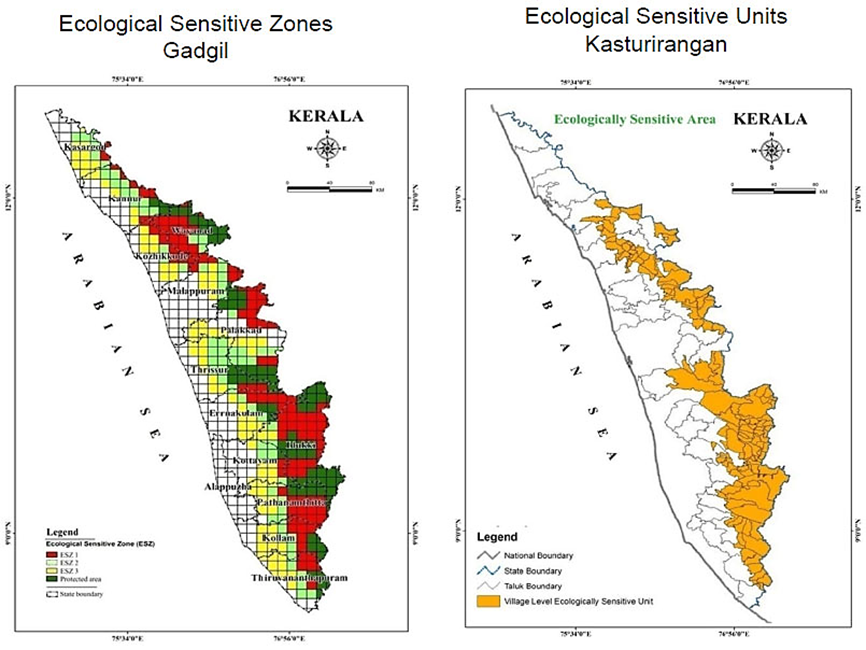
Gadgil Commission = Western Ghats Ecology Expert Panel (WGEEP)= was an environmental research commission appointed by the Ministry of Environment and Forests of India. its about western ghats.
WGEEP designated the entire hill range as an Ecologically Sensitive Area (ESA).
- The report classified the 142 taluks in the Western Ghats boundary ESZ 1, 2 and 3.
- ESZ-1 being of high priority, almost all developmental activities (mining, thermal power plants etc) were restricted in it.
- Recommended that “no new dams based on large-scale storage be permitted in Ecologically Sensitive Zone 1. Since both the Athirappilly of Kerala and Gundia of Karnataka hydel project sites fall in Ecologically Sensitive Zone 1, these projects should not be accorded environmental clearance,” it said.
- Specifies that the present system of governance of the environment should be changed. It asked for a bottom to top approach (right from Gram sabhas) rather than a top to bottom approach. It also asked for decentralization and more powers to local authorities.
- The commission recommended constitution of a Western Ghats Ecology Authority (WGEA), as a statutory authority under the Ministry of Environment and Forests, with the powers under Section 3 of the Environment (Protection) Act, 1986.
CRTICISM
- Was more environment-friendly and not in tune with the ground realities.
- Recommendations were impractical to implement.
- Western Ghats will be ESZ which hamper different states on energy and development fronts.
- Criticism against the constitution of a new body called WGEA. States insist that protection can be given under existing laws.
- Gadgil report doesn’t give a solution for revenue losses due to the implementation of its recommendations.
- Gadgil report is against dams in the Western Ghats, which is a crucial blow on the ailing power sector. Considering the growing energy needs of India, critics argue that this recommendation cannot be taken.
- And the most important: The Gadgil Committee report adversely affects the various mafia .therefore protests in Goa + Kerala.
Kasturirangan committee was constituted to examine the WGEEP report. The committee is often called HLWG – it denotes the 10 member high-level working group (HLWG), headed by Kasturirangan
- Instead of total area of Western Ghats, only 37% (i.e. 60,000 sq. km.) of the total area be brought under ESA under Kasturirangan report.
- A complete ban on mining, quarrying and sand mining in ESA.
- Distinguished between cultural (58% occupied in the Western Ghats by it like human settlements, agricultural fields and plantations) and natural landscape (90% of it should come under ESA according to the committee).
- Current mining areas in the ESA should be phased out within the next 5 years, or at the time of expiry of mining lease, whichever is earlier.
- No thermal power be allowed and hydropower projects are allowed only after detailed study.
- Red industries i.e. which are highly polluting be strictly banned in these areas.
- Kasturirangan report on the Western Ghats has made several pro-farmer recommendations, including the exclusion of inhabited regions and plantations from the purview of ecologically sensitive areas (ESAs).
- The Kasturirangan report had said 123 villages fall under the ESA purview.
CRITICISM
- Used remote sensing and aerial survey methods for zonal demarcation of land in the Western Ghats.
- The usage of such techniques, without examining the ground reality, has caused many errors in the report.
- The power is vested with the Bureaucrats and Forest officials and not with gram sabhas.
- Many fear that the farmers would get evicted if the Kasturirangan Committee report is implemented.
- Under this report, the mining and quarryinglobbies are expected to flourish which will be disastrous for the environment.
- There will be a water shortage, there will be pollution. Finally, farmers will have to quit the area. They will not be able to do farming there.
- Many rubber plantation village came under ESA due to “erroneous method”.
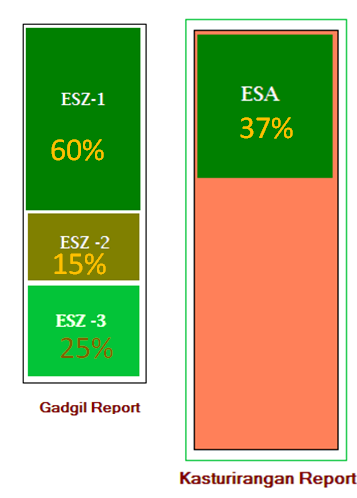
ESA ke andar ESZ bante hai
Gadgil- 1,29,037 sq km.. 142 taluks
Kasturirangan – 1,64,280 sq km.. 188 taluks
Gadgil’s Western Ghats smaller than that of Kasturirangan’s.
- The reports were neither available in the public domain nor the opinion of states was asked. So the National Green Tribunal (NGT) intervened.
- A bench headed by NGT Chairperson Justice Swatanter Kumar imposed a fine of Rs 25,000 on the ministry for failing to file its final report on recommendations of two panels set up to study environmental sensitivity and ecological significance of the Western Ghats, saying better standards were expected from it.
 MY BOX