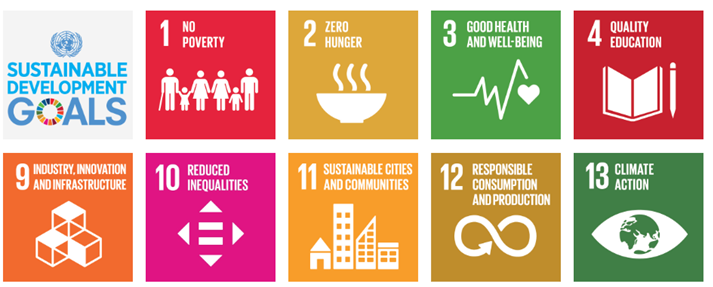
Sustainable Development Goals
- The 2030 Agenda for Sustainable Development -blueprint for peace and prosperity for people and the planet, now and into the future
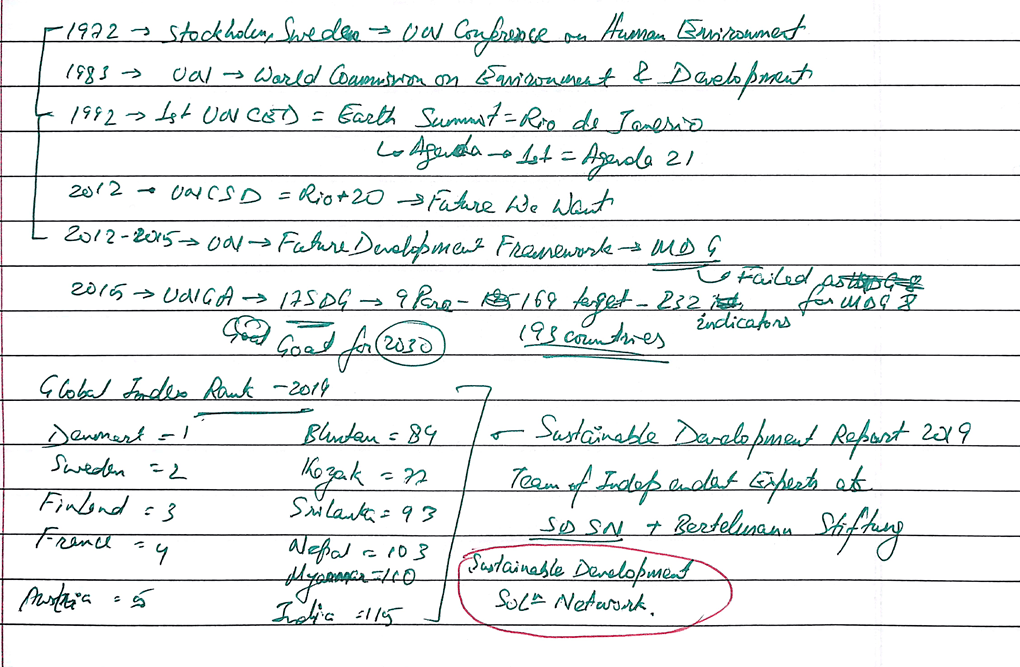
- In June 1992, at the Earth Summit in Rio de Janeiro, Brazil, more than 178 countries adopted Agenda 21,
- 8 Millennium Development Goals (MDGs) to reduce extreme poverty by 2015.
- At the UN Conference on Sustainable Development (Rio+20) in Rio de Janeiro, Brazil, in June 2012, Member States adopted the outcome document “The Future We Want”
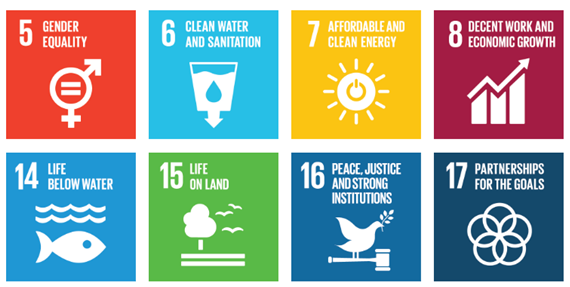
- In January 2015, the General Assembly began the negotiation process on the post-2015 development agenda. The process culminated in the subsequent adoption of the 2030 Agenda for Sustainable Development, with 17 SDGs at its core, at the UN Sustainable Development Summit
- 2015 was a landmark year for multilateralism and international policy shaping, with the adoption of several major agreements:
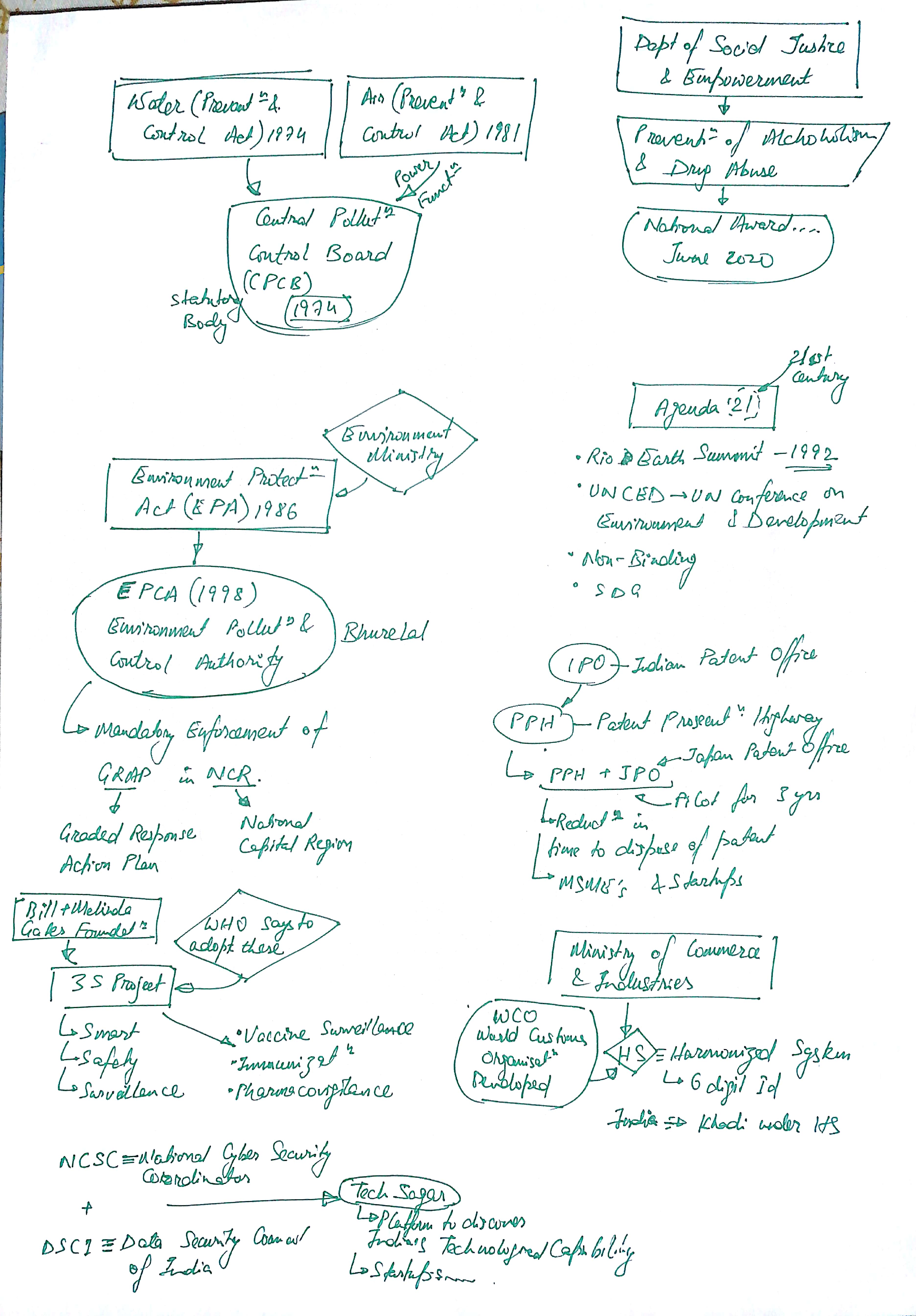
- Sendai Framework for Disaster Risk Reduction (March 2015)
- Addis Ababa Action Agenda on Financing for Development (July 2015)
- Transforming our world: the 2030 Agenda for Sustainable Development with its 17 SDGs was adopted at the UN Sustainable Development Summit in New York in September 2015.
- Paris Agreement on Climate Change (December 2015)
- Now, the annual High-level Political Forum on Sustainable Development serves as the central UN platform for the follow-up and review of the SDGs.
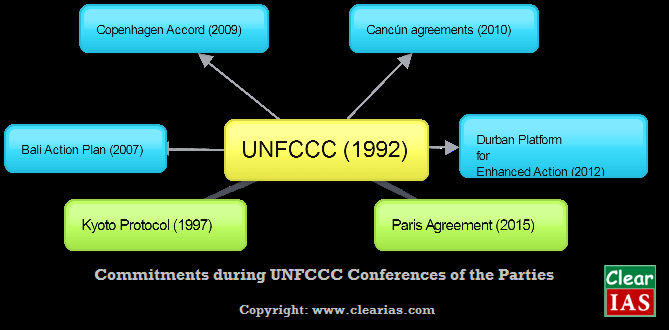
The UNFCCC entered into force on 21 March 1994. Today, it has near-universal membership.
The 197 countries that have ratified the Convention are called Parties to the Convention. The UNFCCC is a “Rio Convention”, one of three adopted at the “Rio Earth Summit” in 1992.
Reducing emissions from deforestation and forest degradation
REDD+ is a voluntary climate change mitigation approach that has been developed by Parties to the UNFCCC. It aims to incentivize developing countries to reduce emissions from deforestation and forest degradation, conserve forest carbon stocks, sustainably manage forests and enhance forest carbon stocks.
Developed countries paying developing countries to not cut down, or re-grow, their forests.
The Kyoto Protocol is an international treaty which extends the 1992 United Nations Framework Convention on Climate Change (UNFCCC) that commits state parties to reduce greenhouse gas emissions, based on the scientific consensus that (part one) global warming is occurring and (part two) it is extremely likely that human-made CO2 emissions have predominantly caused it. The Kyoto Protocol was adopted in Kyoto, Japan, on 11 December 1997 and entered into force on 16 February 2005. There are currently 192 parties (Canada withdrew from the protocol, effective December 2012)[4] to the Protocol.
RAMSAR Convention-2/2/1971 in Ramsar (Iran)
Intergovernmental + Non binding
“the conservation and wise use of all wetlands through local and national actions and international cooperation, as a contribution towards achieving sustainable development throughout the world”
Define wetlands as
“… areas of marsh, fen, peatland or water, whether natural or artificial, permanent or temporary, with water that is static or flowing, fresh, brackish or salt, including areas of marine water the depth of which at low tide does not exceed six metres.” (Ramsar Convention, 1971, Article 1.1)
The Montreux Record is a register of wetland sites on the List of Ramsar wetlands of international importance where changes in ecological character have occurred, are occurring, or are likely to occur as a result of technological developments, pollution or other human interference.
e.g.- Sambar lake in Rajasthan
Vienna convention–Non binding agreement- 1985- ozone hole detected
To encourage ozone related research
To monitor CFCs
Detecting other ozone depleting substance (ODS)
Vienna= capital of Austria
Montreal Convention–Binding agreement– 1987; 1989
To phase out all ODS globally.
197 countries
most successful- Depleted Ozone recovered
Montreal, CANADA
Kigali Amendment– (legally Binding with mandatory targets for countries)
to the Montreal Protocol came into force on 1/1/ 2019. Under the Kigali Amendment countries promised to reduce the use of hydrofluorocarbons (HFCs) by more than 80% over the next 30 years- 2047.
Kigali = capital of Rwanda
Though HFC isnt Ozone depleting gas but a GHG— it is added in Kigali + Montreal as it is legally Binding whereas Kyoto wasnt.
Notterdam Convention– 1998; 2004
Prior Informed Consent (PIC) Harmful chemicals + Pesticide
promote cooperation and responsibility
Notterdam, Netherland
Basel convention– 1989; 1992
Control of Transboundary Movements of Hazardous Wastes and their Disposal, is to protect human health and the environment against the adverse effects of hazardous wastes.
Basel, Switzerland
Stockholm Convention on Persistent Organic Pollutants– 2001; 2004
The Governing Council of the United Nations Environment Programme (UNEP) called for global action to be taken on POPs, which it defined as
“chemical substances that persist in the environment, bio-accumulate through the food web, and pose a risk of causing adverse effects to human health and the environment”. e.g. DDT, Aldrin,
Following this, the Intergovernmental Forum on Chemical Safety (IFCS) and the International Programme on Chemical Safety (IPCS) prepared an assessment of the 12 worst offenders, known as the dirty dozen.
Minamata Convention- 2013
(Legally Binding) The primary aim of the Convention is “to protect human health and the environment” from mercury releases that BIOmagnifies in every food chain step.
Minamata disease is a neurological syndrome caused by severe mercury poisoning. … A congenital form of the disease can also affect fetuses. Minamata disease was first discovered in Minamata City in Kumamoto prefecture, Japan in 1956.
Therafter UNE (now UNEP) was established in 1972.
UNEP- United Nations Environment Programme
Paris Agreement– 2015; 2020 .. non binding
Wont let the temp rise >2C
100 Bill Dollars will be given by Developed countries in 1st 5 yrs.
An international agreement to combat climate change (ccc).
Paris Agreement is the world’s first comprehensive climate agreement. Although developed and developing countries were parties to Kyoto Protocol, developing countries were not mandated to reduce their emissions. Kyoto is going to end in 2020 so, we need Paris Agreement.
COP= Conference of the Parties
CMP= Conference of the Parties serving as the meeting of the Parties to the Kyoto Protocol
The Conference of the Parties, the supreme body of the Convention, shall serve as the meeting of the Parties to the Kyoto Protocol.
Paris Agreement 2015 was formed in COP21 & CMP11
- Keep the global temperature rise this century well below 2 degrees Celsius above the pre-industrial level.
- Pursue efforts to limit the temperature increase even further to 1.5 degrees Celsius.
- Strengthen the ability of countries to deal with the impacts of climate change.
Nationally Determined Contributions (NDC)
- The national pledges by countries to cut emissions are voluntary.
- The Paris Agreement requires all Parties to put forward their best efforts through “nationally determined contributions” (NDCs) and to strengthen these efforts in the years ahead.
- This includes requirements that all Parties report regularly on their emissions and on their implementation efforts.
- In 2018, Parties will take stock of the collective efforts in relation to progress towards the goal set in the Paris Agreement.
- There will also be a global stock take every 5 years to assess the collective progress
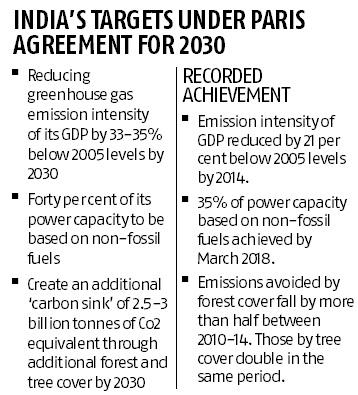
What is India’s progress with respect to the targets?
- According to the Draft update report, India is set to meet 2 of its 3 Paris Agreement goals.
- India is well on way to achieve the target for emission intensity of the economy and share of non-fossil fuel-based power capacity.
- The report notes that citing Central Electricity Authority India had ensured 35 % of its capacity is based on non-fossil fuel base such as renewable, hydroelectricity and nuclear.
- Another 17-23 GW of non-fossil fuel capacity addition could take India to the target well before 2030.
- A point to remember: India did not commit internationally to the renewable energy capacity target (40 % of its capacity would be from non-fossil fuel sources, which includes large hydropower as well as nuclear power).
- In fact, at current rates of improvement on both fronts, India could achieve these targets ahead of the 2030 deadline.
- But the country has so far not been able to make start towards the target for increasing India’s forest cover.
- This goal of increasing forest cover is to create an additional carbon sink.
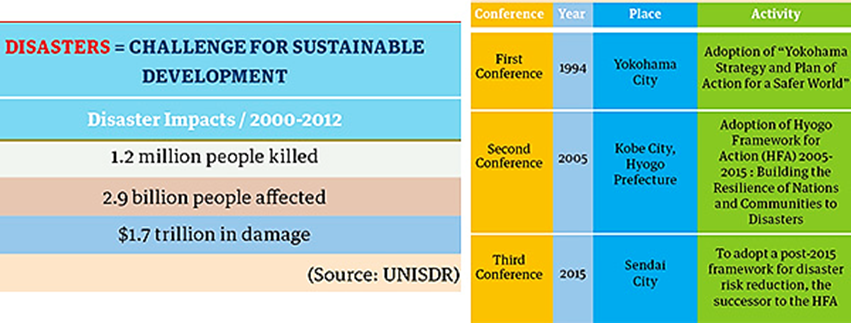
DRR- Disaster Risk Management
UNESCO
The United Nations Educational, Scientific and Cultural Organization (UNESCO), formed in 1945, is a specialized agency of the United Nations (UN) based in Paris.
•Its declared purpose is to contribute to peace and security by promoting international collaboration through educational, scientific, and cultural reforms in order to increase universal respect for justice, the rule of law, and human rights along with fundamental freedom proclaimed in the United Nations Charter.
•UNESCO has 193 members now.
1 trillion USD required to achieve UN’s Decarbonization Target of Shipping Industry
•UN targeted reducing carbon emissions from shipping industry by 50% by 2050 as compared to the levels in 2008.
•1 trillion USD figure = A study of London based Energy Institute (University College London’s Energy Institute)
•2.2% CO2 emission = Shipping
•invest at least 50 to 70 billion USD annually.
UNESCO and Dell Technologies will launch a new education programme where they will train 4,000 Indian teachers in Artificial Technology.
•3 phase program
•The programme will help in achieving United Nations Sustainable Development Goal 4.7.
The 13th APSA award: Asia Pacific Screen Awards which are Asia Pacific’s highest accolade in film were awarded in Brisbane, Australia
•Best Feature Film: ‘Parasite’, directed by South Korea’s Bong Joon-Ho
•Best Performance by an Actress: Max Eigenmann in ‘Verdict’
•Best Performance by an Actor: Manoj Bajpayee in ‘Bhonsle’
•Realises objectives of UNESCO to promote and preserve respective cultures through the influential medium of film
World Heritage Week is celebrated by UNESCO— Nov 19, 2019 to Nov 25, 2019.
•The Objective of celebrating World Heritage Week is to increase awareness among people about safety and preservation of cultural heritages and monuments.
Ever year 10th of November is celebrated as World Science Day for Peace and Development.
2019 Theme: ‘Open science, leaving no one behind’
National Water Mission
NAPCC–> NWM <– MoWR
Goal 1: Comprehensive water data base in public domain and assessment of the
impact of climate change on water resource;
Goal 2: Promotion of citizen and state actions for water conservation,
augmentation and preservation;
Goal 3: Focused attention to vulnerable areas including over-exploited areas;
Goal 4: Increasing water use efficiency by 20%;
Goal 5: Promotion of basin level integrated water resources management.
 MY BOX