Persistive variance SDG DEC_19
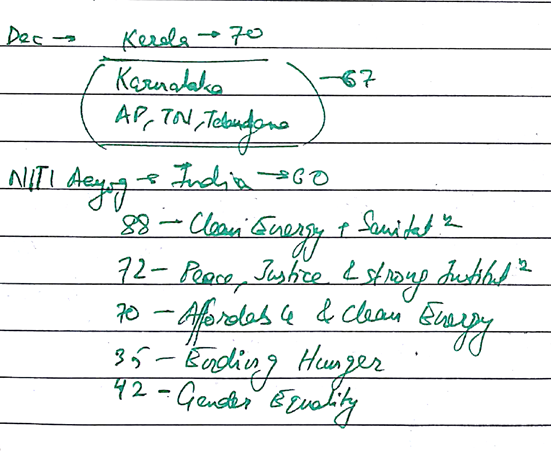
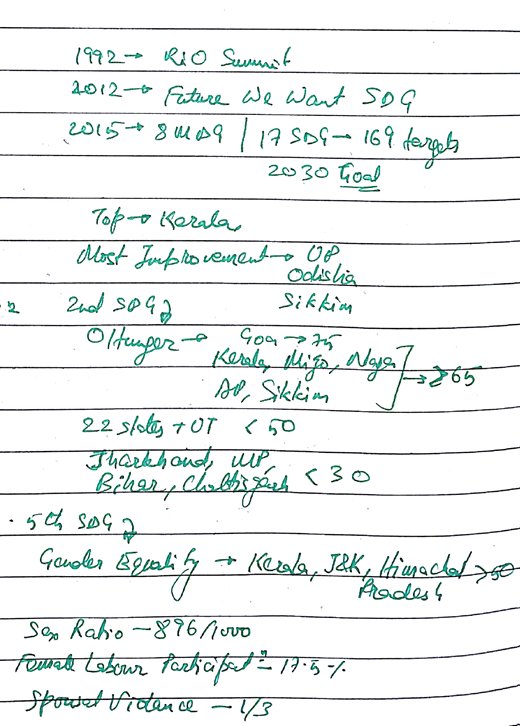
The NITI Aayog’s Sustainable Development Goals Index for 2019, released on Monday, does not reveal any surprising information. The South’s Kerala, Tamil Nadu, Andhra Pradesh, Telangana and Karnataka are joined by Himachal Pradesh, Sikkim and Goa as the best performers while the northern/north-central and north-eastern States have been laggardly in achieving the UN-mandated goals by 2030.
Poor performers such as Uttar Pradesh have shown discernible advances in the indices — measured between 2018-19 — especially in adopting cleaner energy and improving sanitation. But the regional divide is stark in basic livelihood goals such as “eradication of poverty”, and “good health and well being” or even in measures such as “industry, innovation and infrastructure”. This points to variances in both State governance and in administrative structures and implementation of welfare policies. The South, led by Kerala and Tamil Nadu, has done much more in orienting administrative institutions to deliver on basic welfare, leading to actions on health care, education, poverty eradication and hunger, with a governance structure tuned to competitively monitoring actions on these fronts.
The converse is true of northern States — Bihar and Uttar Pradesh — where outcomes have remained relatively poor despite there not being much of a difference in the governance structure. The obvious answer to the puzzle could be the presence of historical socio-political movements that have resulted in greater circulation of elites in power and which have addressed issues related to welfare more thoroughly in the South — Kerala and T.N in particular. Yet even these States need to go further in reaching the UN’s SDGs and achieving the living standards of both the first world and other developing nations.
The western States, especially Gujarat and Maharashtra, are also better off in economic growth and industry, indicating a diversified economy, higher employment ratios, skilled labour and better entrepreneurial culture. A major fault-line in India is in achieving gender equality, where barring middling performers such as Himachal Pradesh, Kerala and Jammu & Kashmir, the rest of the country falls short. Low sex ratio (896 females per 1,000 males), poor labour force participation and presence in managerial positions (only 17.5% and 30%, according to the report), high level of informality of labour, a major gender pay gap (females earn 78% of wages earned by males in regular salaried employment), lack of adequate representation in governance (14.4% in Parliament, but 44.4% in local government) besides high crime rates against women and girls are among the major national level indicators that have contributed to this. States need to climb a mountain to achieve gender equality, but immediate steps such as enhancing women’s participation in governance through parliamentary reservations would go a long way in addressing several of the issues faced by them.
A group of Theocracies
The improvement in India’s ties with the Gulf countries is often cited as a major success of the present government. Prime Minister Narendra Modi’s focus on relations with the Kingdom of Saudi Arabia (KSA) and the United Arab Emirates (UAE), which he has visited more than once in his tenure, and his personal ties with their most powerful royals, has yielded accolades and promises of investment. In March 2019, it resulted in then External Affairs Minister Sushma Swaraj addressing the 57-member Organisation of Islamic Cooperation (OIC) in Abu Dhabi, a breakthrough for India.
The government’s outreach to the grouping was seen as a way of strengthening ties with the “Muslim world” including West Asian countries where more than six million Indians live and work. It was therefore disappointing for the government to note that in June, the OIC appointed a “special envoy” on Jammu and Kashmir, and subsequently issued several strongly worded statements on the government’s decision to amend Article 370 of the Constitution, the Supreme Court verdict on the Ayodhya dispute and the Citizenship (Amendment) Act, 2019, or the CAA. And last week, according to Pakistani officials, the OIC decided to convene a special meeting in Islamabad in 2020 to discuss the Kashmir issue and the repercussions of the CAA, after discussions the Saudi Foreign Minister had in Islamabad. It should be clear to the government that the engagement with the grouping this year was a miscalculation.
In any case, the basis of the OIC is a unity between theocratic Muslim states, an idea that India, as a secular country with a large Muslim population has never been aligned with. At all costs, attempts by the OIC to make statements and arrogate to itself the well-being of India’s Muslims must be rebuffed as gross interference.
However, New Delhi must note that the OIC’s recent statements also stem from a broader tussle within the grouping that has become a concern for traditional leaders, the KSA and the UAE. The challenge comes chiefly from Malaysia, where Prime Minister Mahathir Mohamad has revived his plans for a “reformed” OIC, and has enlisted other challengers to the Riyadh-Abu Dhabi domination of the pan-Islamic movement including Iran, Turkey and Qatar. In that sense, the OIC’s criticism of India is a clear attempt at reaffirming its leadership of the movement. New Delhi must strengthen ties with its strategic partners in the region on both sides of the divide without taking sides or becoming collateral damage in the internecine warfare between them. But it must also be wary of groupings with nothing in common other than a religious world view.
An unclear revamp – GS2
There is no clarity on whether the recent MEA restructuring aligns with India’s strategic goals
The restructuring of the Ministry of External Affairs (MEA) to effectively empower 7 different Additional Secretaries and reorganise their tasks along themes has been widely reported. There is less discussion on whether strategic goals have been updated and how the new capabilities mesh with expected outcomes.
Identifying areas of longer term impact, empowering Additional Secretaries to oversee integrated tasks and giving Secretaries more time to strategise are laudable objectives of the organisational change. Inducting outside expertise in areas such as trade and economics, and cultural power and development partnerships is also needed as the contours of these issues are more technical than diplomatic. That apart, negotiations in international organisations require understanding the negotiating strategy of others; listing compromises made in the past to secure lost ground; and assessing in advance implications of the inevitable tradeoffs that are made at the final stage.
But India’s civil service tenure rules do not recognise the importance of negotiation history and global trends. For example, in climate change since the early 1990s, the same diplomats from the U.S., European Union, Russia, China and Saudi Arabia remained involved for the duration of serious negotiations for over 20 years.
Integration of 2 verticals
Consolidated territorial divisions reflect changing geopolitical realities in Europe, Africa and West Asia, but how are our vital interests affected by the integration of the Indian Ocean and IndoPacific regions into one vertical?
We see the region, as the Prime Minister stated in the ShangriLa Dialogue in Singapore, in 2018, as a “free, open, and inclusive” region, not “directed against any country,” with “Southeast Asia at its centre.”
But are relations with ASEAN part of the vertical’s remit? How will it interact with the other new verticals on international organisations and trade? Have India’s priorities changed on maritime security?
It is also unclear why we are focusing to this extent on ‘soft power,’ or on shaping the preferences of others in terms of culture, instead of sharing the technology layer powering Aadhaar, in which many other countries have been showing an interest. The missing piece in the restructuring is silence on the role of the Public Policy and Research Division, now headed by an outstanding officer. It was central in an earlier round of restructuring with inclusion of military officials and consultants from academia and thinktanks. In reply to a Parliament question, Sushma Swaraj, former External Affairs Minister, had described the Division’s mandate in terms of publication of the Annual Report of the Ministry, preparation of the Monthly Summary of important developments for the Cabinet, and supervision of the functioning of the MEA Boundary Cell, MEA Situation Room and MEA Library. No assessment of the Division’s coordinating role has been shared outside the Ministry, if it has been made.
Unrealised potential
This raises the question of whether the persisting gap between our potential to play a global role and performance, which shows us more as a regional power, has been addressed. This would require us to understand why there is a gap in identifying decisions and actions that are more important than others, and in making difficult choices about what is most important.
Have we assessed the future impact and consequences of today’s decisions? What is the new vision of the MEA? In a fastchanging global environment, resources need to be concentrated on a limited number of objectives, to be achieved within a defined timeframe. The institutions and rules established by the U.S. and the Belt and Road Initiative of China are examples. What is our ‘big idea?’ As the diplomats and the Chief of Defence Staff work out their new roles, they need to recognise that rearranging silos does not dilute the role of politicians and of officials in working across departmental boundaries.
The contours of the new order, with India and China as key players, should not be seen through a western prism
After a gap of 200 years, Asian economies are again larger than the rest of the world’s combined. As India and China resolve their border dispute, Asia is providing the multilateral alternative to a world divided by values, and no longer by ideology.
The phrase ‘Asian Century’ is said to have arisen in the 1988 meeting between Chinese leader Deng Xiaoping and former Indian Prime Minister Rajiv Gandhi, re-establishing relations after the India-China border conflict in 1962. It responds to the re-emergence of the two countries, leveraging size and technological competence to shape a new order that reflects their civilisational values which are distinct from those of the West. The travails of the West, for example, stagnating incomes of the middle class and also climate change, confirm that the global division is now based on values, as has been the case throughout civilisation. Even notions of a balance of power are a western construct, as the Asian giants have by and large lived in peace across the ages.
China, in 2013, after attaining 15% of global wealth, announced the multilateral Belt and Road Initiative (BRI) and in 2014, launched the Asian Infrastructure Investment Bank, challenging the global governance paradigm. In 2015, emerging India established the International Solar Alliance, laying out a distinct global sustainable development framework, and seeking a triumvirate.
The United States has recognised the ‘Asian Century’ bypassing multilateralism; its direct dealings with China and India and the Indo-Pacific construct are examples. The way the U.S. defined human rights solely in political and procedural terms, withdrew from climate change after shifting the burden onto developing countries and the forced inclusion of intellectual property rights into the trade regime illustrate the colonial origins of current multilateralism now being questioned by even its proponents and not just by Asia.
New frameworks
The decisive shift responds both to the Asian growth engine and to Asian technology. Global competition is moving away from country-specific actions to fragmented competition, transformed by global value chains accounting for three-quarters of the growth in global trade over the 20-year period: 1993-2013. There is no provision in global trade rules for company-specific concerns where the global digital economy rather than countries are determinants of wealth and power. Imposing U.S.-determined national security standards on the world has led to only a handful of countries agreeing to ban Huawei 5G technology, has angered Europe over sanctions on companies building a gas pipeline from Russia; sanctions on Iran have affected India’s interests, impacting long-term relations and forcing a tacit choice between the two systems.
China, which had never been fully colonised and is keen to get rich quick, has a head start over India in laying out a new multilateralism based on “common interests” as different from agreed goals of a negotiated treaty. The BRI bilateral agreements optimise, not maximise, financial returns with countries having an effective veto by remaining outside. Countries support the BRI — it covers the territories of 72 countries and 70% of the world population — as a network-based evolving process even with market-based interest rates because of benefits of connectivity and integration into Eurasian markets. Half of future BRI funding is expected from multinational corporations and multilateral banks, adding to their stake in solving difficulties.
Potential of BRI
The BRI provides a strategic framework for new global institution building as its scope is as wide as multilateral treaties. For example, state-owned enterprises in infrastructure sectors in the BRI, with backing from national banks, are contributing to internationalisation of the Renminbi, enhancing China’s role in global economic governance.
As the world leader in digital transactions China is developing block chain-based financial infrastructure in BRI countries and exploring an international block-chain currency for digital settlements without relying on the dollar, thus reducing U.S. leverage.
With the speed and scale of such change, rising Asia remains wary of China and is eager, as is China, that India joins the Regional Comprehensive Economic Partnership, poised to become the world’s largest trading bloc because of the huge Indian market. With the U.S. military ‘pivot to Asia’, China is keen to resolve the border dispute with India to avoid constraints. The recent India-China Summit on boundary issues resolved to work out a “framework on a roadmap to a final solution on border issues”; India has rejected American opposition to Huawei taking part in 5G trials. The Indian government has allowed all applicants, including Huawei Technologies Co. Ltd, to participate.
New values
The contours of the new order should not be seen through a western prism. In 2018, China was the largest supplier of goods to the U.S.; it has also been India’s major trading partner. Every big state has bilateral relations with all three, and they take part in limited sectoral cooperation on a regional basis. Even faraway NATO has recently discussed the implications of the rise of China; China, like India, is not part of any collective security system. Both the U.S. and China have regular high-level discussions on strategic issues with India, recognising its demographic, technological and resource potential to be part of a future global triumvirate.
What are the implications of this state of flux? Asia formed two-thirds of world GDP, and colonialism, not stagnation, led to a decline of the Asian giants. Their re-emergence is not part of a global transformation of “westernization”. The border problem, too, is a remnant of colonialism and not the result of aggression.
Clearly, the U.S., China and India will retain their civilisational models into the future. In Asia, differences will centre on overlapping priorities — security (the U.S.’s efforts to maintain hegemony), economic (China’s emphasis on connectivity, markets and growth) and equitable sustainable development (India-led framework of digital infrastructure designed as a public good). By 2030, there is every possibility of a triumvirate
Asia, and Africa, former colonies with conditions closer to India than to China, are waiting for late-comer India, a civilisational state like China, to lay out its vision of a digital, cooperative, sustainable multilateral strategic framework to complement the frameworks of the other two powers. Early concrete moves for their simultaneous rise are in the global interest.
SAARC VS BIMSTEC— The Indian POV
South Asia is one of the least “∫” integrated Region in the world
South Asia–> Intra- region–> 5% of total South Asian Trade
ASEAN region–> Intra- region–> 25%
World BAnk–> South Asian Trade–> $23 Biilion of an estimated value of $64 billion
Trying to Resuscitate the negotiation on a SAARC investment Treaty–> 2007
UN Conference on Trade & Development–> Intra- region investment–> ~19% of Total invested in the region
SAARC revival is important for INDIA
South Asean Association for Regional Cooperation
bangladesh–> Gen Ziaur Rehmann
1985–> 7 leaders
2007–> Afghanistan
Strives for PEACE + Stability
BIMSTEC–> more preferred by India. Why?
- China moved shifted gears from land to sea disputes–> Maritime diplomacy needed.
- More Cordial relation with the members
- No Pakistan
- Goes with Act East Policy
- focused on trade
So why SAARC failed?
Why ghas nai de rha koi?
- No China + No Myanmar
- Everybody wants to be Big Player
- Everybody stuck due to India vs Pakistan
- became platform for Regional Political issues
MArch 2020–> PM Modi–> online conference with SAARC countries–
agendas-
- SAARC Emergency Fund
- Rapid Response team
So why Revival of SAARc?
China–> Nepal + Bhutan + Myanmar +Srilanka+ Maldives<– has Economic relation +Border Dispute
China + JApan + EU + USA + Korea = Observing nation in SAARC
Neighbours are Neighbours
–> COVID -19–> Reviving SAARC
CHINA⇈ || INDIA⇈
China wooing Bangladesh by Tariff exemption of 97%
Most South Asian countries are heavily dependent on Chinese imports despite geographical proximity to India.
There has been India vs China since 2014… India–> trying to depict Pakistan as terrorist State.
But Prof Muni–> pak is not facing any isolation internationally. India started investing in BIMSTEC but cant replace SAARC.
Shortcomings pf BIMSTEC–>
- Lack of common Identity
- No rich history with BIMSTEC countries
- Onlu Bay of Bengalregion–> Inappropriate to focus on all South Asian countries.
Putting victims on trial
Late June, a single bench of the Karnataka High Court granted anticipatory bail to a man accused of rape. Reasons could be
1. Lack of seriousness of the offence
2. Patriarchal biases of the players in our justice system
3. Associated stereotypes.
Intimidation of the complainant, which would prevent her from being an effective witness in the trial stereotypes is that ‘genuine’ victims/survivors can be recognised by the discernibly common patterns of behaviour they exhibit.
These situations may include anything that is seen as a social taboo for women: whether it is drinking, partying, or indeed, as stated by the defence in the infamous Nirbhaya case, simply being out at night.
Shifting the burden onto the victim
Another common stereotype is that ‘genuine’ victims/survivors physically resist their assailants or shout for help. For instance, in Mahmood Farooqui v. NCT of Delhi (2017), the High Court of Delhi had held that the complainant’s ‘feeble no’, even when spoken, would not be sufficient evidence of lack of consent.
Why judge victim when accused should be tried
Past sexual history with the accused, her consent would be assumed, and any ‘unwillingness’ or ‘hesitation’ on her part would be disregarded. The greatest evil of rape myths or stereotypes is that they put the victim, rather than the accused and society, on trial. The focus shifts from whether the accused committed the offence to whether the victim/survivor’s behaviour met patriarchy’s exacting standards.
The law says
The rape law for adults in India, as amended in 2013, specifically states that failure to resist cannot be taken as evidence of consent. In fact, consent, whether verbal or nonverbal, has been defined to mean ‘unequivocal voluntary agreement’.
Passive submission (which may arise out of fear or deeprooted social conditioning) or acquiescence to nonsexual acts such as drinking together, cannot and should not be equated with consent to sex. The 2013 Amendment also laid down that consent would mean willingness to participate in a ‘specific’ sexual act. Therefore, consent given for a particular sexual liaison cannot be read as ongoing consent, given in perpetuity.
No universal script
It is impossible and unjust to have a universal script against which the behaviour of individual victims/survivors is assessed, because each person and each circumstance is distinct.
Rape myths and stereotypes echo the deeply entrenched patriarchal biases of the players in our criminal justice system, and of society at large. When used in judgments, they become a permanent part of the legal record. As precedent, they create a chilling effect for all future victims/survivors of rape, making the criminal justice system even more unapproachable than it is. This calls for urgent and renewed efforts towards sensitisation and for the need to make sensitivity in handling sexual offences part of our judicial incentive structure.
 MY BOX