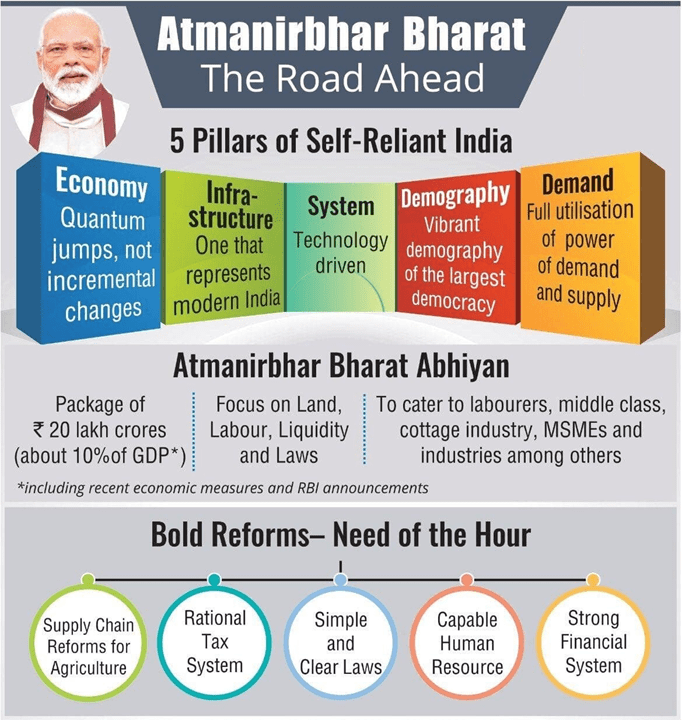
The Atmanirbhar Bharat Abhiyan (meaning self-reliant India scheme) was announced in four tranches by the Union Finance Minister Nirmala Sitharaman in May 2020.
- Govt announced–> Economic stimulus relief package to be worth Rs.20 Lakh crores.
- This includes the already announced Rs 1.70 lakh crore relief package, as the PMGKY, for the poor to overcome difficulties caused by the coronavirus pandemic and the lockdown imposed to check its spread.
- 5 pillars:
- Economy
- Infrastructure
- 21st-century technology-driven arrangements and system
- Demand
- Vibrant Demography
- The 20 lakh crore worth package is almost 10% of the GDP of the country.
- The package emphasizes on land, labour, liquidity, and laws.
- The package includes measures across many sectors such as MSME, cottage industries, middle class, migrants, industry, etc.
- Several reforms are announced to make India a self-reliant economy and mitigate negative effects in the future. Some of the reforms are:
- Simple and clear laws
- Rational taxation system
- Supply chain reforms in agriculture
- Capable human resources
- Robust financial system
Tranches
- 1st tranche contained 16 specific announcements and they spanned across the MSME, NBFC, real estate, power sectors, etc.
- 2nd tranche focuses on providing free food grains to migrant workers who do not possess ration cards.
- 3rd tranche of the economic relief package focuses on agricultural marketing reforms.
- Final tranche focuses on the sectors of defense, aviation, power, mineral, atomic, and space. There is a huge emphasis on privatization.
1st tranche–>
Taxpayers–>
- Extended deadline for income tax returns for the financial year 2019-20 (due date = 30 Nov 2020)
- TDS and TCS have been cut by 25% for the next year.
- EPF support, provided to low-income organized workers in small units under the PMGKY, is being extended for another 3 months.
- PF payments have been reduced from 12% to 10% for both employers and employees for the next 3 months.
MSMEs–>
- ₹3 lakh crore emergency credit line announced will ensure that 45 lakh units
- ₹20,000 crores as subordinate debt for 2 lakh MSMEs which are stressed or deemed non-performing assets.
- ₹50,000 crore equity infusion is planned, through an MSME fund of funds with a corpus of ₹10,000 crores.
- Global tenders will not be allowed for Govt procurement up to ₹200 crores.
- The govt and central public sector enterprises will release all funds due to MSMEs within 45 days.
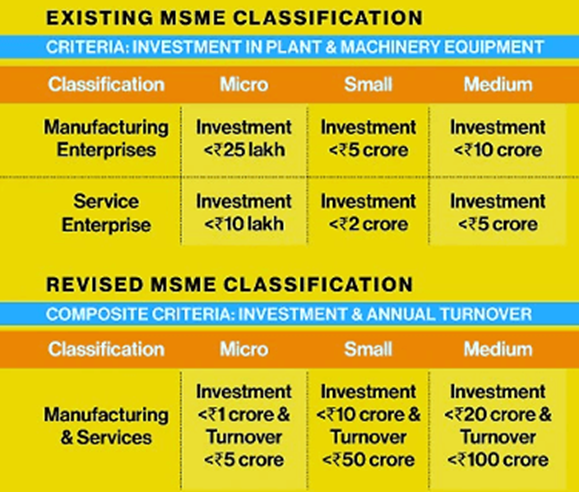
- MSMEs classification changed.
NBFCs–>
- Rs 30,000 crore special liquidity scheme, under which investment will be made in investment-grade debt papers of NBFCs.
- Partial credit guarantee scheme extended under which the govt. guarantees 20% of the first loss to the lenders — NBFCs, HFCs, and MFIs with low credit rating.
Discoms–>
- ₹90,000 Cr. liquidity Injection has been announced.
Real Estate–>
- States and UTs have been advised to extend the registration and completion date of real estate projects by six months.
2nd Tranche–>
Inter-state trade–>
- Plans to enact a central law to permit barrier-free inter-State trade of farm commodities and e-trading.
- This will allow farmers to sell produce at attractive prices beyond the current mandi system.
Contract farming–>
- provide farmers with assured sale prices and quantities even before the crop is sown and also allow private players to invest in inputs and technology in the agricultural sector
Deregulating produce–>
- Centre will be deregulating the sale of 6 types of agricultural produce, including cereals, edible oils, oilseeds, pulses, onions, and potatoes, by amending the Essential Commodities Act, 1955.
- Stock limits will not be imposed on these commodities except in case of national calamity or famine or an extraordinary surge in prices. These stock limits would not apply to processors and exporters.
Agriculture infrastructure–>
- Investment of Rs1.5 lakh crore to build farm-gate infrastructure and support logistics needs for fish workers, livestock farmers, vegetable growers, beekeepers, and related activities.
4th Trance–>
Defence–>
- Banning the import of some weapons and platforms to indigenise defense production.
- Provision for a separate budget for domestic capital procurement–> reduce the defense import bill and encourage domestic production.
- FDI limit in defense manufacturing under the automatic route will be raised from 49% to 74%.
- Ordnance Factory Boards (OFB) would be corporatized and listed on the stock market to improve autonomy, efficiency, and accountability.
Minerals–>
- introduction of commercial mining on a revenue-sharing basis
- private sector would be allowed to bid for 50 coal blocks
Space–>
- Private involvement in space will be encouraged.
- Levelling Pvt players in the space sector, allowing them to use ISRO facilities and participate in future projects on space travel and planetary exploration.
- GOI ease geospatial data policy to make remote-sensing data more widely available to tech entrepreneurs, with safeguards put in place.
Aviation–>
- Six more airports are up for auction on private-public partnership mode, while additional private investment will be invited at 12 airports.
Power–>
Power departments/utilities and distribution companies in U.T.s would be privatized based on a new tariff policy to be announced.
Atomic–>
Research reactors in PPP mode would be set up for the production of medical isotopes.
Allotment of 5 MHz Spectrum in 700 MHz frequency band to Indian Railways for public safety and security services at stations and in trains.
- The project will be completed in the next 5 years.
- Indian Railways has approved TCAS (Train Collision Avoidance System), an indigenously developed ATP (Automatic Train Protection) System.
- Attract multinational industries to set up manufacturing units to fulfil the ‘Make in India’ mission and generate employment.
- It will boost the ‘Aatmanirbhar Bharat’ mission.
Ministry of Education--> Manodarpan Initiative under Atmanirbhar Bharat Abhiyan. It is aimed to provide psychosocial support to students, family members and teachers for their mental health and well-being during the times of Covid-19.
The SPAG9 antigen has received the trademark ASPAGNIITM to treat various cancers.
The ASPAGNIITM is a true example of translational cancer research and the Atmanirbhar Bharat spirit.
WHO–> 1 in 10 Indians will develop cancer during their lifetime, and 1 in 15 will die of cancer
National Institute of Immunology (NII) an Autonomous Institute of Department of Biotechnology (DBT), and clinicians at Cancer Institute, Adyar, Chennai have been working together to translate new scientific discoveries into improved care for cancer patients.
Due to surplus grain, exports in a pandemic year crossed 13 mn tonnes for rice, an all-time high, and 2mn tonnes for wheat, the highest since 2014-15.
- Last fiscal year which ended on March 31, 2021 recorded 92 million tonnes (mt) of rice and wheat was distributed from the central pool.
- It includes 60.32 mt under the National Food Security Act and other regular welfare schemes.
- Besides 31.52 mt under the Pradhan Mantri Garib Kalyan Anna Yojana (PMGKAY), Atmanirbhar Bharat Package (for returning migrant labourers) and assorted programmes launched in the wake of the Covid-19-induced lockdown.
DoT=Department of Telecom issued operational guidelines for the ₹12,195 crores Production-linked incentive (PLI) scheme for the sector for over a period of 5 years (till FY 2025-26).
- The company may decide to invest either in single or multiple eligible products.
- Small Industries Development Bank of India (SIDBI) has been appointed as the Project Management Agency (PMA) for the PLI scheme.
- The Scheme is open to both MSME and Non-MSME Companies including Domestic and Global Companies. Also, manufacturers with products with Indian technology are encouraged to apply.
Applicants would have to meet the minimum revenue criteria.
- The scheme stipulates a minimum investment threshold of ₹10 crores for MSMEs and ₹100 crores for non-MSME applicants.
- Land and building costs will not be counted as investment.
| Sectors | Under the administration of the Department/Ministry |
| High-Efficiency Solar PV Modules | Ministry of New and Renewable Energy |
| Electronic Technology Products | Ministry of Electronics and Information Technology |
| White Goods (ACs & LED) | Department for Promotion of Industry and Internal Trade |
| Speciality Steel | Ministry of Steel |
| Textile Products: MMF segment and technical textiles | Ministry of Textiles |
| Food Products | Ministry of Food Processing Industries |
| Telecom & Networking Products | Department of Telecom |
| Pharmaceuticals drugs | Department of Pharmaceuticals |
| Advance Chemistry Cell (ACC) Battery | NITI Aayog and Department of Heavy Industries |
| Automobiles & Auto Components | Department of Heavy Industries |
Recently, the guidelines for ‘Production Linked Incentive Scheme’ for the Food Processing Industry (PLISFPI) have been issued by the Government.
- The detailed operational scheme guidelines have been issued by the Ministry of Food Processing Industries (MoFPI).
- On this occasion an online portal for ‘Production Linked Incentive Scheme for Food Processing Industry’ (PLISFPI) has also been launched by the union minister for the beneficiaries.
Production Linked Incentive Scheme for the Food Processing Industry (PLISFPI)
- It is a Central Sector Scheme with an outlay of 10 thousand 900 crore rupees. The implementation period for this is set to 2021-22 to 2026-27.
- It aims to support creation of global food manufacturing champions commensurate with India’s natural resource endowment and support Indian brands of food products in the international markets.
Union Cabinet approved two production-linked incentive schemes for white goods (air-conditioners and LED lights) and high-efficiency solar photovoltaic modules.
More on the news
- The Cabinet, at a meeting chaired by Prime Minister, took step towards the vision of “Atmanirbhar Bharat” (self-reliant India) with the approval for the ₹6,238-crore PLI scheme for air-conditioners and LEDs.
- The prime objective of the PLI scheme is to make manufacturing in India globally competitive by removing sectoral disabilities, creating economies of scale and ensuring efficiencies. –
- It is designed to create complete component ecosystem in India and make India an integral part of the global supply chains.
Benefits–
- The National Programme on High Efficiency Solar PV Modules will reduce import dependence in a strategic sector like electricity. It will also support the Atmanirbhar Bharat initiative.
- The scheme was expected to lead to 10,000 MW of additional capacity of solar PV plants and investment of around ₹17,200 crore in solar PV manufacturing projects.
- The scheme would lead to direct employment of 30,000 people and indirect jobs to 1.2 lakh.
HOw Atmanirbhar may improve the condition?
The pandemic has exposed India’s dependence for essential products and low capacity to prodeuce them
Economic slowdown
- Low investment demand
- High unemployment rate
- Reduced consumption & expenditure
- Sharp deceleration of credit supply inspite RBI’s reforms.
- Structural Issues
Short term
- Increase Consumption + Demand
- Relaxed interest rates + subvention by financial instituion.
Long term
- Structural reforms in key sectors -Agriculture + Industries.
- Scaling up manufacturing
- Growth of infrastructure
- Reduce Trade deficit
harness huge demographic dividend
- improving exports by promoting local manufacturers.
- upskilling youth to create employment + human resource mobilisation.
Attract Investments + Startups development and reduce reliance on remittence.
Vocal for local– improve domestic industry reduce foreign reliance on essential products like Pharma API+ automobile components
Liberalisation of agricultural sector of marketing to increase the disposable income of farmers.
Digital tech driven economy.
Opening Space sector + Coal secor for pvt players.
 MY BOX