The President ordered on August 5, that the Order of 1954, which set out the constitutional provisions applicable to J&K.
The great poet and thinker, Maulana Hasrat Mohini, asked in the Constituent Assembly on October 17, 1949: “Why this discrimination please?” The answer was given by Nehru’s confidant, the wise but misunderstood Thanjavur Brahmin, Gopalaswami Ayyangar.
- Kashmir, unlike other princely states, was not yet ripe for integration.
- Part of the State’s territory was in the hands of “rebels and enemies.”
- The UN involvement brought an International angle which would end only when the “Kashmir problem is satisfactorily resolved”.
- “The will of the people through the instrument of the [J&K] Constituent Assembly will determine the constitution of the State as well as the sphere of Union jurisdiction over the State”, but this could happen only when there was real peace and only when the people of the State acquiesced to such an arrangement.
- It was Vallabbhai Patel finally who managed the crisis and navigated most of the amendments sought of the Sheikh Abdullah through the Congress party and the Constituent Assembly to ensure that Article 370 became part of the Indian Constitution.
Article 370 is not intact in its original form. Today the autonomy enjoyed by the State is a shadow of its former self, and there is virtually no institution of the Republic of India that does not include J&K within its scope and jurisdiction.
The only substantial differences from many other States relate to permanent residents and their rights.
Can Article 370 be revoked unilaterally?
Clause 3 of Article 370 is clear. The President may, by public notification, declare that this Article shall cease to be operative but only on the recommendation of the Constituent Assembly of the State. In other words, Article 370 can be revoked only if a new Constituent Assembly of Jammu and Kashmir is convened and is willing to recommend its revocation. Of course, Parliament has the power to amend the Constitution to change this provision. But this could be subject to a judicial review which may find that this clause is a basic feature of the relationship between the State and the Centre and cannot, therefore, be amended.
source: Understanding Article 370
The Supreme Court’s decision to form a five-member Constitution Bench to examine the validity of the abrogation of the special status given to Jammu and Kashmir puts an end to apprehensions that its response to the Centre’s legal measures since August 5 will only be one of quiet acquiescence.
Challenged
- Restrictions imposed on political activity, communications and movement of the people.
- Restriction of some fundamental rights, including the freedom of the media, in the name of achieving greater integration of Jammu and Kashmir with India (decided by wide latitude to the executive to).
- In some habeas corpus matters, the court is yet to examine the legality of the detention of the persons concerned.
- Restrictions imposed on political activity, communications and movement of the people.
- A substantial question is on the validity of the substitution of the concurrence of the Governor for that of the government while under President’s Rule; in effect, the Centre is taking its own consent to alter the status of the State.
- The replacement of the term ‘Constituent Assembly’ (of J&K) found in Article 370 with the term ‘Legislative Assembly’.
- An unprecedented decision- whether a federal unit can be downgraded from the status of a State to that of a Union Territory (1.Jammu & 2. Kashmir).
- The constitutional morality of the rest of the country deciding the destiny of a State without the consent or participation of its citizen.
source: Law and opinion: On SC taking up Kashmir special status issue
- Articles from 371 to 371J,
- Article 371I, which deals with Goa, stands out in the sense that it does not include any provision that can be deemed “special”.
- Article 371E, which deals with Andhra Pradesh and Telangana, too, is not that “special”.
- Existence of the provisions described in Articles 371, 371A-H, and 371J shows that other princely states, too, negotiated the terms and conditions of their entry into the Union, or sought special constitutional protections in view of their unique needs and conditions.
- There is, however, one important difference between Articles 370 and 371 on the one hand, and Articles 371A-H and 371J on the other.
- Articles 370 and 371 have been part of the Constitution from the time of its commencement on January 26, 1950. Articles 371A-H and 371J, however, were incorporated into the Constitution by Parliament through amendments under Article 368.
- Article 368: describes the “power of Parliament to amend the Constitution and procedure therefor”.
- Article 371 { Maharashtra and Gujarat}
- Article 371A {Nagaland-13th Amendment Act, 1962}
- Article 371B {Assam- 22nd Amendment Act, 1969}
- Article 371C {Manipur- 27th Amendment Act, 1971}
- Article 371D { Andhra Pradesh- 32nd Amendment Act, 1973}
- Article 371E {Establishment of Central University in Andhra Pradesh}
- Article 371F {Sikkim- 36th Amendment Act, 1975}
- Article 371G { Mizoram- 53rd Amendment Act, 1986}
- Article 371H { Arunachal Pradesh- 55th Amendment Act, 1986}
- Article 371I { Goa- }
- Article 371J { Karnataka- 98th Amendment Act, 2012}
- 371E substituted by the Andhra Pradesh Reorganisation Act, 2014
MAHARASHTRA & GUJARAT
The Governor has a “special responsibility” to establish “separate development boards” for “Vidarbha, Marathwada, and the rest of Maharashtra”, and Saurashtra and Kutch in Gujarat; ensure “equitable allocation of funds for developmental expenditure over the said areas”, and “equitable arrangement providing adequate facilities for technical education and vocational training, and adequate opportunities for employment” under the state government.
NAGALAND A
Parliament cannot legislate in matters of Naga religion or social practices, the Naga customary law and procedure, administration of civil and criminal justice involving decisions according to Naga customary law, and ownership and transfer of land and its resources, without the concurrence of the Legislative Assembly of the state.
There is a provision for a 35-member Regional Council for Tuensang district, which elects the Tuensang members in the Assembly. A member from the Tuensang district is Minister for Tuensang Affairs. The Governor has the final say on all Tuensang-related matters.
ASSAM B
The President of India may provide for the constitution and functions of a committee of the state Assembly consisting of members elected from the tribal areas of the state.
MANIPUR C
The President of India may provide for the constitution and functions of a committee of elected members from the Hill areas of the state in the Assembly, and entrust “special responsibility” to the Governor to ensure its proper functioning. The Governor has to file a report every year on this subject to the President.
SIKKIM F
The members of the Legislative Assembly of Sikkim shall elect the representative of Sikkim in the House of the People. To protect the rights and interests of various sections of the population of Sikkim, Parliament may provide for the number of seats in the Assembly.
The Governor shall have “special responsibility for peace and for an equitable arrangement for ensuring the social and economic advancement of different sections of the population”. All earlier laws in territories that formed Sikkim shall continue, and any adaptation or modification shall not be questioned in any court.
MIZORAM G
This provision lays down that Parliament cannot make laws on “religious or social practices of the Mizos, Mizo customary law and procedure, administration of civil and criminal justice involving decisions according to Mizo customary law, ownership and transfer of land unless the Legislative Assembly by a resolution so decides”.
ARUNACHAL PRADESH H
The Governor has a special responsibility with regard to law and order, and “he shall, after consulting the Council of Ministers, exercise his individual judgment as to the action to be taken”. Should a question arise over whether a particular matter is one in which the Governor is “required to act in the exercise of his individual judgment, the decision of the Governor in his discretion shall be final”, and “shall not be called in question…”
KARNATAKA J
There is a provision for the establishment of a separate development board for the Hyderabad-Karnataka region, the working of which will be reported annually to the Assembly.
There shall be “equitable allocation of funds for developmental expenditure over the said region”, and “equitable opportunities and facilities” for people of this region in government jobs and education.
An order can be made to provide for reservation “of a proportion” of seats and jobs in educational and vocational training institutions and state government organisations respectively in the Hyderabad-Karnataka region for individuals who belong to that region by birth or domicile.
Autonomous Administration under 6th Schedule
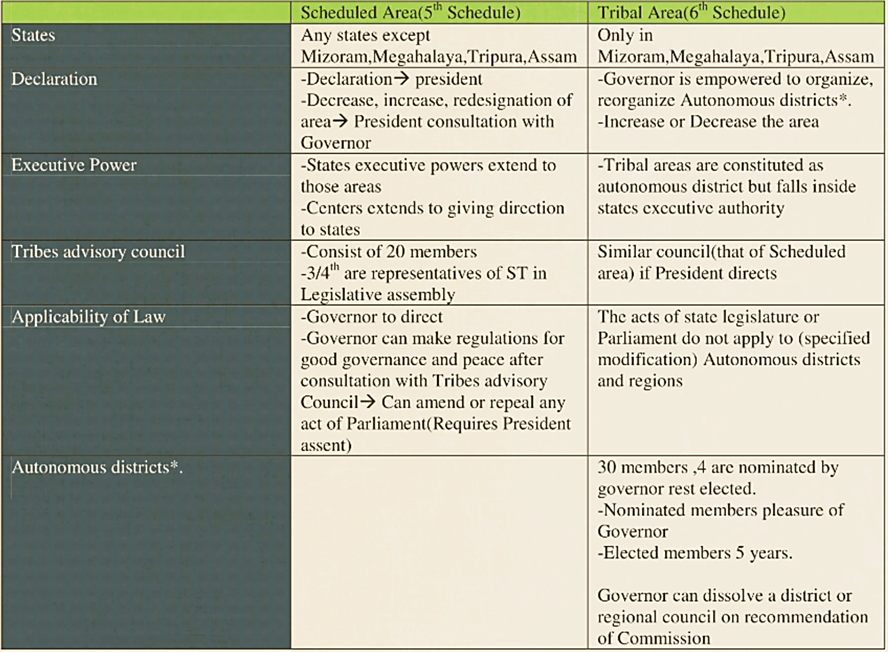
•India’s population consists of 100 million tribal people who have constitutionally been addressed via two distinct avenues i.e 5th and 6th Schedule.
•Both were discussed and passed by Constituent Assembly between September 5-7, 1949.
•5thSchedule applies to the overwhelming majority of India’s tribes in 9 States, while
6th Schedule covers areas that are settled in the northeastern States bordering China and Myanmar.
•The District Council and the Regional Council under the 6th Schedule have real power to make laws, possibility on the various legislative subjects, receiving grants-in-aid from the Consolidated Fund of India to meet the costs of schemes for development, health care, education, roads and regulatory powers to state control
• The 6th Schedule gives tribal communities considerable autonomy; 6th Schedule of the Constitution deals with the administration of the tribal areas in the 4 northeastern states of Assam, Meghalaya, Tripura and Mizoram as per Article 244(2) and Article 275(1) of the Constitution.
•The Governor is empowered to increase or decrease the areas or change the names of the autonomous districts. While executive powers of the Union extend in Scheduled areas with respect to their administration in Vth schedule, the VIth schedule areas remain within executive authority of the state.
Article 244 —
Administration of Scheduled Areas and Tribal Areas
(1) The provisions of the Fifth Schedule shall apply to the administration and control of the Scheduled Areas and Scheduled Tribes in any State other than the States of Assam Meghalaya, Tripura and Mizoram
ART275— Grants from the Union to certain States
JAn 2019-amendment of Art 280
125th Constitutional Amendment of Art 280— Which deals with the Finance Commission
Finance Commission –> Consolidated Fund of States to supplement resources –> District Councils which has Village council a subset.
Increased no. seats in the Administrative Councils.
Election commission to conduct Municipal + Village councils. Anti-Defection provisions to disqualify the councils.
Ladakh–> proposed to be a Autonomous Administration under 6th Schedule.
 MY BOX